

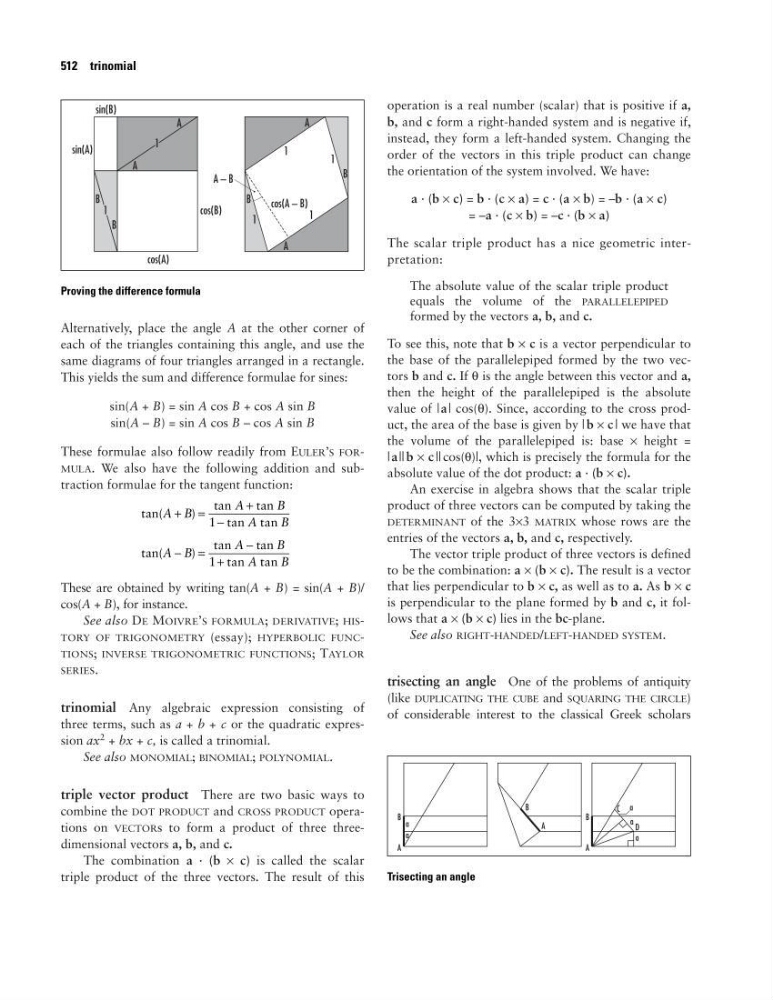
Alternatively, place the angle A at the other corner of
each of the triangles containing this angle, and use the
same diagrams of four triangles arranged in a rectangle.
This yields the sum and difference formulae for sines:
sin(A + B) = sin A cos B + cos A sin B
sin(A – B) = sin A cos B – cos A sin B
These formulae also follow readily from EULER’S FORMULA. We also have the following addition and subtraction formulae for the tangent function:
These are obtained by writing tan(A + B) = sin(A + B)/
cos(A + B), for instance.
See also DE MOIVRE’S FORMULA; DERIVATIVE; HISTORY OF TRIGONOMETRY (essay); HYPERBOLIC FUNCTIONS; INVERSE TRIGONOMETRIC FUNCTIONS; TAYLOR
SERIES.
trinomial Any algebraic expression consisting of
three terms, such as a + b + c or the quadratic expression ax
2 + bx + c, is called a trinomial.
See also MONOMIAL; BINOMIAL; POLYNOMIAL.
triple vector product There are two basic ways to
combine the DOT PRODUCT and CROSS PRODUCT operations on VECTORs to form a product of three threedimensional vectors a, b, and c.
The combination a · (b × c) is called the scalar
triple product of the three vectors. The result of this
operation is a real number (scalar) that is positive if a,
b, and c form a right-handed system and is negative if,
instead, they form a left-handed system. Changing the
order of the vectors in this triple product can change
the orientation of the system involved. We have:
a · (b × c) = b · (c × a) = c · (a × b) = –b · (a × c)
= –a · (c × b) = –c · (b × a)
The scalar triple product has a nice geometric interpretation:
The absolute value of the scalar triple product
equals the volume of the PARALLELEPIPED
formed by the vectors a, b, and c.
To see this, note that b × c is a vector perpendicular to
the base of the parallelepiped formed by the two vectors b and c. If θ is the angle between this vector and a,
then the height of the parallelepiped is the absolute
value of |a | cos(θ). Since, according to the cross product, the area of the base is given by | b × c | we have that
the volume of the parallelepiped is: base × height =
|a|| b × c || cos(θ)|, which is precisely the formula for the
absolute value of the dot product: a · (b × c).
An exercise in algebra shows that the scalar triple
product of three vectors can be computed by taking the
DETERMINANT of the 3×3 MATRIX whose rows are the
entries of the vectors a, b, and c, respectively.
The vector triple product of three vectors is defined
to be the combination: a × (b × c). The result is a vector
that lies perpendicular to b × c, as well as to a. As b × c
is perpendicular to the plane formed by b and c, it follows that a × (b × c) lies in the bc-plane.
See also RIGHT-HANDED/LEFT-HANDED SYSTEM.
trisecting an angle One of the problems of antiquity
(like DUPLICATING THE CUBE and SQUARING THE CIRCLE)
of considerable interest to the classical Greek scholars
tan(
)
tan
tan
tan tan
tan(
)
tan
tan
tan tan
A B
A
B
A
B
A B
A
B
A
B
+ =
+
−
− =
−
+
1
1
512 trinomial
Proving the difference formula
Trisecting an angle
each of the triangles containing this angle, and use the
same diagrams of four triangles arranged in a rectangle.
This yields the sum and difference formulae for sines:
sin(A + B) = sin A cos B + cos A sin B
sin(A – B) = sin A cos B – cos A sin B
These formulae also follow readily from EULER’S FORMULA. We also have the following addition and subtraction formulae for the tangent function:
These are obtained by writing tan(A + B) = sin(A + B)/
cos(A + B), for instance.
See also DE MOIVRE’S FORMULA; DERIVATIVE; HISTORY OF TRIGONOMETRY (essay); HYPERBOLIC FUNCTIONS; INVERSE TRIGONOMETRIC FUNCTIONS; TAYLOR
SERIES.
trinomial Any algebraic expression consisting of
three terms, such as a + b + c or the quadratic expression ax
2 + bx + c, is called a trinomial.
See also MONOMIAL; BINOMIAL; POLYNOMIAL.
triple vector product There are two basic ways to
combine the DOT PRODUCT and CROSS PRODUCT operations on VECTORs to form a product of three threedimensional vectors a, b, and c.
The combination a · (b × c) is called the scalar
triple product of the three vectors. The result of this
operation is a real number (scalar) that is positive if a,
b, and c form a right-handed system and is negative if,
instead, they form a left-handed system. Changing the
order of the vectors in this triple product can change
the orientation of the system involved. We have:
a · (b × c) = b · (c × a) = c · (a × b) = –b · (a × c)
= –a · (c × b) = –c · (b × a)
The scalar triple product has a nice geometric interpretation:
The absolute value of the scalar triple product
equals the volume of the PARALLELEPIPED
formed by the vectors a, b, and c.
To see this, note that b × c is a vector perpendicular to
the base of the parallelepiped formed by the two vectors b and c. If θ is the angle between this vector and a,
then the height of the parallelepiped is the absolute
value of |a | cos(θ). Since, according to the cross product, the area of the base is given by | b × c | we have that
the volume of the parallelepiped is: base × height =
|a|| b × c || cos(θ)|, which is precisely the formula for the
absolute value of the dot product: a · (b × c).
An exercise in algebra shows that the scalar triple
product of three vectors can be computed by taking the
DETERMINANT of the 3×3 MATRIX whose rows are the
entries of the vectors a, b, and c, respectively.
The vector triple product of three vectors is defined
to be the combination: a × (b × c). The result is a vector
that lies perpendicular to b × c, as well as to a. As b × c
is perpendicular to the plane formed by b and c, it follows that a × (b × c) lies in the bc-plane.
See also RIGHT-HANDED/LEFT-HANDED SYSTEM.
trisecting an angle One of the problems of antiquity
(like DUPLICATING THE CUBE and SQUARING THE CIRCLE)
of considerable interest to the classical Greek scholars
tan(
)
tan
tan
tan tan
tan(
)
tan
tan
tan tan
A B
A
B
A
B
A B
A
B
A
B
+ =
+
−
− =
−
+
1
1
512 trinomial
Proving the difference formula
Trisecting an angle