

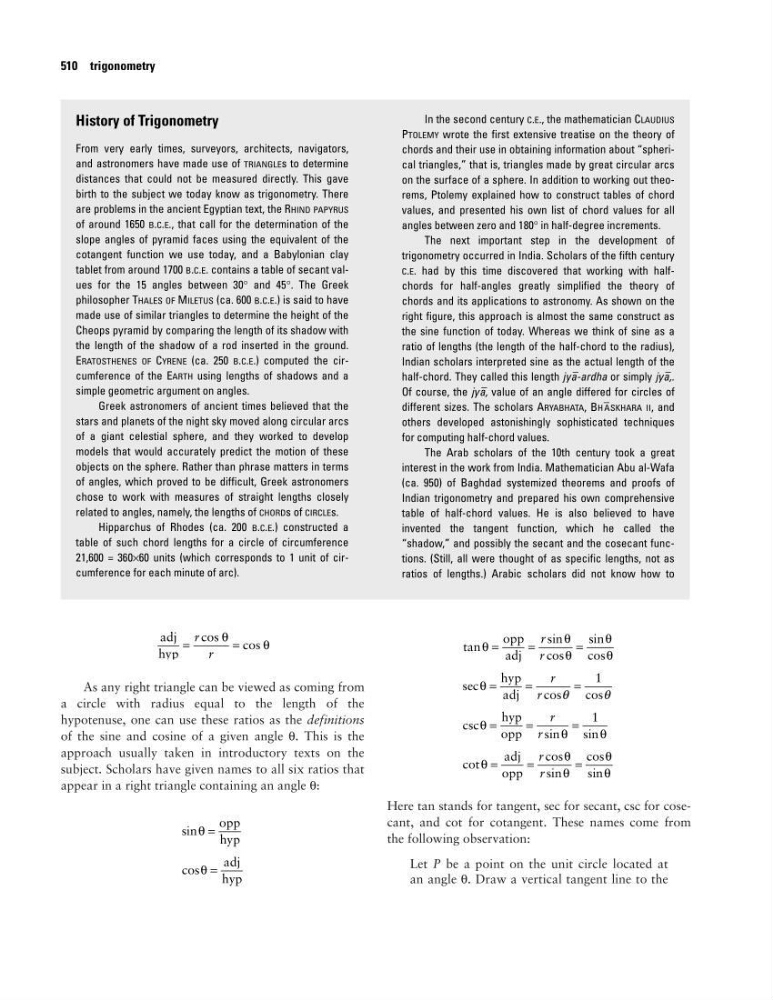
As any right triangle can be viewed as coming from
a circle with radius equal to the length of the
hypotenuse, one can use these ratios as the definitions
of the sine and cosine of a given angle θ. This is the
approach usually taken in introductory texts on the
subject. Scholars have given names to all six ratios that
appear in a right triangle containing an angle θ:
Here tan stands for tangent, sec for secant, csc for cosecant, and cot for cotangent. These names come from
the following observation:
Let P be a point on the unit circle located at
an angle θ. Draw a vertical tangent line to the
tan
sin
cos
sin
cos
sec
cos
cos
csc
sin
sin
cot
cos
sin
cos
sin
θ
θ
θ
θ
θ
θ
θ
θ
θ
θ
θ
θ
θ
θ
=
=
=
=
=
=
=
=
=
=
=
=
opp
adj
hyp
adj
hyp
opp
adj
opp
r
r
r
r
r
r
r
r
θ
θ
1
1
sin
cos
θ
θ
=
=
opp
hyp
adj
hyp
adj
hyp
=
=
r
r
cos
cos
θ
θ
510 trigonometry
History of Trigonometry
From very early times, surveyors, architects, navigators,
and astronomers have made use of TRIANGLEs to determine
distances that could not be measured directly. This gave
birth to the subject we today know as trigonometry. There
are problems in the ancient Egyptian text, the RHIND PAPYRUS
of around 1650 B.C.E., that call for the determination of the
slope angles of pyramid faces using the equivalent of the
cotangent function we use today, and a Babylonian clay
tablet from around 1700 B.C.E. contains a table of secant values for the 15 angles between 30° and 45°. The Greek
philosopher THALES OF MILETUS (ca. 600 B.C.E.) is said to have
made use of similar triangles to determine the height of the
Cheops pyramid by comparing the length of its shadow with
the length of the shadow of a rod inserted in the ground.
ERATOSTHENES OF CYRENE (ca. 250 B.C.E.) computed the circumference of the EARTH using lengths of shadows and a
simple geometric argument on angles.
Greek astronomers of ancient times believed that the
stars and planets of the night sky moved along circular arcs
of a giant celestial sphere, and they worked to develop
models that would accurately predict the motion of these
objects on the sphere. Rather than phrase matters in terms
of angles, which proved to be difficult, Greek astronomers
chose to work with measures of straight lengths closely
related to angles, namely, the lengths of CHORDs of CIRCLEs.
Hipparchus of Rhodes (ca. 200 B.C.E.) constructed a
table of such chord lengths for a circle of circumference
21,600 = 360×60 units (which corresponds to 1 unit of circumference for each minute of arc).
In the second century C.E., the mathematician CLAUDIUS
PTOLEMY wrote the first extensive treatise on the theory of
chords and their use in obtaining information about “spherical triangles,” that is, triangles made by great circular arcs
on the surface of a sphere. In addition to working out theorems, Ptolemy explained how to construct tables of chord
values, and presented his own list of chord values for all
angles between zero and 180° in half-degree increments.
The next important step in the development of
trigonometry occurred in India. Scholars of the fifth century
C.E. had by this time discovered that working with halfchords for half-angles greatly simplified the theory of
chords and its applications to astronomy. As shown on the
right figure, this approach is almost the same construct as
the sine function of today. Whereas we think of sine as a
ratio of lengths (the length of the half-chord to the radius),
Indian scholars interpreted sine as the actual length of the
half-chord. They called this length jy –
a-ardha or simply jy –
a,.
Of course, the jy –
a, value of an angle differed for circles of
different sizes. The scholars ARYABHATA, BH – ASKHARA II, and
others developed astonishingly sophisticated techniques
for computing half-chord values.
The Arab scholars of the 10th century took a great
interest in the work from India. Mathematician Abu al-Wafa
(ca. 950) of Baghdad systemized theorems and proofs of
Indian trigonometry and prepared his own comprehensive
table of half-chord values. He is also believed to have
invented the tangent function, which he called the
“shadow,” and possibly the secant and the cosecant functions. (Still, all were thought of as specific lengths, not as
ratios of lengths.) Arabic scholars did not know how to
a circle with radius equal to the length of the
hypotenuse, one can use these ratios as the definitions
of the sine and cosine of a given angle θ. This is the
approach usually taken in introductory texts on the
subject. Scholars have given names to all six ratios that
appear in a right triangle containing an angle θ:
Here tan stands for tangent, sec for secant, csc for cosecant, and cot for cotangent. These names come from
the following observation:
Let P be a point on the unit circle located at
an angle θ. Draw a vertical tangent line to the
tan
sin
cos
sin
cos
sec
cos
cos
csc
sin
sin
cot
cos
sin
cos
sin
θ
θ
θ
θ
θ
θ
θ
θ
θ
θ
θ
θ
θ
θ
=
=
=
=
=
=
=
=
=
=
=
=
opp
adj
hyp
adj
hyp
opp
adj
opp
r
r
r
r
r
r
r
r
θ
θ
1
1
sin
cos
θ
θ
=
=
opp
hyp
adj
hyp
adj
hyp
=
=
r
r
cos
cos
θ
θ
510 trigonometry
History of Trigonometry
From very early times, surveyors, architects, navigators,
and astronomers have made use of TRIANGLEs to determine
distances that could not be measured directly. This gave
birth to the subject we today know as trigonometry. There
are problems in the ancient Egyptian text, the RHIND PAPYRUS
of around 1650 B.C.E., that call for the determination of the
slope angles of pyramid faces using the equivalent of the
cotangent function we use today, and a Babylonian clay
tablet from around 1700 B.C.E. contains a table of secant values for the 15 angles between 30° and 45°. The Greek
philosopher THALES OF MILETUS (ca. 600 B.C.E.) is said to have
made use of similar triangles to determine the height of the
Cheops pyramid by comparing the length of its shadow with
the length of the shadow of a rod inserted in the ground.
ERATOSTHENES OF CYRENE (ca. 250 B.C.E.) computed the circumference of the EARTH using lengths of shadows and a
simple geometric argument on angles.
Greek astronomers of ancient times believed that the
stars and planets of the night sky moved along circular arcs
of a giant celestial sphere, and they worked to develop
models that would accurately predict the motion of these
objects on the sphere. Rather than phrase matters in terms
of angles, which proved to be difficult, Greek astronomers
chose to work with measures of straight lengths closely
related to angles, namely, the lengths of CHORDs of CIRCLEs.
Hipparchus of Rhodes (ca. 200 B.C.E.) constructed a
table of such chord lengths for a circle of circumference
21,600 = 360×60 units (which corresponds to 1 unit of circumference for each minute of arc).
In the second century C.E., the mathematician CLAUDIUS
PTOLEMY wrote the first extensive treatise on the theory of
chords and their use in obtaining information about “spherical triangles,” that is, triangles made by great circular arcs
on the surface of a sphere. In addition to working out theorems, Ptolemy explained how to construct tables of chord
values, and presented his own list of chord values for all
angles between zero and 180° in half-degree increments.
The next important step in the development of
trigonometry occurred in India. Scholars of the fifth century
C.E. had by this time discovered that working with halfchords for half-angles greatly simplified the theory of
chords and its applications to astronomy. As shown on the
right figure, this approach is almost the same construct as
the sine function of today. Whereas we think of sine as a
ratio of lengths (the length of the half-chord to the radius),
Indian scholars interpreted sine as the actual length of the
half-chord. They called this length jy –
a-ardha or simply jy –
a,.
Of course, the jy –
a, value of an angle differed for circles of
different sizes. The scholars ARYABHATA, BH – ASKHARA II, and
others developed astonishingly sophisticated techniques
for computing half-chord values.
The Arab scholars of the 10th century took a great
interest in the work from India. Mathematician Abu al-Wafa
(ca. 950) of Baghdad systemized theorems and proofs of
Indian trigonometry and prepared his own comprehensive
table of half-chord values. He is also believed to have
invented the tangent function, which he called the
“shadow,” and possibly the secant and the cosecant functions. (Still, all were thought of as specific lengths, not as
ratios of lengths.) Arabic scholars did not know how to