

height of the pyramids by observing the length of shadows. (Historians today take this as evidence that Thales
was familiar with the principles of similar triangles.)
Greek historian Herodotus (ca. 485 B.C.E.) wrote that
Thales correctly predicted the eclipse of the sun in 585
B.C.E. (though some scholars today suggest that this
may have only been a lucky guess).
Aristotle wrote about Thales’s worldview in his
text Metaphysics. Apparently Thales believed that the
Earth was a flat disc floating on an infinite ocean of
water. He used this theory to give a rational explanation of why earthquakes occur.
Theodorus of Cyrene (ca. 465–398 B.C.E.) Greek
Geometry, Number theory Born in Cyrene (now
Shahhat, Libya), Theodorus is remembered for his
work on IRRATIONAL NUMBERS, proving that not only
is √
–
2 irrational, but so too are √
–
3 and √
–
5, as well as the
roots of all other nonsquare quantities up to 17.
Theodorus is noted as having tutored the great
philosopher PLATO (ca. 428–348 B.C.E.) in the subject
of mathematics. Plato later described much of the work
of Theodorus in his text Theaetetus, and it is chiefly
through this document that we know anything of
Theodorus’s life and work. We learn there, for instance,
that Theodorus also studied astronomy, music, and
arithmetic.
Unfortunately, Plato did not describe the method
by which Theodorus proved his quantities to be irrational, and historians today are puzzled as to why
Theodorus stopped his work with the number √
–
17. It is
likely that Theodorus developed a series of arguments
that were highly dependent on the particular number
being studied and failed to develop a general approach
that dealt with all numbers in one fell swoop. This is
all the more curious, given that the standard arithmetic
proof of the irrationality of √
–
2 was well known to
scholars of his day, a proof that can very easily be
generalized to numbers other than 2. (If √
–
2 = , then
a
2 = 2b
2
, creating a contradiction: the PRIME number 2
appears an even number of times in the prime factorization of a
2 and an odd number of times in the factorization of 2b
2
.) One also can establish the irrationality
of √
–
2 geometrically as follows:
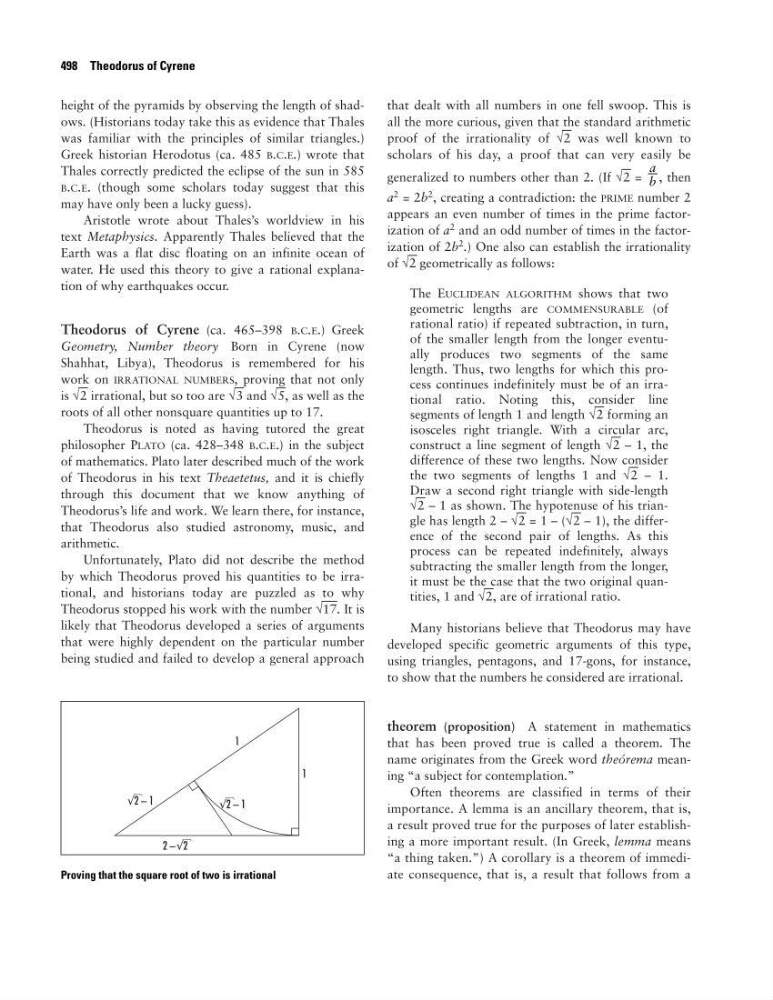
The EUCLIDEAN ALGORITHM shows that two
geometric lengths are COMMENSURABLE (of
rational ratio) if repeated subtraction, in turn,
of the smaller length from the longer eventually produces two segments of the same
length. Thus, two lengths for which this process continues indefinitely must be of an irrational ratio. Noting this, consider line
segments of length 1 and length √
–
2 forming an
isosceles right triangle. With a circular arc,
construct a line segment of length √
–
2 – 1, the
difference of these two lengths. Now consider
the two segments of lengths 1 and √
–
2 – 1.
Draw a second right triangle with side-length
√
–
2 – 1 as shown. The hypotenuse of his triangle has length 2 – √
–
2 = 1 – (√
–
2 – 1), the difference of the second pair of lengths. As this
process can be repeated indefinitely, always
subtracting the smaller length from the longer,
it must be the case that the two original quantities, 1 and √
–
2, are of irrational ratio.
Many historians believe that Theodorus may have
developed specific geometric arguments of this type,
using triangles, pentagons, and 17-gons, for instance,
to show that the numbers he considered are irrational.
theorem (proposition) A statement in mathematics
that has been proved true is called a theorem. The
name originates from the Greek word theórema meaning “a subject for contemplation.”
Often theorems are classified in terms of their
importance. A lemma is an ancillary theorem, that is,
a result proved true for the purposes of later establishing a more important result. (In Greek, lemma means
“a thing taken.”) A corollary is a theorem of immediate consequence, that is, a result that follows from a
a
–
b
498 Theodorus of Cyrene
Proving that the square root of two is irrational
was familiar with the principles of similar triangles.)
Greek historian Herodotus (ca. 485 B.C.E.) wrote that
Thales correctly predicted the eclipse of the sun in 585
B.C.E. (though some scholars today suggest that this
may have only been a lucky guess).
Aristotle wrote about Thales’s worldview in his
text Metaphysics. Apparently Thales believed that the
Earth was a flat disc floating on an infinite ocean of
water. He used this theory to give a rational explanation of why earthquakes occur.
Theodorus of Cyrene (ca. 465–398 B.C.E.) Greek
Geometry, Number theory Born in Cyrene (now
Shahhat, Libya), Theodorus is remembered for his
work on IRRATIONAL NUMBERS, proving that not only
is √
–
2 irrational, but so too are √
–
3 and √
–
5, as well as the
roots of all other nonsquare quantities up to 17.
Theodorus is noted as having tutored the great
philosopher PLATO (ca. 428–348 B.C.E.) in the subject
of mathematics. Plato later described much of the work
of Theodorus in his text Theaetetus, and it is chiefly
through this document that we know anything of
Theodorus’s life and work. We learn there, for instance,
that Theodorus also studied astronomy, music, and
arithmetic.
Unfortunately, Plato did not describe the method
by which Theodorus proved his quantities to be irrational, and historians today are puzzled as to why
Theodorus stopped his work with the number √
–
17. It is
likely that Theodorus developed a series of arguments
that were highly dependent on the particular number
being studied and failed to develop a general approach
that dealt with all numbers in one fell swoop. This is
all the more curious, given that the standard arithmetic
proof of the irrationality of √
–
2 was well known to
scholars of his day, a proof that can very easily be
generalized to numbers other than 2. (If √
–
2 = , then
a
2 = 2b
2
, creating a contradiction: the PRIME number 2
appears an even number of times in the prime factorization of a
2 and an odd number of times in the factorization of 2b
2
.) One also can establish the irrationality
of √
–
2 geometrically as follows:
The EUCLIDEAN ALGORITHM shows that two
geometric lengths are COMMENSURABLE (of
rational ratio) if repeated subtraction, in turn,
of the smaller length from the longer eventually produces two segments of the same
length. Thus, two lengths for which this process continues indefinitely must be of an irrational ratio. Noting this, consider line
segments of length 1 and length √
–
2 forming an
isosceles right triangle. With a circular arc,
construct a line segment of length √
–
2 – 1, the
difference of these two lengths. Now consider
the two segments of lengths 1 and √
–
2 – 1.
Draw a second right triangle with side-length
√
–
2 – 1 as shown. The hypotenuse of his triangle has length 2 – √
–
2 = 1 – (√
–
2 – 1), the difference of the second pair of lengths. As this
process can be repeated indefinitely, always
subtracting the smaller length from the longer,
it must be the case that the two original quantities, 1 and √
–
2, are of irrational ratio.
Many historians believe that Theodorus may have
developed specific geometric arguments of this type,
using triangles, pentagons, and 17-gons, for instance,
to show that the numbers he considered are irrational.
theorem (proposition) A statement in mathematics
that has been proved true is called a theorem. The
name originates from the Greek word theórema meaning “a subject for contemplation.”
Often theorems are classified in terms of their
importance. A lemma is an ancillary theorem, that is,
a result proved true for the purposes of later establishing a more important result. (In Greek, lemma means
“a thing taken.”) A corollary is a theorem of immediate consequence, that is, a result that follows from a
a
–
b
498 Theodorus of Cyrene
Proving that the square root of two is irrational