

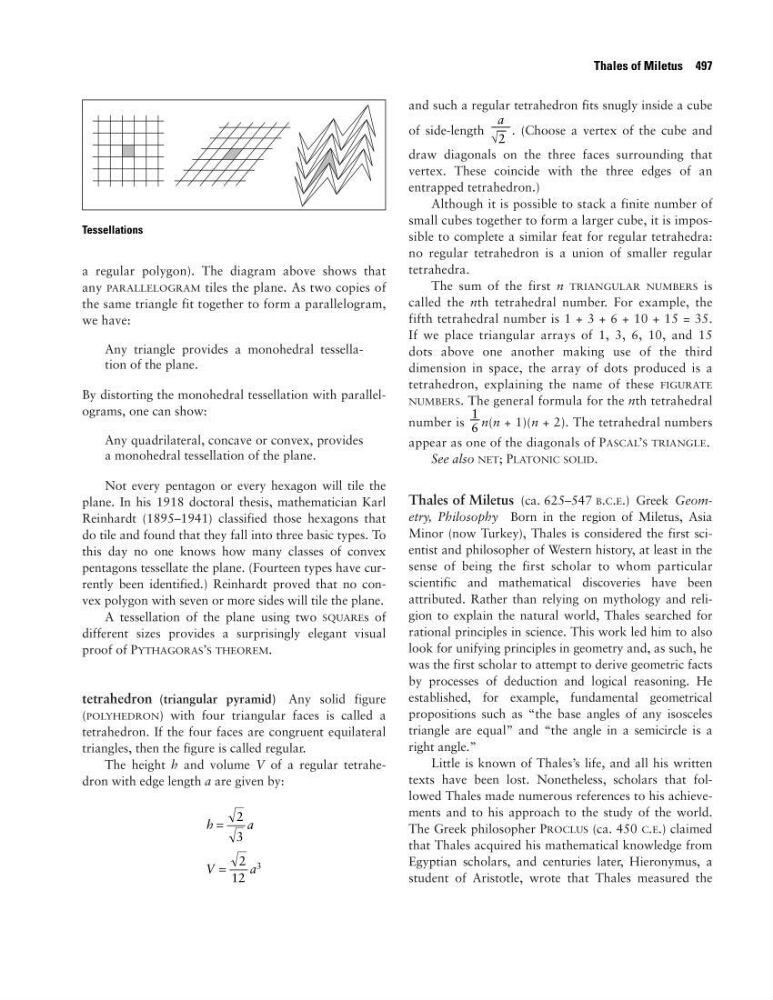
a regular polygon). The diagram above shows that
any PARALLELOGRAM tiles the plane. As two copies of
the same triangle fit together to form a parallelogram,
we have:
Any triangle provides a monohedral tessellation of the plane.
By distorting the monohedral tessellation with parallelograms, one can show:
Any quadrilateral, concave or convex, provides
a monohedral tessellation of the plane.
Not every pentagon or every hexagon will tile the
plane. In his 1918 doctoral thesis, mathematician Karl
Reinhardt (1895–1941) classified those hexagons that
do tile and found that they fall into three basic types. To
this day no one knows how many classes of convex
pentagons tessellate the plane. (Fourteen types have currently been identified.) Reinhardt proved that no convex polygon with seven or more sides will tile the plane.
A tessellation of the plane using two SQUAREs of
different sizes provides a surprisingly elegant visual
proof of PYTHAGORAS’S THEOREM.
tetrahedron (triangular pyramid) Any solid figure
(POLYHEDRON) with four triangular faces is called a
tetrahedron. If the four faces are congruent equilateral
triangles, then the figure is called regular.
The height h and volume V of a regular tetrahedron with edge length a are given by:
and such a regular tetrahedron fits snugly inside a cube
of side-length
. (Choose a vertex of the cube and
draw diagonals on the three faces surrounding that
vertex. These coincide with the three edges of an
entrapped tetrahedron.)
Although it is possible to stack a finite number of
small cubes together to form a larger cube, it is impossible to complete a similar feat for regular tetrahedra:
no regular tetrahedron is a union of smaller regular
tetrahedra.
The sum of the first n TRIANGULAR NUMBERS is
called the nth tetrahedral number. For example, the
fifth tetrahedral number is 1 + 3 + 6 + 10 + 15 = 35.
If we place triangular arrays of 1, 3, 6, 10, and 15
dots above one another making use of the third
dimension in space, the array of dots produced is a
tetrahedron, explaining the name of these FIGURATE
NUMBERS. The general formula for the nth tetrahedral
number is n(n + 1)(n + 2). The tetrahedral numbers
appear as one of the diagonals of PASCAL’S TRIANGLE.
See also NET; PLATONIC SOLID.
Thales of Miletus (ca. 625–547 B.C.E.) Greek Geometry, Philosophy Born in the region of Miletus, Asia
Minor (now Turkey), Thales is considered the first scientist and philosopher of Western history, at least in the
sense of being the first scholar to whom particular
scientific and mathematical discoveries have been
attributed. Rather than relying on mythology and religion to explain the natural world, Thales searched for
rational principles in science. This work led him to also
look for unifying principles in geometry and, as such, he
was the first scholar to attempt to derive geometric facts
by processes of deduction and logical reasoning. He
established, for example, fundamental geometrical
propositions such as “the base angles of any isosceles
triangle are equal” and “the angle in a semicircle is a
right angle.”
Little is known of Thales’s life, and all his written
texts have been lost. Nonetheless, scholars that followed Thales made numerous references to his achievements and to his approach to the study of the world.
The Greek philosopher PROCLUS (ca. 450 C.E.) claimed
that Thales acquired his mathematical knowledge from
Egyptian scholars, and centuries later, Hieronymus, a
student of Aristotle, wrote that Thales measured the
1
–
6
a
––
√
–
2
h
a
V
a
=
=
2
3
2
12
3
Thales of Miletus 497
Tessellations
any PARALLELOGRAM tiles the plane. As two copies of
the same triangle fit together to form a parallelogram,
we have:
Any triangle provides a monohedral tessellation of the plane.
By distorting the monohedral tessellation with parallelograms, one can show:
Any quadrilateral, concave or convex, provides
a monohedral tessellation of the plane.
Not every pentagon or every hexagon will tile the
plane. In his 1918 doctoral thesis, mathematician Karl
Reinhardt (1895–1941) classified those hexagons that
do tile and found that they fall into three basic types. To
this day no one knows how many classes of convex
pentagons tessellate the plane. (Fourteen types have currently been identified.) Reinhardt proved that no convex polygon with seven or more sides will tile the plane.
A tessellation of the plane using two SQUAREs of
different sizes provides a surprisingly elegant visual
proof of PYTHAGORAS’S THEOREM.
tetrahedron (triangular pyramid) Any solid figure
(POLYHEDRON) with four triangular faces is called a
tetrahedron. If the four faces are congruent equilateral
triangles, then the figure is called regular.
The height h and volume V of a regular tetrahedron with edge length a are given by:
and such a regular tetrahedron fits snugly inside a cube
of side-length
. (Choose a vertex of the cube and
draw diagonals on the three faces surrounding that
vertex. These coincide with the three edges of an
entrapped tetrahedron.)
Although it is possible to stack a finite number of
small cubes together to form a larger cube, it is impossible to complete a similar feat for regular tetrahedra:
no regular tetrahedron is a union of smaller regular
tetrahedra.
The sum of the first n TRIANGULAR NUMBERS is
called the nth tetrahedral number. For example, the
fifth tetrahedral number is 1 + 3 + 6 + 10 + 15 = 35.
If we place triangular arrays of 1, 3, 6, 10, and 15
dots above one another making use of the third
dimension in space, the array of dots produced is a
tetrahedron, explaining the name of these FIGURATE
NUMBERS. The general formula for the nth tetrahedral
number is n(n + 1)(n + 2). The tetrahedral numbers
appear as one of the diagonals of PASCAL’S TRIANGLE.
See also NET; PLATONIC SOLID.
Thales of Miletus (ca. 625–547 B.C.E.) Greek Geometry, Philosophy Born in the region of Miletus, Asia
Minor (now Turkey), Thales is considered the first scientist and philosopher of Western history, at least in the
sense of being the first scholar to whom particular
scientific and mathematical discoveries have been
attributed. Rather than relying on mythology and religion to explain the natural world, Thales searched for
rational principles in science. This work led him to also
look for unifying principles in geometry and, as such, he
was the first scholar to attempt to derive geometric facts
by processes of deduction and logical reasoning. He
established, for example, fundamental geometrical
propositions such as “the base angles of any isosceles
triangle are equal” and “the angle in a semicircle is a
right angle.”
Little is known of Thales’s life, and all his written
texts have been lost. Nonetheless, scholars that followed Thales made numerous references to his achievements and to his approach to the study of the world.
The Greek philosopher PROCLUS (ca. 450 C.E.) claimed
that Thales acquired his mathematical knowledge from
Egyptian scholars, and centuries later, Hieronymus, a
student of Aristotle, wrote that Thales measured the
1
–
6
a
––
√
–
2
h
a
V
a
=
=
2
3
2
12
3
Thales of Miletus 497
Tessellations