

(Noting that calculators only display eight or 10 decimal places, one need only use the first few terms of the
Taylor series to obtain adequately accurate answers.)
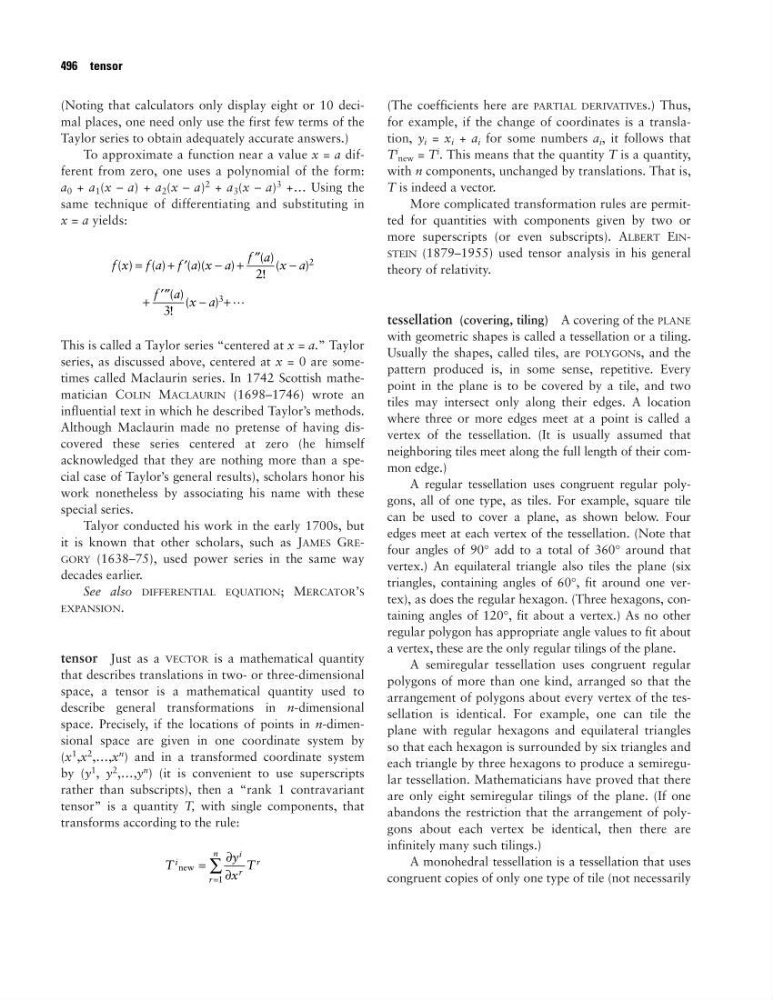
To approximate a function near a value x = a different from zero, one uses a polynomial of the form:
a 0 + a 1 (x – a) + a 2 (x – a)
2 + a 3 (x – a)
3 +… Using the
same technique of differentiating and substituting in
x = a yields:
This is called a Taylor series “centered at x = a.” Taylor
series, as discussed above, centered at x = 0 are sometimes called Maclaurin series. In 1742 Scottish mathematician COLIN MACLAURIN (1698–1746) wrote an
influential text in which he described Taylor’s methods.
Although Maclaurin made no pretense of having discovered these series centered at zero (he himself
acknowledged that they are nothing more than a special case of Taylor’s general results), scholars honor his
work nonetheless by associating his name with these
special series.
Talyor conducted his work in the early 1700s, but
it is known that other scholars, such as JAMES GREGORY (1638–75), used power series in the same way
decades earlier.
See also DIFFERENTIAL EQUATION; MERCATOR’S
EXPANSION.
tensor Just as a VECTOR is a mathematical quantity
that describes translations in two- or three-dimensional
space, a tensor is a mathematical quantity used to
describe general transformations in n-dimensional
space. Precisely, if the locations of points in n-dimensional space are given in one coordinate system by
(x
1
,x
2
,…,x
n
) and in a transformed coordinate system
by (y
1
, y
2
,…,y
n
) (it is convenient to use superscripts
rather than subscripts), then a “rank 1 contravariant
tensor” is a quantity T, with single components, that
transforms according to the rule:
(The coefficients here are PARTIAL DERIVATIVEs.) Thus,
for example, if the change of coordinates is a translation, y i = x i + a i for some numbers a i , it follows that
T
i
new = T
i
. This means that the quantity T is a quantity,
with n components, unchanged by translations. That is,
T is indeed a vector.
More complicated transformation rules are permitted for quantities with components given by two or
more superscripts (or even subscripts). ALBERT EINSTEIN (1879–1955) used tensor analysis in his general
theory of relativity.
tessellation (covering, tiling) A covering of the PLANE
with geometric shapes is called a tessellation or a tiling.
Usually the shapes, called tiles, are POLYGONs, and the
pattern produced is, in some sense, repetitive. Every
point in the plane is to be covered by a tile, and two
tiles may intersect only along their edges. A location
where three or more edges meet at a point is called a
vertex of the tessellation. (It is usually assumed that
neighboring tiles meet along the full length of their common edge.)
A regular tessellation uses congruent regular polygons, all of one type, as tiles. For example, square tile
can be used to cover a plane, as shown below. Four
edges meet at each vertex of the tessellation. (Note that
four angles of 90° add to a total of 360° around that
vertex.) An equilateral triangle also tiles the plane (six
triangles, containing angles of 60°, fit around one vertex), as does the regular hexagon. (Three hexagons, containing angles of 120°, fit about a vertex.) As no other
regular polygon has appropriate angle values to fit about
a vertex, these are the only regular tilings of the plane.
A semiregular tessellation uses congruent regular
polygons of more than one kind, arranged so that the
arrangement of polygons about every vertex of the tessellation is identical. For example, one can tile the
plane with regular hexagons and equilateral triangles
so that each hexagon is surrounded by six triangles and
each triangle by three hexagons to produce a semiregular tessellation. Mathematicians have proved that there
are only eight semiregular tilings of the plane. (If one
abandons the restriction that the arrangement of polygons about each vertex be identical, then there are
infinitely many such tilings.)
A monohedral tessellation is a tessellation that uses
congruent copies of only one type of tile (not necessarily
T
y
x
T
i
i
r
r
r
n
new =
∂
∂
=
∑
1
f x f a f a x a
f a x a
f a x a
( ) ( )
( )(
)
( )
!
(
)
( )
!
(
)
=
+ ′
− +
′′
−
+
′′′
− +
2
3
2
3 L
496 tensor
Taylor series to obtain adequately accurate answers.)
To approximate a function near a value x = a different from zero, one uses a polynomial of the form:
a 0 + a 1 (x – a) + a 2 (x – a)
2 + a 3 (x – a)
3 +… Using the
same technique of differentiating and substituting in
x = a yields:
This is called a Taylor series “centered at x = a.” Taylor
series, as discussed above, centered at x = 0 are sometimes called Maclaurin series. In 1742 Scottish mathematician COLIN MACLAURIN (1698–1746) wrote an
influential text in which he described Taylor’s methods.
Although Maclaurin made no pretense of having discovered these series centered at zero (he himself
acknowledged that they are nothing more than a special case of Taylor’s general results), scholars honor his
work nonetheless by associating his name with these
special series.
Talyor conducted his work in the early 1700s, but
it is known that other scholars, such as JAMES GREGORY (1638–75), used power series in the same way
decades earlier.
See also DIFFERENTIAL EQUATION; MERCATOR’S
EXPANSION.
tensor Just as a VECTOR is a mathematical quantity
that describes translations in two- or three-dimensional
space, a tensor is a mathematical quantity used to
describe general transformations in n-dimensional
space. Precisely, if the locations of points in n-dimensional space are given in one coordinate system by
(x
1
,x
2
,…,x
n
) and in a transformed coordinate system
by (y
1
, y
2
,…,y
n
) (it is convenient to use superscripts
rather than subscripts), then a “rank 1 contravariant
tensor” is a quantity T, with single components, that
transforms according to the rule:
(The coefficients here are PARTIAL DERIVATIVEs.) Thus,
for example, if the change of coordinates is a translation, y i = x i + a i for some numbers a i , it follows that
T
i
new = T
i
. This means that the quantity T is a quantity,
with n components, unchanged by translations. That is,
T is indeed a vector.
More complicated transformation rules are permitted for quantities with components given by two or
more superscripts (or even subscripts). ALBERT EINSTEIN (1879–1955) used tensor analysis in his general
theory of relativity.
tessellation (covering, tiling) A covering of the PLANE
with geometric shapes is called a tessellation or a tiling.
Usually the shapes, called tiles, are POLYGONs, and the
pattern produced is, in some sense, repetitive. Every
point in the plane is to be covered by a tile, and two
tiles may intersect only along their edges. A location
where three or more edges meet at a point is called a
vertex of the tessellation. (It is usually assumed that
neighboring tiles meet along the full length of their common edge.)
A regular tessellation uses congruent regular polygons, all of one type, as tiles. For example, square tile
can be used to cover a plane, as shown below. Four
edges meet at each vertex of the tessellation. (Note that
four angles of 90° add to a total of 360° around that
vertex.) An equilateral triangle also tiles the plane (six
triangles, containing angles of 60°, fit around one vertex), as does the regular hexagon. (Three hexagons, containing angles of 120°, fit about a vertex.) As no other
regular polygon has appropriate angle values to fit about
a vertex, these are the only regular tilings of the plane.
A semiregular tessellation uses congruent regular
polygons of more than one kind, arranged so that the
arrangement of polygons about every vertex of the tessellation is identical. For example, one can tile the
plane with regular hexagons and equilateral triangles
so that each hexagon is surrounded by six triangles and
each triangle by three hexagons to produce a semiregular tessellation. Mathematicians have proved that there
are only eight semiregular tilings of the plane. (If one
abandons the restriction that the arrangement of polygons about each vertex be identical, then there are
infinitely many such tilings.)
A monohedral tessellation is a tessellation that uses
congruent copies of only one type of tile (not necessarily
T
y
x
T
i
i
r
r
r
n
new =
∂
∂
=
∑
1
f x f a f a x a
f a x a
f a x a
( ) ( )
( )(
)
( )
!
(
)
( )
!
(
)
=
+ ′
− +
′′
−
+
′′′
− +
2
3
2
3 L
496 tensor