

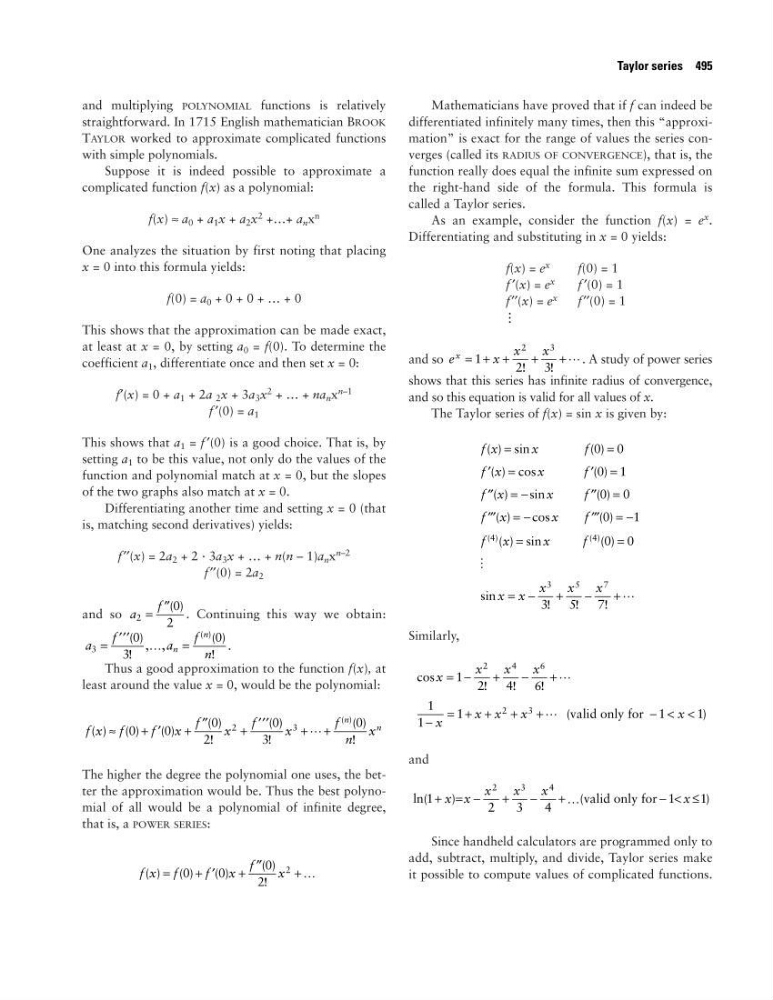
and multiplying POLYNOMIAL functions is relatively
straightforward. In 1715 English mathematician BROOK
TAYLOR worked to approximate complicated functions
with simple polynomials.
Suppose it is indeed possible to approximate a
complicated function f(x) as a polynomial:
f(x) ≈ a 0 + a 1 x + a 2 x
2 +…+ a n x
n
One analyzes the situation by first noting that placing
x = 0 into this formula yields:
f(0) = a 0 + 0 + 0 + … + 0
This shows that the approximation can be made exact,
at least at x = 0, by setting a 0 = f(0). To determine the
coefficient a 1 , differentiate once and then set x = 0:
f′(x) = 0 + a 1 + 2a 2 x + 3a 3 x
2 + … + na n x
n–1
f ′(0) = a 1
This shows that a 1 = f ′(0) is a good choice. That is, by
setting a 1 to be this value, not only do the values of the
function and polynomial match at x = 0, but the slopes
of the two graphs also match at x = 0.
Differentiating another time and setting x = 0 (that
is, matching second derivatives) yields:
f′′(x) = 2a 2 + 2 · 3a 3 x + … + n(n – 1)a n x
n–2
f′′(0) = 2a 2
and so
. Continuing this way we obtain:
.
Thus a good approximation to the function f(x), at
least around the value x = 0, would be the polynomial:
The higher the degree the polynomial one uses, the better the approximation would be. Thus the best polynomial of all would be a polynomial of infinite degree,
that is, a POWER SERIES:
Mathematicians have proved that if f can indeed be
differentiated infinitely many times, then this “approximation” is exact for the range of values the series converges (called its RADIUS OF CONVERGENCE), that is, the
function really does equal the infinite sum expressed on
the right-hand side of the formula. This formula is
called a Taylor series.
As an example, consider the function f(x) = e
x .
Differentiating and substituting in x = 0 yields:
f(x) = e
x
f(0) = 1
f ′(x) = e
x
f ′(0) = 1
f′′(x) = e
x
f′′(0) = 1
and so
. A study of power series
shows that this series has infinite radius of convergence,
and so this equation is valid for all values of x.
The Taylor series of f(x) = sin x is given by:
Similarly,
and
Since handheld calculators are programmed only to
add, subtract, multiply, and divide, Taylor series make
it possible to compute values of complicated functions.
ln(
)
(
)
1
2
3
4
1
1
2
3
4
+ = −
+
−
+
− < ≤
x x
x
x
x
x
L valid only for
cos
!
!
!
(
)
x
x
x
x
x
x x
x
x
= −
+
−
+
−
= + +
+ +
− < <
1 2
4
6
1
1
1
1
1
2
4
6
2
3
L
L valid only for
f x
x
f
f x
x
f
f x
x
f
f x
x
f
f x
x
f
x x
x
x
x
( ) sin
( )
( ) cos
( )
( )
sin
( )
( )
cos
( )
( ) sin
( )
sin
!
!
!
( )
( )
=
=
′ =
′ =
′′ = −
′′ =
′′′ = −
′′′ = −
=
=
= −
+
−
+
0 0
0 1
0 0
0
1
0 0
3
5
7
4
4
3
5
7
M
L
e
x
x
x
x
= + +
+
+
1
2
3
2
3
!
!
L
…
f x f
f
x
f
x
( ) ( )
( )
( )
!
=
+ ′
+
′′
+
0
0
0
2
2
K
f x f
f
x
f
x
f
x
f
n
x
n
n
( ) ( )
( )
( )
!
( )
!
( )
!
( )
≈
+ ′
+
′′
+
′′′
+ +
0
0
0
2
0
3
0
2
3
L
a
f
a
f
n
n
n
3
0
3
0
=
′′′
=
( )
!
, ,
( )
!
( )
K
a
f
2
0
2
=
′′( )
Taylor series 495
straightforward. In 1715 English mathematician BROOK
TAYLOR worked to approximate complicated functions
with simple polynomials.
Suppose it is indeed possible to approximate a
complicated function f(x) as a polynomial:
f(x) ≈ a 0 + a 1 x + a 2 x
2 +…+ a n x
n
One analyzes the situation by first noting that placing
x = 0 into this formula yields:
f(0) = a 0 + 0 + 0 + … + 0
This shows that the approximation can be made exact,
at least at x = 0, by setting a 0 = f(0). To determine the
coefficient a 1 , differentiate once and then set x = 0:
f′(x) = 0 + a 1 + 2a 2 x + 3a 3 x
2 + … + na n x
n–1
f ′(0) = a 1
This shows that a 1 = f ′(0) is a good choice. That is, by
setting a 1 to be this value, not only do the values of the
function and polynomial match at x = 0, but the slopes
of the two graphs also match at x = 0.
Differentiating another time and setting x = 0 (that
is, matching second derivatives) yields:
f′′(x) = 2a 2 + 2 · 3a 3 x + … + n(n – 1)a n x
n–2
f′′(0) = 2a 2
and so
. Continuing this way we obtain:
.
Thus a good approximation to the function f(x), at
least around the value x = 0, would be the polynomial:
The higher the degree the polynomial one uses, the better the approximation would be. Thus the best polynomial of all would be a polynomial of infinite degree,
that is, a POWER SERIES:
Mathematicians have proved that if f can indeed be
differentiated infinitely many times, then this “approximation” is exact for the range of values the series converges (called its RADIUS OF CONVERGENCE), that is, the
function really does equal the infinite sum expressed on
the right-hand side of the formula. This formula is
called a Taylor series.
As an example, consider the function f(x) = e
x .
Differentiating and substituting in x = 0 yields:
f(x) = e
x
f(0) = 1
f ′(x) = e
x
f ′(0) = 1
f′′(x) = e
x
f′′(0) = 1
and so
. A study of power series
shows that this series has infinite radius of convergence,
and so this equation is valid for all values of x.
The Taylor series of f(x) = sin x is given by:
Similarly,
and
Since handheld calculators are programmed only to
add, subtract, multiply, and divide, Taylor series make
it possible to compute values of complicated functions.
ln(
)
(
)
1
2
3
4
1
1
2
3
4
+ = −
+
−
+
− < ≤
x x
x
x
x
x
L valid only for
cos
!
!
!
(
)
x
x
x
x
x
x x
x
x
= −
+
−
+
−
= + +
+ +
− < <
1 2
4
6
1
1
1
1
1
2
4
6
2
3
L
L valid only for
f x
x
f
f x
x
f
f x
x
f
f x
x
f
f x
x
f
x x
x
x
x
( ) sin
( )
( ) cos
( )
( )
sin
( )
( )
cos
( )
( ) sin
( )
sin
!
!
!
( )
( )
=
=
′ =
′ =
′′ = −
′′ =
′′′ = −
′′′ = −
=
=
= −
+
−
+
0 0
0 1
0 0
0
1
0 0
3
5
7
4
4
3
5
7
M
L
e
x
x
x
x
= + +
+
+
1
2
3
2
3
!
!
L
…
f x f
f
x
f
x
( ) ( )
( )
( )
!
=
+ ′
+
′′
+
0
0
0
2
2
K
f x f
f
x
f
x
f
x
f
n
x
n
n
( ) ( )
( )
( )
!
( )
!
( )
!
( )
≈
+ ′
+
′′
+
′′′
+ +
0
0
0
2
0
3
0
2
3
L
a
f
a
f
n
n
n
3
0
3
0
=
′′′
=
( )
!
, ,
( )
!
( )
K
a
f
2
0
2
=
′′( )
Taylor series 495