

previously established theorem requiring little or no
further explanation. A conjecture, on the other hand,
is a statement yet to be proved or disproved. The following sequence of results illustrates these ideas:
Lemma: A natural number squared is either
divisible by four, or leaves a remainder of 1
when divided by 4.
Proof: Let a be a natural number. If a is even, then it
can be written in the form a = 2m for some number m.
Consequently, a
2 = (2m)
2 = 4m
2 is divisible by 4. If, on
the other hand, a is odd, then a = 2m + 1 for some
number m, and so a
2 = (2m + 1)
2 = 4m
2 + 4m + 1 is 1
more than a multiple of 4.
Theorem: If a number N equals the sum of two
squares, N = a
2 + b
2
, then N leaves either a
remainder of 0, 1, or 2, but not 3, when
divided by 4.
Proof: By the lemma, a
2 leaves a remainder of either 0
or 1 when divided by 4, as does the number b
2
. It is
impossible for the two remainders to sum to a total
remainder of 3.
Corollary: It is impossible to write 2,867,039
as a sum of two square numbers.
Proof: This number leaves a remainder of 3 when
divided by 4.
Conjecture: It is possible to write 3,457,417,105
as a sum of two square numbers.
This is yet to be proved or disproved.
See also SQUARE.
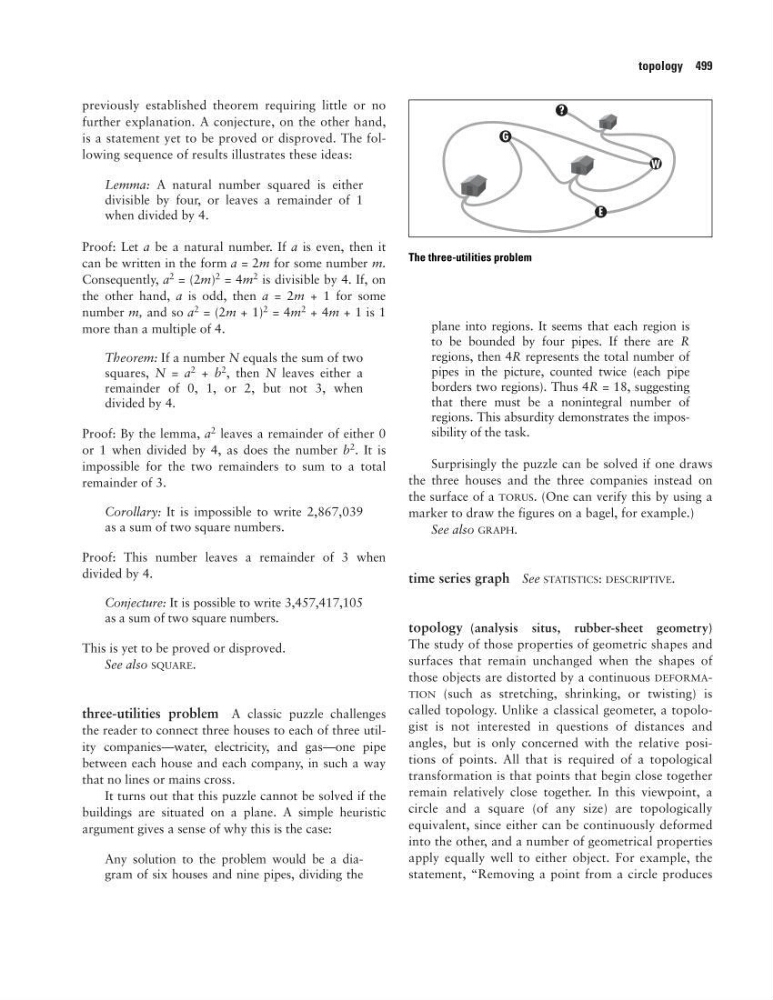
three-utilities problem A classic puzzle challenges
the reader to connect three houses to each of three utility companies—water, electricity, and gas—one pipe
between each house and each company, in such a way
that no lines or mains cross.
It turns out that this puzzle cannot be solved if the
buildings are situated on a plane. A simple heuristic
argument gives a sense of why this is the case:
Any solution to the problem would be a diagram of six houses and nine pipes, dividing the
plane into regions. It seems that each region is
to be bounded by four pipes. If there are R
regions, then 4R represents the total number of
pipes in the picture, counted twice (each pipe
borders two regions). Thus 4R = 18, suggesting
that there must be a nonintegral number of
regions. This absurdity demonstrates the impossibility of the task.
Surprisingly the puzzle can be solved if one draws
the three houses and the three companies instead on
the surface of a TORUS. (One can verify this by using a
marker to draw the figures on a bagel, for example.)
See also GRAPH.
time series graph See STATISTICS: DESCRIPTIVE.
topology (analysis situs, rubber-sheet geometry)
The study of those properties of geometric shapes and
surfaces that remain unchanged when the shapes of
those objects are distorted by a continuous DEFORMATION (such as stretching, shrinking, or twisting) is
called topology. Unlike a classical geometer, a topologist is not interested in questions of distances and
angles, but is only concerned with the relative positions of points. All that is required of a topological
transformation is that points that begin close together
remain relatively close together. In this viewpoint, a
circle and a square (of any size) are topologically
equivalent, since either can be continuously deformed
into the other, and a number of geometrical properties
apply equally well to either object. For example, the
statement, “Removing a point from a circle produces
topology 499
The three-utilities problem
further explanation. A conjecture, on the other hand,
is a statement yet to be proved or disproved. The following sequence of results illustrates these ideas:
Lemma: A natural number squared is either
divisible by four, or leaves a remainder of 1
when divided by 4.
Proof: Let a be a natural number. If a is even, then it
can be written in the form a = 2m for some number m.
Consequently, a
2 = (2m)
2 = 4m
2 is divisible by 4. If, on
the other hand, a is odd, then a = 2m + 1 for some
number m, and so a
2 = (2m + 1)
2 = 4m
2 + 4m + 1 is 1
more than a multiple of 4.
Theorem: If a number N equals the sum of two
squares, N = a
2 + b
2
, then N leaves either a
remainder of 0, 1, or 2, but not 3, when
divided by 4.
Proof: By the lemma, a
2 leaves a remainder of either 0
or 1 when divided by 4, as does the number b
2
. It is
impossible for the two remainders to sum to a total
remainder of 3.
Corollary: It is impossible to write 2,867,039
as a sum of two square numbers.
Proof: This number leaves a remainder of 3 when
divided by 4.
Conjecture: It is possible to write 3,457,417,105
as a sum of two square numbers.
This is yet to be proved or disproved.
See also SQUARE.
three-utilities problem A classic puzzle challenges
the reader to connect three houses to each of three utility companies—water, electricity, and gas—one pipe
between each house and each company, in such a way
that no lines or mains cross.
It turns out that this puzzle cannot be solved if the
buildings are situated on a plane. A simple heuristic
argument gives a sense of why this is the case:
Any solution to the problem would be a diagram of six houses and nine pipes, dividing the
plane into regions. It seems that each region is
to be bounded by four pipes. If there are R
regions, then 4R represents the total number of
pipes in the picture, counted twice (each pipe
borders two regions). Thus 4R = 18, suggesting
that there must be a nonintegral number of
regions. This absurdity demonstrates the impossibility of the task.
Surprisingly the puzzle can be solved if one draws
the three houses and the three companies instead on
the surface of a TORUS. (One can verify this by using a
marker to draw the figures on a bagel, for example.)
See also GRAPH.
time series graph See STATISTICS: DESCRIPTIVE.
topology (analysis situs, rubber-sheet geometry)
The study of those properties of geometric shapes and
surfaces that remain unchanged when the shapes of
those objects are distorted by a continuous DEFORMATION (such as stretching, shrinking, or twisting) is
called topology. Unlike a classical geometer, a topologist is not interested in questions of distances and
angles, but is only concerned with the relative positions of points. All that is required of a topological
transformation is that points that begin close together
remain relatively close together. In this viewpoint, a
circle and a square (of any size) are topologically
equivalent, since either can be continuously deformed
into the other, and a number of geometrical properties
apply equally well to either object. For example, the
statement, “Removing a point from a circle produces
topology 499
The three-utilities problem