

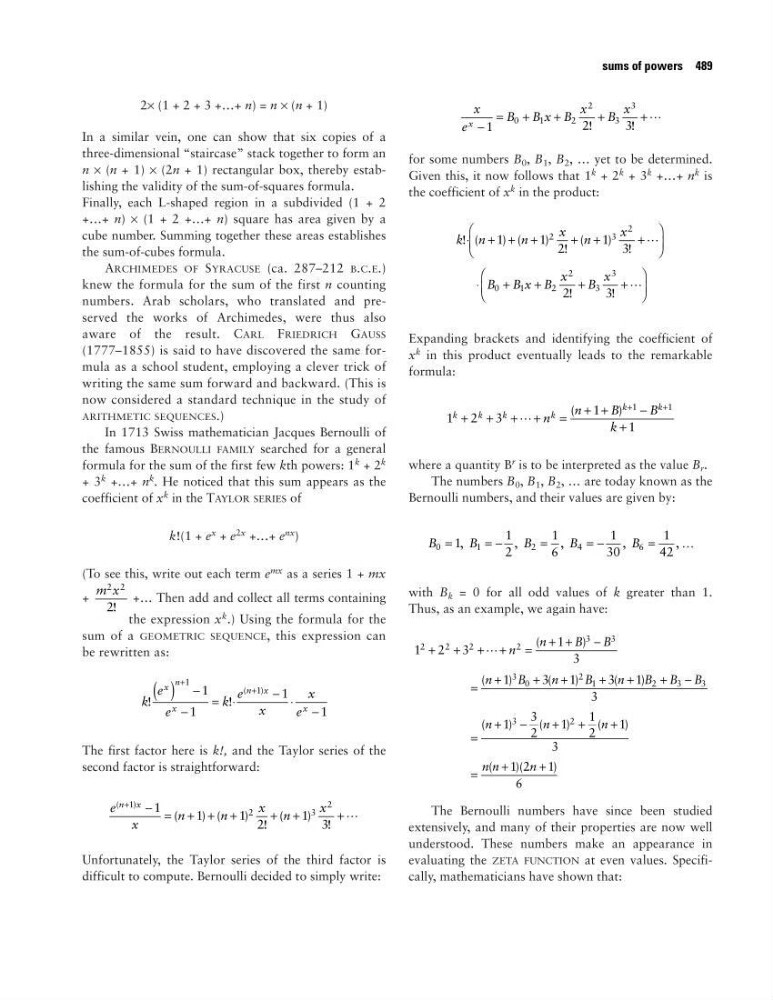
2× (1 + 2 + 3 +…+ n) = n × (n + 1)
In a similar vein, one can show that six copies of a
three-dimensional “staircase” stack together to form an
n × (n + 1) × (2n + 1) rectangular box, thereby establishing the validity of the sum-of-squares formula.
Finally, each L-shaped region in a subdivided (1 + 2
+…+ n) × (1 + 2 +…+ n) square has area given by a
cube number. Summing together these areas establishes
the sum-of-cubes formula.
ARCHIMEDES OF SYRACUSE (ca. 287–212 B.C.E.)
knew the formula for the sum of the first n counting
numbers. Arab scholars, who translated and preserved the works of Archimedes, were thus also
aware of the result. CARL FRIEDRICH GAUSS
(1777–1855) is said to have discovered the same formula as a school student, employing a clever trick of
writing the same sum forward and backward. (This is
now considered a standard technique in the study of
ARITHMETIC SEQUENCES.)
In 1713 Swiss mathematician Jacques Bernoulli of
the famous BERNOULLI FAMILY searched for a general
formula for the sum of the first few kth powers: 1
k + 2
k
+ 3
k +…+ n
k
. He noticed that this sum appears as the
coefficient of x
k in the TAYLOR SERIES of
k!(1 + e
x + e
2x +…+ e
nx )
(To see this, write out each term e
mx as a series 1 + mx
+
+… Then add and collect all terms containing
the expression x
k .) Using the formula for the
sum of a GEOMETRIC SEQUENCE, this expression can
be rewritten as:
The first factor here is k!, and the Taylor series of the
second factor is straightforward:
Unfortunately, the Taylor series of the third factor is
difficult to compute. Bernoulli decided to simply write:
for some numbers B 0 , B 1 , B 2 , … yet to be determined.
Given this, it now follows that 1
k + 2
k + 3
k +…+ n
k is
the coefficient of x
k in the product:
Expanding brackets and identifying the coefficient of
x
k in this product eventually leads to the remarkable
formula:
where a quantity B
r is to be interpreted as the value B r .
The numbers B 0 , B 1 , B 2 , … are today known as the
Bernoulli numbers, and their values are given by:
with B k = 0 for all odd values of k greater than 1.
Thus, as an example, we again have:
The Bernoulli numbers have since been studied
extensively, and many of their properties are now well
understood. These numbers make an appearance in
evaluating the ZETA FUNCTION at even values. Specifically, mathematicians have shown that:
1 2 3
1
3
1
3
1
3
1
3
1
3
2
1
1
2
1
3
1 2 1
6
2
2
2
2
3
3
3
0
2
1
2
3
3
3
2
+ + + +
=
+ +
−
=
+
+
+
+
+
+ −
=
+ −
+
+
+
=
+
+
L n
n
B
B
n
B
n
B
n
B B B
n
n
n
n n
n
(
)
(
)
(
)
(
)
(
)
(
)
(
)
(
)(
)
B
B
B
B
B
0
1
2
4
6
1
1
2
1
6
1
30
1
42
=
=−
=
=−
=
,
,
,
,
,K
1 2 3
1
1
1
1
k
k
k
k
k
k
n
n
B
B
k
+ + + +
=
+ +
−
+
+
+
L
(
)
k n
n
x n
x
B B x B
x
B
x
! (
) (
) !
(
) !
!
!
⋅ + + +
+ +
+
⋅
+
+
+
+
1
1 2
1 3
2
3
2
3
2
0
1
2
2
3
3
L
L
x
e
B B x B
x
B
x
x
−
=
+
+
+
+
1
2
3
0
1
2
2
3
3
!
!
L
e
x
n
n
x n
x
n x
(
)
(
) (
) !
(
) !
+
− = + + +
+ +
+
1
2
3
2
1
1
1 2
1 3
L
k
e
e
k
e
x
x
e
x
n
x
n x
x
!
!
(
)
( ) −
−
= ⋅
− ⋅ −
+
+
1
1
1
1
1
1
m x
2 2
2!
sums of powers 489
In a similar vein, one can show that six copies of a
three-dimensional “staircase” stack together to form an
n × (n + 1) × (2n + 1) rectangular box, thereby establishing the validity of the sum-of-squares formula.
Finally, each L-shaped region in a subdivided (1 + 2
+…+ n) × (1 + 2 +…+ n) square has area given by a
cube number. Summing together these areas establishes
the sum-of-cubes formula.
ARCHIMEDES OF SYRACUSE (ca. 287–212 B.C.E.)
knew the formula for the sum of the first n counting
numbers. Arab scholars, who translated and preserved the works of Archimedes, were thus also
aware of the result. CARL FRIEDRICH GAUSS
(1777–1855) is said to have discovered the same formula as a school student, employing a clever trick of
writing the same sum forward and backward. (This is
now considered a standard technique in the study of
ARITHMETIC SEQUENCES.)
In 1713 Swiss mathematician Jacques Bernoulli of
the famous BERNOULLI FAMILY searched for a general
formula for the sum of the first few kth powers: 1
k + 2
k
+ 3
k +…+ n
k
. He noticed that this sum appears as the
coefficient of x
k in the TAYLOR SERIES of
k!(1 + e
x + e
2x +…+ e
nx )
(To see this, write out each term e
mx as a series 1 + mx
+
+… Then add and collect all terms containing
the expression x
k .) Using the formula for the
sum of a GEOMETRIC SEQUENCE, this expression can
be rewritten as:
The first factor here is k!, and the Taylor series of the
second factor is straightforward:
Unfortunately, the Taylor series of the third factor is
difficult to compute. Bernoulli decided to simply write:
for some numbers B 0 , B 1 , B 2 , … yet to be determined.
Given this, it now follows that 1
k + 2
k + 3
k +…+ n
k is
the coefficient of x
k in the product:
Expanding brackets and identifying the coefficient of
x
k in this product eventually leads to the remarkable
formula:
where a quantity B
r is to be interpreted as the value B r .
The numbers B 0 , B 1 , B 2 , … are today known as the
Bernoulli numbers, and their values are given by:
with B k = 0 for all odd values of k greater than 1.
Thus, as an example, we again have:
The Bernoulli numbers have since been studied
extensively, and many of their properties are now well
understood. These numbers make an appearance in
evaluating the ZETA FUNCTION at even values. Specifically, mathematicians have shown that:
1 2 3
1
3
1
3
1
3
1
3
1
3
2
1
1
2
1
3
1 2 1
6
2
2
2
2
3
3
3
0
2
1
2
3
3
3
2
+ + + +
=
+ +
−
=
+
+
+
+
+
+ −
=
+ −
+
+
+
=
+
+
L n
n
B
B
n
B
n
B
n
B B B
n
n
n
n n
n
(
)
(
)
(
)
(
)
(
)
(
)
(
)
(
)(
)
B
B
B
B
B
0
1
2
4
6
1
1
2
1
6
1
30
1
42
=
=−
=
=−
=
,
,
,
,
,K
1 2 3
1
1
1
1
k
k
k
k
k
k
n
n
B
B
k
+ + + +
=
+ +
−
+
+
+
L
(
)
k n
n
x n
x
B B x B
x
B
x
! (
) (
) !
(
) !
!
!
⋅ + + +
+ +
+
⋅
+
+
+
+
1
1 2
1 3
2
3
2
3
2
0
1
2
2
3
3
L
L
x
e
B B x B
x
B
x
x
−
=
+
+
+
+
1
2
3
0
1
2
2
3
3
!
!
L
e
x
n
n
x n
x
n x
(
)
(
) (
) !
(
) !
+
− = + + +
+ +
+
1
2
3
2
1
1
1 2
1 3
L
k
e
e
k
e
x
x
e
x
n
x
n x
x
!
!
(
)
( ) −
−
= ⋅
− ⋅ −
+
+
1
1
1
1
1
1
m x
2 2
2!
sums of powers 489