

are often interested in problems involving the sum of a
large collection of quantities, and a compact notation for
writing such sums is helpful. The Greek letter Σ (representing “S” for “sum”), the so-called sigma notation
invented by Swiss mathematician LEONHARD EULER in
1755, can be used to express the
sum of the numbers a 1 ,a 2 ,…,a n as
. One reads this
as “the sum from k = 1 to n of a k ,” and computes it
via the following procedure:
Write the terms a k , first with k replaced by 1,
and then with k replaced by 2, stopping with
k replaced by n. Add together all the terms
written:
= a 1 + a 2 + … + a n
Thus, for example, the expression
represents the
sum 1
2 + 2
2 + 3
2 + 4
2
, which equals 30.
The letter k used as a subscript in sigma notation is
called the index of summation and is a DUMMY VARIABLE: any other letter could be used in its stead. For
example, the expressions
and
also represent
the same sum 1
2 + 2
2 + 3
2 + 4
2
.
A summation need not begin with index k = 1. For
example, the expression
represents the sum
(10
3 – 10
2
) + (11
3 – 11
2
) + (12
3 – 12
2
). A summation
could contain just a single term, as for
, for
instance. Any summation of the form
with n < m
is considered empty and to have value zero. Finally,
sums alternating in sign can be represented by introducing a factor of the form (–1)
k–1 . For example,
equals
.
Summations satisfy the following two basic properties:
where c is a constant. (These statements are patently
true when the summations are written out in full.)
The sigma notation is also used to denote SERIES,
that is, infinite sums:
For example, the GEOMETRIC SERIES can be written:
. If –1 < x < 1, then it has
value
, in which case we can write:
.
GOTTFRIED WILHELM LEIBNIZ (1646–1716), coinventor of CALCULUS, used an elongated “S,” ∫, both for
the sum of a sequence of integers and as a sign of integration (which he thought of as continuous summation).
See also ARITHMETIC SERIES; CONVERGENT SERIES;
INFINITE PRODUCT; SUMS OF POWERS.
sums of powers The following formulae, called the
sums of powers formulae, give simple equations for the
sums of the first few counting, square, and cube numbers. They can readily be proved by the method of
INDUCTION:
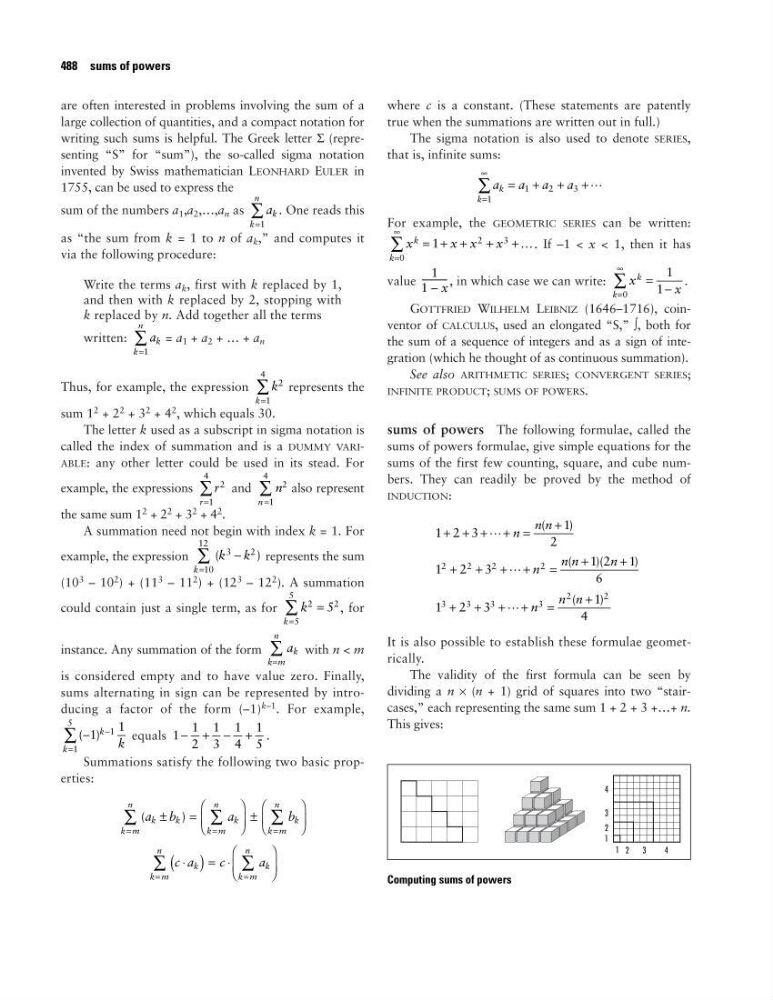
It is also possible to establish these formulae geometrically.
The validity of the first formula can be seen by
dividing a n × (n + 1) grid of squares into two “staircases,” each representing the same sum 1 + 2 + 3 +…+ n.
This gives:
1 2 3
1
2
1 2 3
1 2 1
6
1 2 3
1
4
2
2
2
2
3
3
3
3
2
2
+ + + + =
+
+ + + +
=
+
+
+ + + +
=
+
L
L
L
n
n n
n
n n
n
n
n n
(
)
(
)(
)
(
)
x
x
k
k=
∞
∑ = −
0
1
1
1
––
1 – x
x
x x
x
k
k=
∞
∑ = + + + +
0
2
3
1
K
a
a a a
k
k=
∞
∑ = + + +
1
1
2
3 L
(
)
a b
a
b
c a
c
a
k
k
k m
n
k
k m
n
k
k m
n
k
k m
n
k
k m
n
±
=
±
⋅
( ) = ⋅
=
=
=
=
=
∑
∑
∑
∑
∑
1
1
2
1
3
1
4
1
5
− + − +
( )
−
−
=
∑ 1
1
1
1
5
k
k
k
a k
k m
n
=
∑
k
k
2
5
5
2
5
=
∑ =
(
)
k k
k
3
2
10
12
−
=
∑
n
n
2
1
4
=
∑
r
r
2
1
4
=
∑
k
k
2
1
4
=
∑
a k
k
n
=
∑
1
a k
k
n
=
∑
1
488 sums of powers
Computing sums of powers
large collection of quantities, and a compact notation for
writing such sums is helpful. The Greek letter Σ (representing “S” for “sum”), the so-called sigma notation
invented by Swiss mathematician LEONHARD EULER in
1755, can be used to express the
sum of the numbers a 1 ,a 2 ,…,a n as
. One reads this
as “the sum from k = 1 to n of a k ,” and computes it
via the following procedure:
Write the terms a k , first with k replaced by 1,
and then with k replaced by 2, stopping with
k replaced by n. Add together all the terms
written:
= a 1 + a 2 + … + a n
Thus, for example, the expression
represents the
sum 1
2 + 2
2 + 3
2 + 4
2
, which equals 30.
The letter k used as a subscript in sigma notation is
called the index of summation and is a DUMMY VARIABLE: any other letter could be used in its stead. For
example, the expressions
and
also represent
the same sum 1
2 + 2
2 + 3
2 + 4
2
.
A summation need not begin with index k = 1. For
example, the expression
represents the sum
(10
3 – 10
2
) + (11
3 – 11
2
) + (12
3 – 12
2
). A summation
could contain just a single term, as for
, for
instance. Any summation of the form
with n < m
is considered empty and to have value zero. Finally,
sums alternating in sign can be represented by introducing a factor of the form (–1)
k–1 . For example,
equals
.
Summations satisfy the following two basic properties:
where c is a constant. (These statements are patently
true when the summations are written out in full.)
The sigma notation is also used to denote SERIES,
that is, infinite sums:
For example, the GEOMETRIC SERIES can be written:
. If –1 < x < 1, then it has
value
, in which case we can write:
.
GOTTFRIED WILHELM LEIBNIZ (1646–1716), coinventor of CALCULUS, used an elongated “S,” ∫, both for
the sum of a sequence of integers and as a sign of integration (which he thought of as continuous summation).
See also ARITHMETIC SERIES; CONVERGENT SERIES;
INFINITE PRODUCT; SUMS OF POWERS.
sums of powers The following formulae, called the
sums of powers formulae, give simple equations for the
sums of the first few counting, square, and cube numbers. They can readily be proved by the method of
INDUCTION:
It is also possible to establish these formulae geometrically.
The validity of the first formula can be seen by
dividing a n × (n + 1) grid of squares into two “staircases,” each representing the same sum 1 + 2 + 3 +…+ n.
This gives:
1 2 3
1
2
1 2 3
1 2 1
6
1 2 3
1
4
2
2
2
2
3
3
3
3
2
2
+ + + + =
+
+ + + +
=
+
+
+ + + +
=
+
L
L
L
n
n n
n
n n
n
n
n n
(
)
(
)(
)
(
)
x
x
k
k=
∞
∑ = −
0
1
1
1
––
1 – x
x
x x
x
k
k=
∞
∑ = + + + +
0
2
3
1
K
a
a a a
k
k=
∞
∑ = + + +
1
1
2
3 L
(
)
a b
a
b
c a
c
a
k
k
k m
n
k
k m
n
k
k m
n
k
k m
n
k
k m
n
±
=
±
⋅
( ) = ⋅
=
=
=
=
=
∑
∑
∑
∑
∑
1
1
2
1
3
1
4
1
5
− + − +
( )
−
−
=
∑ 1
1
1
1
5
k
k
k
a k
k m
n
=
∑
k
k
2
5
5
2
5
=
∑ =
(
)
k k
k
3
2
10
12
−
=
∑
n
n
2
1
4
=
∑
r
r
2
1
4
=
∑
k
k
2
1
4
=
∑
a k
k
n
=
∑
1
a k
k
n
=
∑
1
488 sums of powers
Computing sums of powers