

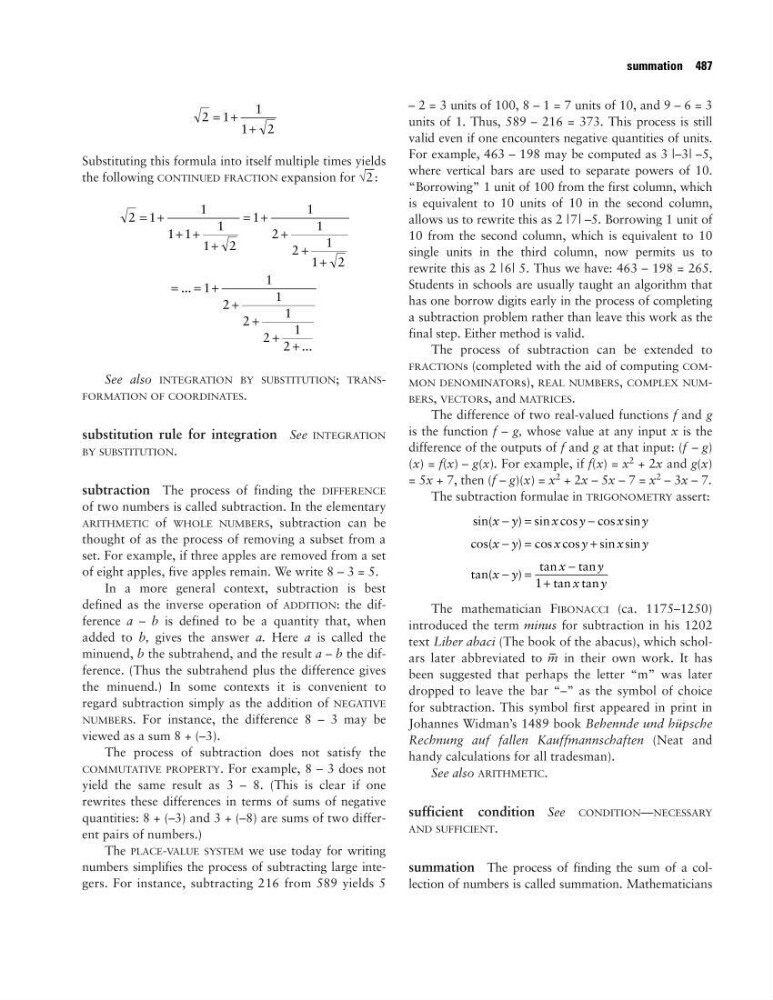
Substituting this formula into itself multiple times yields
the following CONTINUED FRACTION expansion for √
–
2:
See also INTEGRATION BY SUBSTITUTION; TRANSFORMATION OF COORDINATES.
substitution rule for integration See INTEGRATION
BY SUBSTITUTION.
subtraction The process of finding the DIFFERENCE
of two numbers is called subtraction. In the elementary
ARITHMETIC of WHOLE NUMBERS, subtraction can be
thought of as the process of removing a subset from a
set. For example, if three apples are removed from a set
of eight apples, five apples remain. We write 8 – 3 = 5.
In a more general context, subtraction is best
defined as the inverse operation of ADDITION: the difference a – b is defined to be a quantity that, when
added to b, gives the answer a. Here a is called the
minuend, b the subtrahend, and the result a – b the difference. (Thus the subtrahend plus the difference gives
the minuend.) In some contexts it is convenient to
regard subtraction simply as the addition of NEGATIVE
NUMBERS. For instance, the difference 8 – 3 may be
viewed as a sum 8 + (–3).
The process of subtraction does not satisfy the
COMMUTATIVE PROPERTY. For example, 8 – 3 does not
yield the same result as 3 – 8. (This is clear if one
rewrites these differences in terms of sums of negative
quantities: 8 + (–3) and 3 + (–8) are sums of two different pairs of numbers.)
The PLACE-VALUE SYSTEM we use today for writing
numbers simplifies the process of subtracting large integers. For instance, subtracting 216 from 589 yields 5
– 2 = 3 units of 100, 8 – 1 = 7 units of 10, and 9 – 6 = 3
units of 1. Thus, 589 – 216 = 373. This process is still
valid even if one encounters negative quantities of units.
For example, 463 – 198 may be computed as 3 |–3| –5,
where vertical bars are used to separate powers of 10.
“Borrowing” 1 unit of 100 from the first column, which
is equivalent to 10 units of 10 in the second column,
allows us to rewrite this as 2 |7| –5. Borrowing 1 unit of
10 from the second column, which is equivalent to 10
single units in the third column, now permits us to
rewrite this as 2 |6| 5. Thus we have: 463 – 198 = 265.
Students in schools are usually taught an algorithm that
has one borrow digits early in the process of completing
a subtraction problem rather than leave this work as the
final step. Either method is valid.
The process of subtraction can be extended to
FRACTIONs (completed with the aid of computing COMMON DENOMINATORs), REAL NUMBERS, COMPLEX NUMBERS, VECTORs, and MATRICES.
The difference of two real-valued functions f and g
is the function f – g, whose value at any input x is the
difference of the outputs of f and g at that input: (f – g)
(x) = f(x) – g(x). For example, if f(x) = x
2 + 2x and g(x)
= 5x + 7, then (f – g)(x) = x
2 + 2x – 5x – 7 = x
2 – 3x – 7.
The subtraction formulae in TRIGONOMETRY assert:
The mathematician FIBONACCI (ca. 1175–1250)
introduced the term minus for subtraction in his 1202
text Liber abaci (The book of the abacus), which scholars later abbreviated to –
m in their own work. It has
been suggested that perhaps the letter “m” was later
dropped to leave the bar “–” as the symbol of choice
for subtraction. This symbol first appeared in print in
Johannes Widman’s 1489 book Behennde und hüpsche
Rechnung auf fallen Kauffmannschaften (Neat and
handy calculations for all tradesman).
See also ARITHMETIC.
sufficient condition See CONDITION—NECESSARY
AND SUFFICIENT.
summation The process of finding the sum of a collection of numbers is called summation. Mathematicians
sin(
) sin cos
cos sin
cos(
) cos cos
sin sin
tan(
)
tan
tan
tan tan
x y
x
y
x y
x y
x
y
x y
x y
x
y
x
y
− =
−
− =
+
− =
−
+
1
1
1
2
1
2
1
2
1
2
= = +
+
+
+ +
...
...
2 1
1
1 1
1
1
2
1
1
2
1
2
1
1
2
= +
+ + +
= +
+
+ +
2 1
1
1
2
= + +
summation 487
the following CONTINUED FRACTION expansion for √
–
2:
See also INTEGRATION BY SUBSTITUTION; TRANSFORMATION OF COORDINATES.
substitution rule for integration See INTEGRATION
BY SUBSTITUTION.
subtraction The process of finding the DIFFERENCE
of two numbers is called subtraction. In the elementary
ARITHMETIC of WHOLE NUMBERS, subtraction can be
thought of as the process of removing a subset from a
set. For example, if three apples are removed from a set
of eight apples, five apples remain. We write 8 – 3 = 5.
In a more general context, subtraction is best
defined as the inverse operation of ADDITION: the difference a – b is defined to be a quantity that, when
added to b, gives the answer a. Here a is called the
minuend, b the subtrahend, and the result a – b the difference. (Thus the subtrahend plus the difference gives
the minuend.) In some contexts it is convenient to
regard subtraction simply as the addition of NEGATIVE
NUMBERS. For instance, the difference 8 – 3 may be
viewed as a sum 8 + (–3).
The process of subtraction does not satisfy the
COMMUTATIVE PROPERTY. For example, 8 – 3 does not
yield the same result as 3 – 8. (This is clear if one
rewrites these differences in terms of sums of negative
quantities: 8 + (–3) and 3 + (–8) are sums of two different pairs of numbers.)
The PLACE-VALUE SYSTEM we use today for writing
numbers simplifies the process of subtracting large integers. For instance, subtracting 216 from 589 yields 5
– 2 = 3 units of 100, 8 – 1 = 7 units of 10, and 9 – 6 = 3
units of 1. Thus, 589 – 216 = 373. This process is still
valid even if one encounters negative quantities of units.
For example, 463 – 198 may be computed as 3 |–3| –5,
where vertical bars are used to separate powers of 10.
“Borrowing” 1 unit of 100 from the first column, which
is equivalent to 10 units of 10 in the second column,
allows us to rewrite this as 2 |7| –5. Borrowing 1 unit of
10 from the second column, which is equivalent to 10
single units in the third column, now permits us to
rewrite this as 2 |6| 5. Thus we have: 463 – 198 = 265.
Students in schools are usually taught an algorithm that
has one borrow digits early in the process of completing
a subtraction problem rather than leave this work as the
final step. Either method is valid.
The process of subtraction can be extended to
FRACTIONs (completed with the aid of computing COMMON DENOMINATORs), REAL NUMBERS, COMPLEX NUMBERS, VECTORs, and MATRICES.
The difference of two real-valued functions f and g
is the function f – g, whose value at any input x is the
difference of the outputs of f and g at that input: (f – g)
(x) = f(x) – g(x). For example, if f(x) = x
2 + 2x and g(x)
= 5x + 7, then (f – g)(x) = x
2 + 2x – 5x – 7 = x
2 – 3x – 7.
The subtraction formulae in TRIGONOMETRY assert:
The mathematician FIBONACCI (ca. 1175–1250)
introduced the term minus for subtraction in his 1202
text Liber abaci (The book of the abacus), which scholars later abbreviated to –
m in their own work. It has
been suggested that perhaps the letter “m” was later
dropped to leave the bar “–” as the symbol of choice
for subtraction. This symbol first appeared in print in
Johannes Widman’s 1489 book Behennde und hüpsche
Rechnung auf fallen Kauffmannschaften (Neat and
handy calculations for all tradesman).
See also ARITHMETIC.
sufficient condition See CONDITION—NECESSARY
AND SUFFICIENT.
summation The process of finding the sum of a collection of numbers is called summation. Mathematicians
sin(
) sin cos
cos sin
cos(
) cos cos
sin sin
tan(
)
tan
tan
tan tan
x y
x
y
x y
x y
x
y
x y
x y
x
y
x
y
− =
−
− =
+
− =
−
+
1
1
1
2
1
2
1
2
1
2
= = +
+
+
+ +
...
...
2 1
1
1 1
1
1
2
1
1
2
1
2
1
1
2
= +
+ + +
= +
+
+ +
2 1
1
1
2
= + +
summation 487