

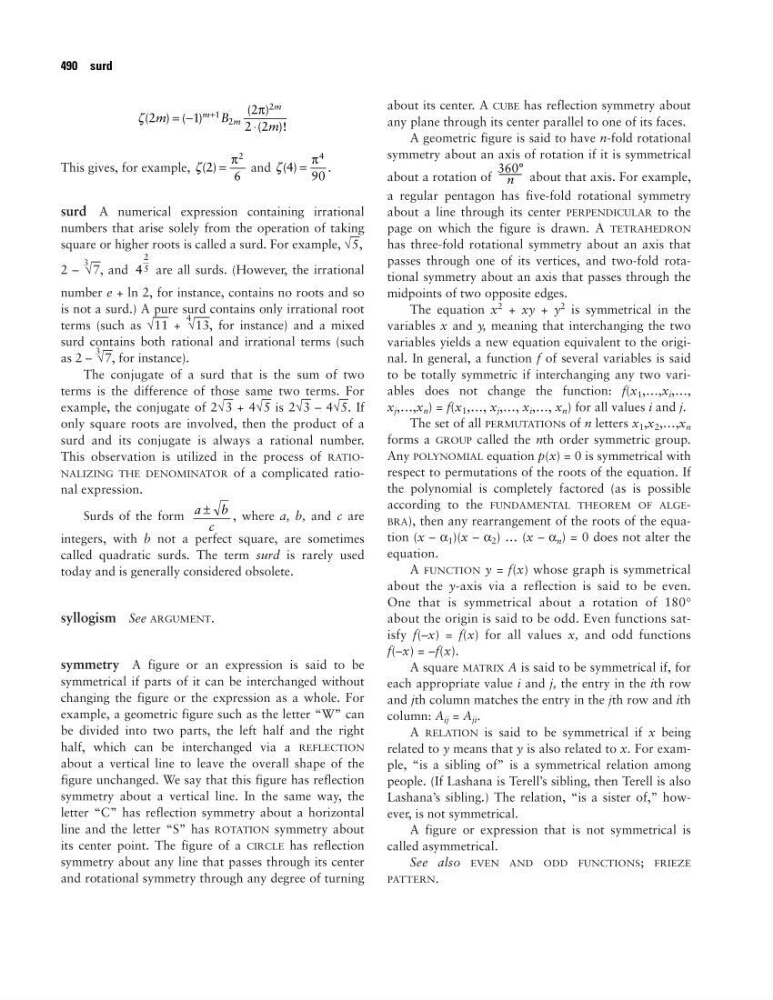
This gives, for example,
and
.
surd A numerical expression containing irrational
numbers that arise solely from the operation of taking
square or higher roots is called a surd. For example, √
–
5,
2 –
3
√
–
7, and
are all surds. (However, the irrational
number e + ln 2, for instance, contains no roots and so
is not a surd.) A pure surd contains only irrational root
terms (such as √
–
11 +
4
√
–
13, for instance) and a mixed
surd contains both rational and irrational terms (such
as 2 –
3
√
–
7, for instance).
The conjugate of a surd that is the sum of two
terms is the difference of those same two terms. For
example, the conjugate of 2√
–
3 + 4√
–
5 is 2√
–
3 – 4√
–
5. If
only square roots are involved, then the product of a
surd and its conjugate is always a rational number.
This observation is utilized in the process of RATIONALIZING THE DENOMINATOR of a complicated rational expression.
Surds of the form
, where a, b, and c are
integers, with b not a perfect square, are sometimes
called quadratic surds. The term surd is rarely used
today and is generally considered obsolete.
syllogism See ARGUMENT.
symmetry A figure or an expression is said to be
symmetrical if parts of it can be interchanged without
changing the figure or the expression as a whole. For
example, a geometric figure such as the letter “W” can
be divided into two parts, the left half and the right
half, which can be interchanged via a REFLECTION
about a vertical line to leave the overall shape of the
figure unchanged. We say that this figure has reflection
symmetry about a vertical line. In the same way, the
letter “C” has reflection symmetry about a horizontal
line and the letter “S” has ROTATION symmetry about
its center point. The figure of a CIRCLE has reflection
symmetry about any line that passes through its center
and rotational symmetry through any degree of turning
about its center. A CUBE has reflection symmetry about
any plane through its center parallel to one of its faces.
A geometric figure is said to have n-fold rotational
symmetry about an axis of rotation if it is symmetrical
about a rotation of
about that axis. For example,
a regular pentagon has five-fold rotational symmetry
about a line through its center PERPENDICULAR to the
page on which the figure is drawn. A TETRAHEDRON
has three-fold rotational symmetry about an axis that
passes through one of its vertices, and two-fold rotational symmetry about an axis that passes through the
midpoints of two opposite edges.
The equation x
2 + xy + y
2 is symmetrical in the
variables x and y, meaning that interchanging the two
variables yields a new equation equivalent to the original. In general, a function f of several variables is said
to be totally symmetric if interchanging any two variables does not change the function: f(x 1 ,…,x i ,…,
x j ,…,x n ) = f(x 1 ,…, x j ,…, x i ,…, x n ) for all values i and j.
The set of all PERMUTATIONs of n letters x 1 ,x 2 ,…,x n
forms a GROUP called the nth order symmetric group.
Any POLYNOMIAL equation p(x) = 0 is symmetrical with
respect to permutations of the roots of the equation. If
the polynomial is completely factored (as is possible
according to the FUNDAMENTAL THEOREM OF ALGEBRA), then any rearrangement of the roots of the equation (x – α 1 )(x – α 2 ) … (x – α n ) = 0 does not alter the
equation.
A FUNCTION y = f(x) whose graph is symmetrical
about the y-axis via a reflection is said to be even.
One that is symmetrical about a rotation of 180°
about the origin is said to be odd. Even functions satisfy f(–x) = f(x) for all values x, and odd functions
f(–x) = –f(x).
A square MATRIX A is said to be symmetrical if, for
each appropriate value i and j, the entry in the ith row
and jth column matches the entry in the jth row and ith
column: A ij = A ji .
A RELATION is said to be symmetrical if x being
related to y means that y is also related to x. For example, “is a sibling of” is a symmetrical relation among
people. (If Lashana is Terell’s sibling, then Terell is also
Lashana’s sibling.) The relation, “is a sister of,” however, is not symmetrical.
A figure or expression that is not symmetrical is
called asymmetrical.
See also EVEN AND ODD FUNCTIONS; FRIEZE
PATTERN.
360° —— n
a
b
c
±
4
2
5
ζ( )
4 90
4
=
π
ζ( )
2
6
2
=
π
ζ( ) ( )
( )
( )!
2
1
2
2 2
1
2
2
m
B
m
m
m
m
= −
⋅
+
π
490 surd
and
.
surd A numerical expression containing irrational
numbers that arise solely from the operation of taking
square or higher roots is called a surd. For example, √
–
5,
2 –
3
√
–
7, and
are all surds. (However, the irrational
number e + ln 2, for instance, contains no roots and so
is not a surd.) A pure surd contains only irrational root
terms (such as √
–
11 +
4
√
–
13, for instance) and a mixed
surd contains both rational and irrational terms (such
as 2 –
3
√
–
7, for instance).
The conjugate of a surd that is the sum of two
terms is the difference of those same two terms. For
example, the conjugate of 2√
–
3 + 4√
–
5 is 2√
–
3 – 4√
–
5. If
only square roots are involved, then the product of a
surd and its conjugate is always a rational number.
This observation is utilized in the process of RATIONALIZING THE DENOMINATOR of a complicated rational expression.
Surds of the form
, where a, b, and c are
integers, with b not a perfect square, are sometimes
called quadratic surds. The term surd is rarely used
today and is generally considered obsolete.
syllogism See ARGUMENT.
symmetry A figure or an expression is said to be
symmetrical if parts of it can be interchanged without
changing the figure or the expression as a whole. For
example, a geometric figure such as the letter “W” can
be divided into two parts, the left half and the right
half, which can be interchanged via a REFLECTION
about a vertical line to leave the overall shape of the
figure unchanged. We say that this figure has reflection
symmetry about a vertical line. In the same way, the
letter “C” has reflection symmetry about a horizontal
line and the letter “S” has ROTATION symmetry about
its center point. The figure of a CIRCLE has reflection
symmetry about any line that passes through its center
and rotational symmetry through any degree of turning
about its center. A CUBE has reflection symmetry about
any plane through its center parallel to one of its faces.
A geometric figure is said to have n-fold rotational
symmetry about an axis of rotation if it is symmetrical
about a rotation of
about that axis. For example,
a regular pentagon has five-fold rotational symmetry
about a line through its center PERPENDICULAR to the
page on which the figure is drawn. A TETRAHEDRON
has three-fold rotational symmetry about an axis that
passes through one of its vertices, and two-fold rotational symmetry about an axis that passes through the
midpoints of two opposite edges.
The equation x
2 + xy + y
2 is symmetrical in the
variables x and y, meaning that interchanging the two
variables yields a new equation equivalent to the original. In general, a function f of several variables is said
to be totally symmetric if interchanging any two variables does not change the function: f(x 1 ,…,x i ,…,
x j ,…,x n ) = f(x 1 ,…, x j ,…, x i ,…, x n ) for all values i and j.
The set of all PERMUTATIONs of n letters x 1 ,x 2 ,…,x n
forms a GROUP called the nth order symmetric group.
Any POLYNOMIAL equation p(x) = 0 is symmetrical with
respect to permutations of the roots of the equation. If
the polynomial is completely factored (as is possible
according to the FUNDAMENTAL THEOREM OF ALGEBRA), then any rearrangement of the roots of the equation (x – α 1 )(x – α 2 ) … (x – α n ) = 0 does not alter the
equation.
A FUNCTION y = f(x) whose graph is symmetrical
about the y-axis via a reflection is said to be even.
One that is symmetrical about a rotation of 180°
about the origin is said to be odd. Even functions satisfy f(–x) = f(x) for all values x, and odd functions
f(–x) = –f(x).
A square MATRIX A is said to be symmetrical if, for
each appropriate value i and j, the entry in the ith row
and jth column matches the entry in the jth row and ith
column: A ij = A ji .
A RELATION is said to be symmetrical if x being
related to y means that y is also related to x. For example, “is a sibling of” is a symmetrical relation among
people. (If Lashana is Terell’s sibling, then Terell is also
Lashana’s sibling.) The relation, “is a sister of,” however, is not symmetrical.
A figure or expression that is not symmetrical is
called asymmetrical.
See also EVEN AND ODD FUNCTIONS; FRIEZE
PATTERN.
360° —— n
a
b
c
±
4
2
5
ζ( )
4 90
4
=
π
ζ( )
2
6
2
=
π
ζ( ) ( )
( )
( )!
2
1
2
2 2
1
2
2
m
B
m
m
m
m
= −
⋅
+
π
490 surd