

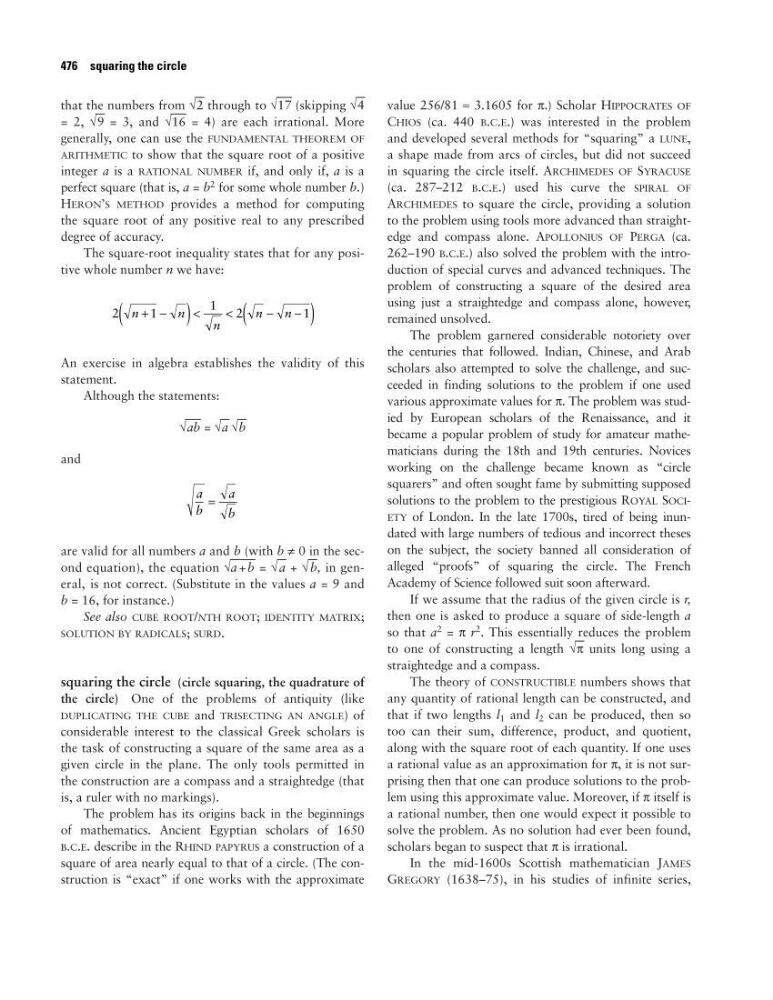
that the numbers from √
–
2 through to √
–
17 (skipping √
–
4
= 2, √
–
9 = 3, and √
–
16 = 4) are each irrational. More
generally, one can use the FUNDAMENTAL THEOREM OF
ARITHMETIC to show that the square root of a positive
integer a is a RATIONAL NUMBER if, and only if, a is a
perfect square (that is, a = b
2 for some whole number b.)
HERON’S METHOD provides a method for computing
the square root of any positive real to any prescribed
degree of accuracy.
The square-root inequality states that for any positive whole number n we have:
An exercise in algebra establishes the validity of this
statement.
Although the statements:
√
–
ab = √
–
a √
–
b
and
are valid for all numbers a and b (with b ≠ 0 in the second equation), the equation √
–
a + b = √
–
a + √
–
b, in general, is not correct. (Substitute in the values a = 9 and
b = 16, for instance.)
See also CUBE ROOT/NTH ROOT; IDENTITY MATRIX;
SOLUTION BY RADICALS; SURD.
squaring the circle (circle squaring, the quadrature of
the circle) One of the problems of antiquity (like
DUPLICATING THE CUBE and TRISECTING AN ANGLE) of
considerable interest to the classical Greek scholars is
the task of constructing a square of the same area as a
given circle in the plane. The only tools permitted in
the construction are a compass and a straightedge (that
is, a ruler with no markings).
The problem has its origins back in the beginnings
of mathematics. Ancient Egyptian scholars of 1650
B.C.E. describe in the RHIND PAPYRUS a construction of a
square of area nearly equal to that of a circle. (The construction is “exact” if one works with the approximate
value 256/81 ≈ 3.1605 for π.) Scholar HIPPOCRATES OF
CHIOS (ca. 440 B.C.E.) was interested in the problem
and developed several methods for “squaring” a LUNE,
a shape made from arcs of circles, but did not succeed
in squaring the circle itself. ARCHIMEDES OF SYRACUSE
(ca. 287–212 B.C.E.) used his curve the SPIRAL OF
ARCHIMEDES to square the circle, providing a solution
to the problem using tools more advanced than straightedge and compass alone. APOLLONIUS OF PERGA (ca.
262–190 B.C.E.) also solved the problem with the introduction of special curves and advanced techniques. The
problem of constructing a square of the desired area
using just a straightedge and compass alone, however,
remained unsolved.
The problem garnered considerable notoriety over
the centuries that followed. Indian, Chinese, and Arab
scholars also attempted to solve the challenge, and succeeded in finding solutions to the problem if one used
various approximate values for π. The problem was studied by European scholars of the Renaissance, and it
became a popular problem of study for amateur mathematicians during the 18th and 19th centuries. Novices
working on the challenge became known as “circle
squarers” and often sought fame by submitting supposed
solutions to the problem to the prestigious ROYAL SOCIETY of London. In the late 1700s, tired of being inundated with large numbers of tedious and incorrect theses
on the subject, the society banned all consideration of
alleged “proofs” of squaring the circle. The French
Academy of Science followed suit soon afterward.
If we assume that the radius of the given circle is r,
then one is asked to produce a square of side-length a
so that a
2 = π r
2
. This essentially reduces the problem
to one of constructing a length √
–
π units long using a
straightedge and a compass.
The theory of CONSTRUCTIBLE numbers shows that
any quantity of rational length can be constructed, and
that if two lengths l 1 and l 2 can be produced, then so
too can their sum, difference, product, and quotient,
along with the square root of each quantity. If one uses
a rational value as an approximation for π, it is not surprising then that one can produce solutions to the problem using this approximate value. Moreover, if π itself is
a rational number, then one would expect it possible to
solve the problem. As no solution had ever been found,
scholars began to suspect that π is irrational.
In the mid-1600s Scottish mathematician JAMES
GREGORY (1638–75), in his studies of infinite series,
a
b
a
b
=
2
1
1
2
1
n
n
n
n
n
+ −
(
) < < − −
(
)
476 squaring the circle
–
2 through to √
–
17 (skipping √
–
4
= 2, √
–
9 = 3, and √
–
16 = 4) are each irrational. More
generally, one can use the FUNDAMENTAL THEOREM OF
ARITHMETIC to show that the square root of a positive
integer a is a RATIONAL NUMBER if, and only if, a is a
perfect square (that is, a = b
2 for some whole number b.)
HERON’S METHOD provides a method for computing
the square root of any positive real to any prescribed
degree of accuracy.
The square-root inequality states that for any positive whole number n we have:
An exercise in algebra establishes the validity of this
statement.
Although the statements:
√
–
ab = √
–
a √
–
b
and
are valid for all numbers a and b (with b ≠ 0 in the second equation), the equation √
–
a + b = √
–
a + √
–
b, in general, is not correct. (Substitute in the values a = 9 and
b = 16, for instance.)
See also CUBE ROOT/NTH ROOT; IDENTITY MATRIX;
SOLUTION BY RADICALS; SURD.
squaring the circle (circle squaring, the quadrature of
the circle) One of the problems of antiquity (like
DUPLICATING THE CUBE and TRISECTING AN ANGLE) of
considerable interest to the classical Greek scholars is
the task of constructing a square of the same area as a
given circle in the plane. The only tools permitted in
the construction are a compass and a straightedge (that
is, a ruler with no markings).
The problem has its origins back in the beginnings
of mathematics. Ancient Egyptian scholars of 1650
B.C.E. describe in the RHIND PAPYRUS a construction of a
square of area nearly equal to that of a circle. (The construction is “exact” if one works with the approximate
value 256/81 ≈ 3.1605 for π.) Scholar HIPPOCRATES OF
CHIOS (ca. 440 B.C.E.) was interested in the problem
and developed several methods for “squaring” a LUNE,
a shape made from arcs of circles, but did not succeed
in squaring the circle itself. ARCHIMEDES OF SYRACUSE
(ca. 287–212 B.C.E.) used his curve the SPIRAL OF
ARCHIMEDES to square the circle, providing a solution
to the problem using tools more advanced than straightedge and compass alone. APOLLONIUS OF PERGA (ca.
262–190 B.C.E.) also solved the problem with the introduction of special curves and advanced techniques. The
problem of constructing a square of the desired area
using just a straightedge and compass alone, however,
remained unsolved.
The problem garnered considerable notoriety over
the centuries that followed. Indian, Chinese, and Arab
scholars also attempted to solve the challenge, and succeeded in finding solutions to the problem if one used
various approximate values for π. The problem was studied by European scholars of the Renaissance, and it
became a popular problem of study for amateur mathematicians during the 18th and 19th centuries. Novices
working on the challenge became known as “circle
squarers” and often sought fame by submitting supposed
solutions to the problem to the prestigious ROYAL SOCIETY of London. In the late 1700s, tired of being inundated with large numbers of tedious and incorrect theses
on the subject, the society banned all consideration of
alleged “proofs” of squaring the circle. The French
Academy of Science followed suit soon afterward.
If we assume that the radius of the given circle is r,
then one is asked to produce a square of side-length a
so that a
2 = π r
2
. This essentially reduces the problem
to one of constructing a length √
–
π units long using a
straightedge and a compass.
The theory of CONSTRUCTIBLE numbers shows that
any quantity of rational length can be constructed, and
that if two lengths l 1 and l 2 can be produced, then so
too can their sum, difference, product, and quotient,
along with the square root of each quantity. If one uses
a rational value as an approximation for π, it is not surprising then that one can produce solutions to the problem using this approximate value. Moreover, if π itself is
a rational number, then one would expect it possible to
solve the problem. As no solution had ever been found,
scholars began to suspect that π is irrational.
In the mid-1600s Scottish mathematician JAMES
GREGORY (1638–75), in his studies of infinite series,
a
b
a
b
=
2
1
1
2
1
n
n
n
n
n
+ −
(
) < < − −
(
)
476 squaring the circle