

attempted to show that π is not only irrational, but,
moreover, that it is a TRANSCENDENTAL NUMBER. This
would establish, once and for all, that √
–
π cannot possibly be constructed. Unfortunately, Gregory did not succeed in this goal. It was not until a century later that
German mathematician JOHANN HEINRICH LAMBERT
(1728–77) succeeded in proving that π is irrational,
and another century after that that CARL LOUIS FERDINAND VON LINDEMANN (1852–1939) finally proved in
1880 that π is indeed transcendental. As a consequence,
Lindemann had proved that the problem of squaring
the circle is unsolvable.
It is interesting to note that in 1914 SRINIVASA
AIYANGAR RAMANUJAN (1887–1920) used a ruler-andcompass construction akin to squaring a circle to find
the following remarkable approximation for π correct
to the ninth decimal place:
squeeze rule (sandwich result) This rule asserts that
if a function f(x) is sandwiched between two other
functions g(x) and h(x), at least for values x close to a
number a (that is, we have g(x) ≤ f(x) ≤ h(x)), and if
lim x→a g(x) = L and lim x→a h(x) = L, then it must be the
case that lim x→a f(x) exists and equals L as well. For
example, the inequalities 1 – x ≤ f(x) ≤ 1 + x
2 imply
that lim x→0 f(x) = 1.
Perhaps the most important application of the
squeeze rule is the calculation of the limit
, which
arises in computing the DERIVATIVE of the sine function.
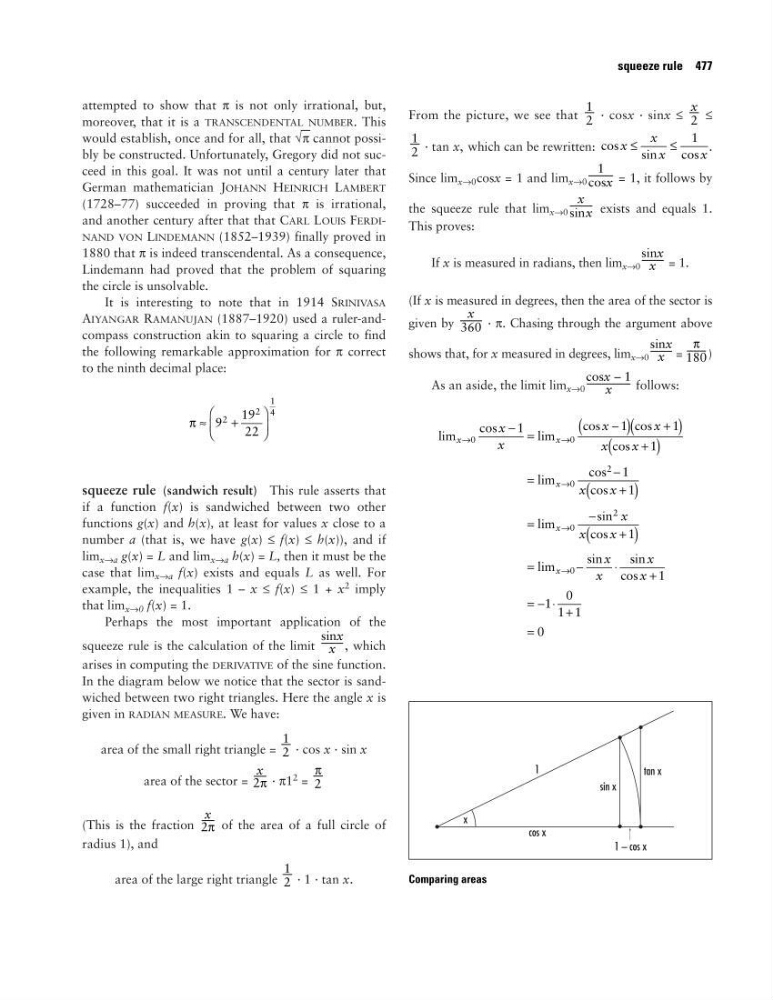
In the diagram below we notice that the sector is sandwiched between two right triangles. Here the angle x is
given in RADIAN MEASURE. We have:
area of the small right triangle =
· cos x · sin x
area of the sector =
· π1
2 =
(This is the fraction
of the area of a full circle of
radius 1), and
area of the large right triangle
· 1 · tan x.
From the picture, we see that
· cosx · sinx ≤
≤
· tan x, which can be rewritten:
.
Since lim x→0 cosx = 1 and lim x→0
= 1, it follows by
the squeeze rule that lim x→0
exists and equals 1.
This proves:
If x is measured in radians, then lim x→0
= 1.
(If x is measured in degrees, then the area of the sector is
given by
· π. Chasing through the argument above
shows that, for x measured in degrees, lim x→0
=
)
As an aside, the limit lim x→0
follows:
lim
cos
lim
cos
cos
cos
lim
cos
cos
lim
sin
cos
lim
sin
sin
cos
x
x
x
x
x
x
x
x
x
x
x
x
x
x
x
x
x
x
x
x
→
→
→
→
→
− =
−
(
)
+
(
)
+
(
)
=
−
+
(
)
=
−
+
(
)
=
−
⋅
+
= − ⋅ +
=
0
0
0
2
0
2
0
1
1
1
1
1
1
1
1
1
0
1 1
0
cosx – 1
–––––– x
π
–––
180
sinx ––– x
x
–––
360
sinx ––– x
x
–––
sinx
1
–––
cosx
cos
sin
cos
x
x
x
x
≤
≤
1
1
–
2
x
–
2
1
–
2
1
–
2
x
–
2π
π
–
2
x
–
2π
1
–
2
sinx ––– x
π ≈
+
9
19
22
2
2
1
4
squeeze rule 477
Comparing areas
moreover, that it is a TRANSCENDENTAL NUMBER. This
would establish, once and for all, that √
–
π cannot possibly be constructed. Unfortunately, Gregory did not succeed in this goal. It was not until a century later that
German mathematician JOHANN HEINRICH LAMBERT
(1728–77) succeeded in proving that π is irrational,
and another century after that that CARL LOUIS FERDINAND VON LINDEMANN (1852–1939) finally proved in
1880 that π is indeed transcendental. As a consequence,
Lindemann had proved that the problem of squaring
the circle is unsolvable.
It is interesting to note that in 1914 SRINIVASA
AIYANGAR RAMANUJAN (1887–1920) used a ruler-andcompass construction akin to squaring a circle to find
the following remarkable approximation for π correct
to the ninth decimal place:
squeeze rule (sandwich result) This rule asserts that
if a function f(x) is sandwiched between two other
functions g(x) and h(x), at least for values x close to a
number a (that is, we have g(x) ≤ f(x) ≤ h(x)), and if
lim x→a g(x) = L and lim x→a h(x) = L, then it must be the
case that lim x→a f(x) exists and equals L as well. For
example, the inequalities 1 – x ≤ f(x) ≤ 1 + x
2 imply
that lim x→0 f(x) = 1.
Perhaps the most important application of the
squeeze rule is the calculation of the limit
, which
arises in computing the DERIVATIVE of the sine function.
In the diagram below we notice that the sector is sandwiched between two right triangles. Here the angle x is
given in RADIAN MEASURE. We have:
area of the small right triangle =
· cos x · sin x
area of the sector =
· π1
2 =
(This is the fraction
of the area of a full circle of
radius 1), and
area of the large right triangle
· 1 · tan x.
From the picture, we see that
· cosx · sinx ≤
≤
· tan x, which can be rewritten:
.
Since lim x→0 cosx = 1 and lim x→0
= 1, it follows by
the squeeze rule that lim x→0
exists and equals 1.
This proves:
If x is measured in radians, then lim x→0
= 1.
(If x is measured in degrees, then the area of the sector is
given by
· π. Chasing through the argument above
shows that, for x measured in degrees, lim x→0
=
)
As an aside, the limit lim x→0
follows:
lim
cos
lim
cos
cos
cos
lim
cos
cos
lim
sin
cos
lim
sin
sin
cos
x
x
x
x
x
x
x
x
x
x
x
x
x
x
x
x
x
x
x
x
→
→
→
→
→
− =
−
(
)
+
(
)
+
(
)
=
−
+
(
)
=
−
+
(
)
=
−
⋅
+
= − ⋅ +
=
0
0
0
2
0
2
0
1
1
1
1
1
1
1
1
1
0
1 1
0
cosx – 1
–––––– x
π
–––
180
sinx ––– x
x
–––
360
sinx ––– x
x
–––
sinx
1
–––
cosx
cos
sin
cos
x
x
x
x
≤
≤
1
1
–
2
x
–
2
1
–
2
1
–
2
x
–
2π
π
–
2
x
–
2π
1
–
2
sinx ––– x
π ≈
+
9
19
22
2
2
1
4
squeeze rule 477
Comparing areas