

A farmer wishes to build a rectangular pen with
400 ft of fencing. What shape rectangle gives
the largest area for this given length of fence?
The answer is a 100 × 100 square pen. Any other rectangle will have one side shorter than 100 ft, say 100 –
x ft, a longer width, 100 + x ft, and consequently area
of (100 – x)(100 + x) = 10,000 – x
2 ft
2
, which is less
than the area of the square pen.
A square is one of the three regular POLYGONs that
provides a TESSELLATION of the plane. Two squares of
different sizes also tile the plane. Such a tessellation
holds within it a purely visual proof of PYTHAGORAS’S
THEOREM.
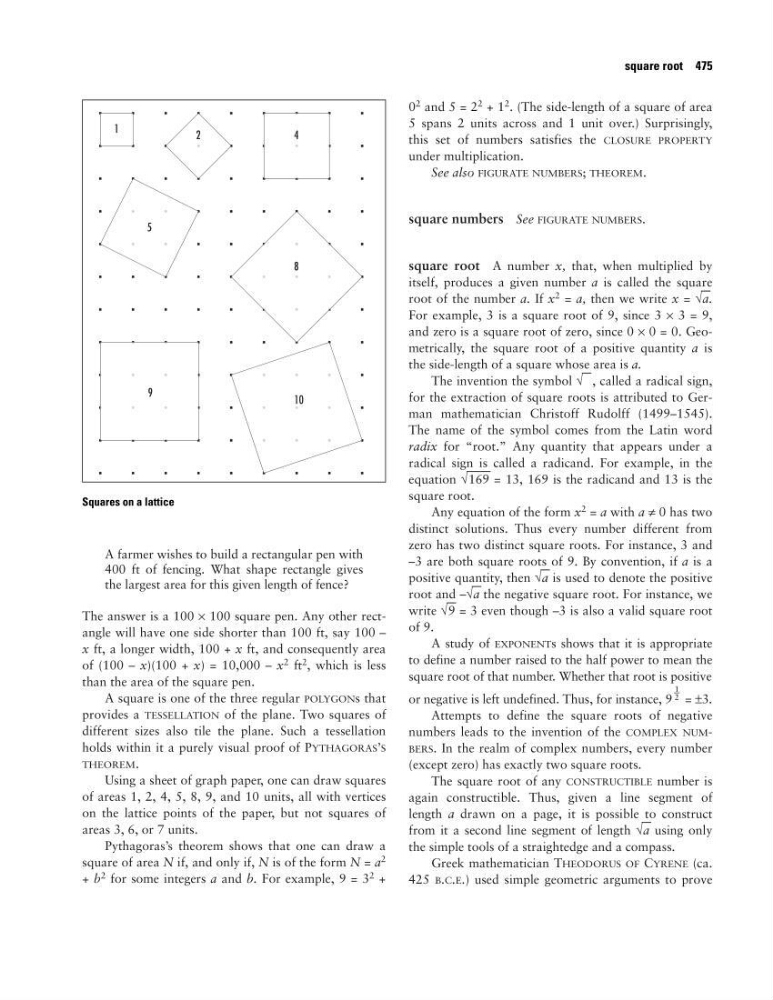
Using a sheet of graph paper, one can draw squares
of areas 1, 2, 4, 5, 8, 9, and 10 units, all with vertices
on the lattice points of the paper, but not squares of
areas 3, 6, or 7 units.
Pythagoras’s theorem shows that one can draw a
square of area N if, and only if, N is of the form N = a
2
+ b
2 for some integers a and b. For example, 9 = 3
2 +
0 2 and 5 = 2
2 + 1
2 . (The side-length of a square of area
5 spans 2 units across and 1 unit over.) Surprisingly,
this set of numbers satisfies the CLOSURE PROPERTY
under multiplication.
See also FIGURATE NUMBERS; THEOREM.
square numbers See FIGURATE NUMBERS.
square root A number x, that, when multiplied by
itself, produces a given number a is called the square
root of the number a. If x
2 = a, then we write x = √
–
a.
For example, 3 is a square root of 9, since 3 × 3 = 9,
and zero is a square root of zero, since 0 × 0 = 0. Geometrically, the square root of a positive quantity a is
the side-length of a square whose area is a.
The invention the symbol √
– , called a radical sign,
for the extraction of square roots is attributed to German mathematician Christoff Rudolff (1499–1545).
The name of the symbol comes from the Latin word
radix for “root.” Any quantity that appears under a
radical sign is called a radicand. For example, in the
equation √
–
169 = 13, 169 is the radicand and 13 is the
square root.
Any equation of the form x
2 = a with a ≠ 0 has two
distinct solutions. Thus every number different from
zero has two distinct square roots. For instance, 3 and
–3 are both square roots of 9. By convention, if a is a
positive quantity, then √
–
a is used to denote the positive
root and –√
–
a the negative square root. For instance, we
write √
–
9 = 3 even though –3 is also a valid square root
of 9.
A study of EXPONENTs shows that it is appropriate
to define a number raised to the half power to mean the
square root of that number. Whether that root is positive
or negative is left undefined. Thus, for instance, 9 = ±3.
Attempts to define the square roots of negative
numbers leads to the invention of the COMPLEX NUMBERS. In the realm of complex numbers, every number
(except zero) has exactly two square roots.
The square root of any CONSTRUCTIBLE number is
again constructible. Thus, given a line segment of
length a drawn on a page, it is possible to construct
from it a second line segment of length √
–
a using only
the simple tools of a straightedge and a compass.
Greek mathematician THEODORUS OF CYRENE (ca.
425 B.C.E.) used simple geometric arguments to prove
1
–
2
square root 475
Squares on a lattice
400 ft of fencing. What shape rectangle gives
the largest area for this given length of fence?
The answer is a 100 × 100 square pen. Any other rectangle will have one side shorter than 100 ft, say 100 –
x ft, a longer width, 100 + x ft, and consequently area
of (100 – x)(100 + x) = 10,000 – x
2 ft
2
, which is less
than the area of the square pen.
A square is one of the three regular POLYGONs that
provides a TESSELLATION of the plane. Two squares of
different sizes also tile the plane. Such a tessellation
holds within it a purely visual proof of PYTHAGORAS’S
THEOREM.
Using a sheet of graph paper, one can draw squares
of areas 1, 2, 4, 5, 8, 9, and 10 units, all with vertices
on the lattice points of the paper, but not squares of
areas 3, 6, or 7 units.
Pythagoras’s theorem shows that one can draw a
square of area N if, and only if, N is of the form N = a
2
+ b
2 for some integers a and b. For example, 9 = 3
2 +
0 2 and 5 = 2
2 + 1
2 . (The side-length of a square of area
5 spans 2 units across and 1 unit over.) Surprisingly,
this set of numbers satisfies the CLOSURE PROPERTY
under multiplication.
See also FIGURATE NUMBERS; THEOREM.
square numbers See FIGURATE NUMBERS.
square root A number x, that, when multiplied by
itself, produces a given number a is called the square
root of the number a. If x
2 = a, then we write x = √
–
a.
For example, 3 is a square root of 9, since 3 × 3 = 9,
and zero is a square root of zero, since 0 × 0 = 0. Geometrically, the square root of a positive quantity a is
the side-length of a square whose area is a.
The invention the symbol √
– , called a radical sign,
for the extraction of square roots is attributed to German mathematician Christoff Rudolff (1499–1545).
The name of the symbol comes from the Latin word
radix for “root.” Any quantity that appears under a
radical sign is called a radicand. For example, in the
equation √
–
169 = 13, 169 is the radicand and 13 is the
square root.
Any equation of the form x
2 = a with a ≠ 0 has two
distinct solutions. Thus every number different from
zero has two distinct square roots. For instance, 3 and
–3 are both square roots of 9. By convention, if a is a
positive quantity, then √
–
a is used to denote the positive
root and –√
–
a the negative square root. For instance, we
write √
–
9 = 3 even though –3 is also a valid square root
of 9.
A study of EXPONENTs shows that it is appropriate
to define a number raised to the half power to mean the
square root of that number. Whether that root is positive
or negative is left undefined. Thus, for instance, 9 = ±3.
Attempts to define the square roots of negative
numbers leads to the invention of the COMPLEX NUMBERS. In the realm of complex numbers, every number
(except zero) has exactly two square roots.
The square root of any CONSTRUCTIBLE number is
again constructible. Thus, given a line segment of
length a drawn on a page, it is possible to construct
from it a second line segment of length √
–
a using only
the simple tools of a straightedge and a compass.
Greek mathematician THEODORUS OF CYRENE (ca.
425 B.C.E.) used simple geometric arguments to prove
1
–
2
square root 475
Squares on a lattice