

Riemann and Klein proved that all but the fifth of
EUCLID’S POSTULATES hold in this model and, moreover,
that this model is consistent (that is, free of CONTRADICTIONs). This establishes that the parallel postulate
cannot be logically deduced as a consequence of the
remaining axioms proposed by Euclid.
In spherical geometry all angles in triangles sum to
more than 180°, and the ratio of the circumference of
any circle to its diameter is greater than π (and this
value varies from circle to circle).
See also EUCLIDEAN GEOMETRY; HYPERBOLIC GEOMETRY; PLAYFAIR’S AXIOM.
spherical triangle A three-sided figure on the surface
of a SPHERE bounded by the arcs of three great circles is
called a spherical triangle. Unlike plane triangles, the
angles in a spherical triangle do not sum to the constant value of 180°. In fact, the sum of angles is always
greater than 180° and can be as great as 540°. (This
occurs when all three sides of the spherical triangle lie
on the same great circle.)
A right spherical triangle has at least one right angle.
A birectangular triangle contains two right angles, and a
trirectangular triangle has three right angles. (For
instance, any triangle that connects the North Pole to
two points on the equator of the Earth is birectangular.
Such a triangle can also be trirectangular if the points on
the equator are positioned appropriately.) A spherical
triangle with no right angles is called oblique.
If the angles of a spherical triangle are A, B, and C,
measured in degrees, then the surface area of the triangle is given by the formula:
Here R is the radius of the sphere. The quantity A + B
+ C – 180, usually denoted E, is called the spherical
excess of the triangle. If the three side-lengths of the triangle are given by a, b, and c, then the spherical excess
can also be computed via the following remarkable formula discovered by Swiss mathematician Simon
Lhuilier (1750–1840):
spiral of Archimedes (Archimedean spiral) Studied
by the great ARCHIMEDES OF SYRACUSE (ca. 287–212
B.C.E.) in his work On Spirals, an Archimedean spiral is
the curve traced out by a point rotating about a fixed
point at a constant angular speed while moving away
from that point at a constant speed. (For example, it is
the path traced by a fly walking radially outward from
the center of a uniform rotating disc.) The equation of
such a spiral has a simple form in POLAR COORDINATES:
r = aθ
where a is a positive constant.
A curve given by an equation of the form r =
is
called a hyperbolic spiral. These curves were studied by
Johann Bernoulli of the famous BERNOULLI FAMILY.
Curves of the form
appear as tightly wrapped
spirals. A curve given by logr = aθ is called a logarithmic spiral.
See also GOLDEN RATIO.
square In geometry a square is a planar figure with
four equal straight sides and four interior right angles.
It is simultaneously a RECTANGLE, a PARALLELOGRAM,
and a rhombus.
A square with side-length x has AREA x × x = x
2
,
which explains the term squaring for the operation of
raising a number or a variable to the second power.
Squares are solutions to ISOPERIMETRIC PROBLEMS
of the following classic type:
r a n
= θ
1
a
–
θ
tan
tan(
)tan(
)tan(
)tan(
)
E
a b c
a b c
a b c
a b c
4
4
4
4
4
=
+ +
− + +
− +
+ −
area =
+ + −
(
)
πR A B C
2
180
180
474 spherical triangle
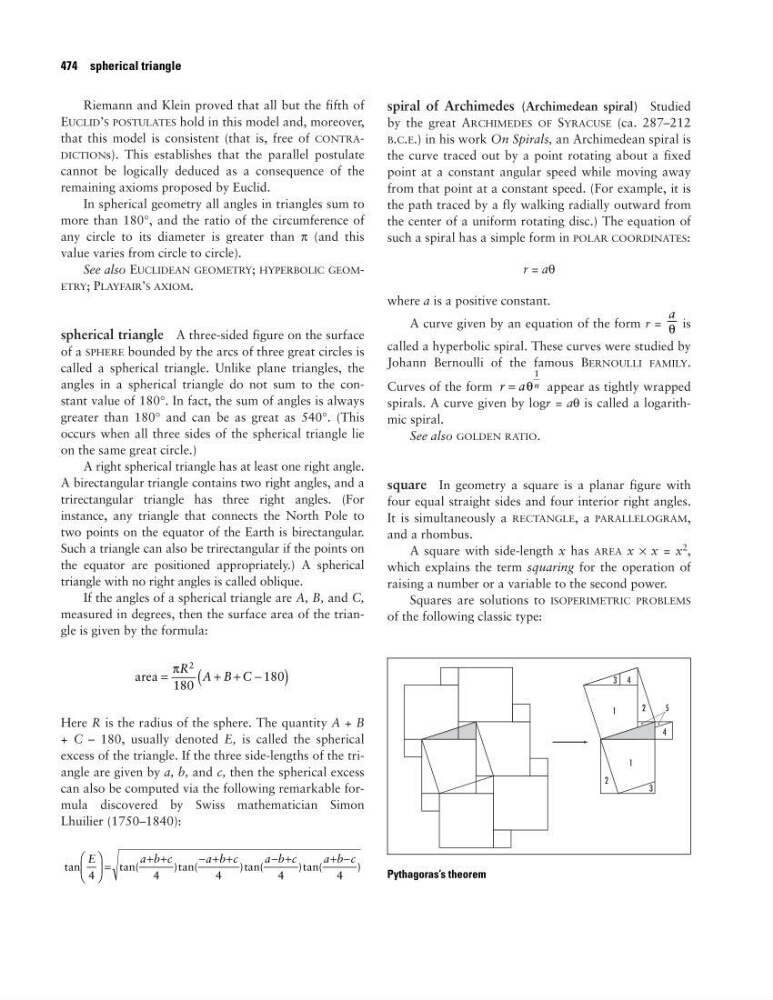
Pythagoras’s theorem
EUCLID’S POSTULATES hold in this model and, moreover,
that this model is consistent (that is, free of CONTRADICTIONs). This establishes that the parallel postulate
cannot be logically deduced as a consequence of the
remaining axioms proposed by Euclid.
In spherical geometry all angles in triangles sum to
more than 180°, and the ratio of the circumference of
any circle to its diameter is greater than π (and this
value varies from circle to circle).
See also EUCLIDEAN GEOMETRY; HYPERBOLIC GEOMETRY; PLAYFAIR’S AXIOM.
spherical triangle A three-sided figure on the surface
of a SPHERE bounded by the arcs of three great circles is
called a spherical triangle. Unlike plane triangles, the
angles in a spherical triangle do not sum to the constant value of 180°. In fact, the sum of angles is always
greater than 180° and can be as great as 540°. (This
occurs when all three sides of the spherical triangle lie
on the same great circle.)
A right spherical triangle has at least one right angle.
A birectangular triangle contains two right angles, and a
trirectangular triangle has three right angles. (For
instance, any triangle that connects the North Pole to
two points on the equator of the Earth is birectangular.
Such a triangle can also be trirectangular if the points on
the equator are positioned appropriately.) A spherical
triangle with no right angles is called oblique.
If the angles of a spherical triangle are A, B, and C,
measured in degrees, then the surface area of the triangle is given by the formula:
Here R is the radius of the sphere. The quantity A + B
+ C – 180, usually denoted E, is called the spherical
excess of the triangle. If the three side-lengths of the triangle are given by a, b, and c, then the spherical excess
can also be computed via the following remarkable formula discovered by Swiss mathematician Simon
Lhuilier (1750–1840):
spiral of Archimedes (Archimedean spiral) Studied
by the great ARCHIMEDES OF SYRACUSE (ca. 287–212
B.C.E.) in his work On Spirals, an Archimedean spiral is
the curve traced out by a point rotating about a fixed
point at a constant angular speed while moving away
from that point at a constant speed. (For example, it is
the path traced by a fly walking radially outward from
the center of a uniform rotating disc.) The equation of
such a spiral has a simple form in POLAR COORDINATES:
r = aθ
where a is a positive constant.
A curve given by an equation of the form r =
is
called a hyperbolic spiral. These curves were studied by
Johann Bernoulli of the famous BERNOULLI FAMILY.
Curves of the form
appear as tightly wrapped
spirals. A curve given by logr = aθ is called a logarithmic spiral.
See also GOLDEN RATIO.
square In geometry a square is a planar figure with
four equal straight sides and four interior right angles.
It is simultaneously a RECTANGLE, a PARALLELOGRAM,
and a rhombus.
A square with side-length x has AREA x × x = x
2
,
which explains the term squaring for the operation of
raising a number or a variable to the second power.
Squares are solutions to ISOPERIMETRIC PROBLEMS
of the following classic type:
r a n
= θ
1
a
–
θ
tan
tan(
)tan(
)tan(
)tan(
)
E
a b c
a b c
a b c
a b c
4
4
4
4
4
=
+ +
− + +
− +
+ −
area =
+ + −
(
)
πR A B C
2
180
180
474 spherical triangle
Pythagoras’s theorem