

described by three coordinates ρ,θ, and ϕ, called the
spherical coordinates of P, where ρ is the distance of P
from the origin O of a CARTESIAN COORDINATE system, θ
is the angle between the x-axis and the projection of the
line segment connecting O to P onto the xy-plane (measured in a counterclockwise sense from the x-axis), and ϕ
is the angle from the z-axis to the line segment connecting O to P. The angle θ, called the longitude, takes a
value between zero and 360°, and the angle ϕ, called the
colatitude, takes a value between zero and 180°. The
angles can also be presented in RADIAN MEASURE.
Spherical coordinates are useful for describing surfaces with spherical symmetry about the origin. For
example, the equation of a sphere of radius 5 is simply
ρ = 5. (As the angles θ and ϕ vary in their allowed
ranges, the points of a sphere are described.) The surface defined by the equation θ = c, for some constant c
(allowing ρ and ϕ to vary), is a vertical HALF-PLANE
with one side along the z-axis, and the surface ϕ = c is
one nappe of a right circular CONE.
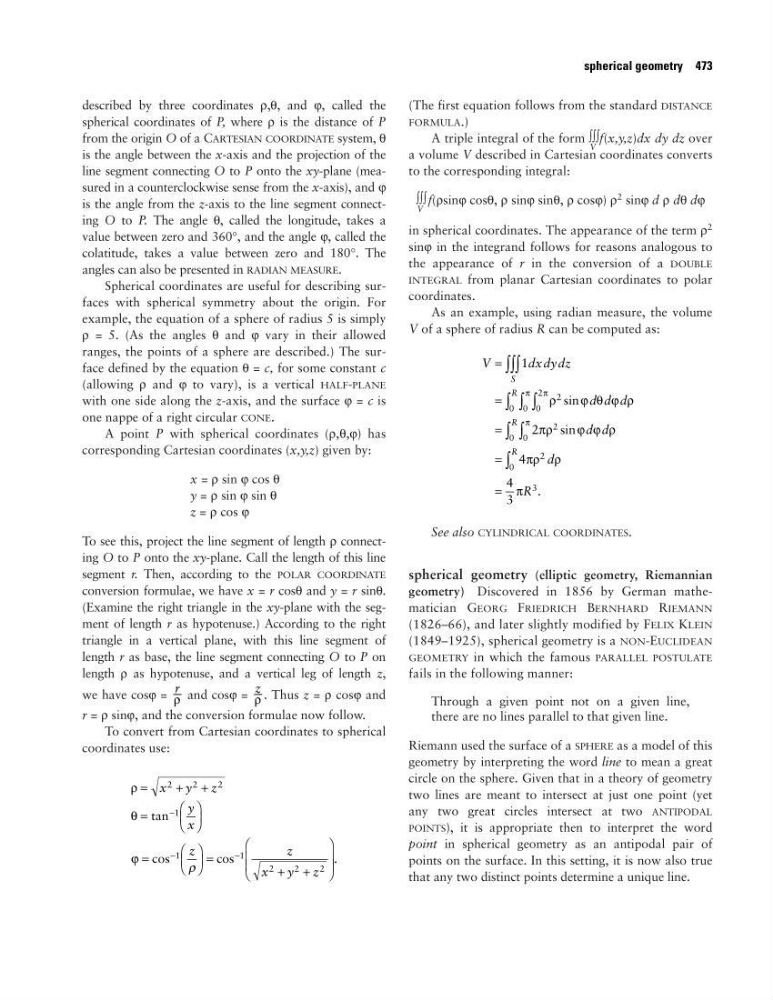
A point P with spherical coordinates (ρ,θ,ϕ) has
corresponding Cartesian coordinates (x,y,z) given by:
x = ρ sin ϕ cos θ
y = ρ sin ϕ sin θ
z = ρ cos ϕ
To see this, project the line segment of length ρ connecting O to P onto the xy-plane. Call the length of this line
segment r. Then, according to the POLAR COORDINATE
conversion formulae, we have x = r cosθ and y = r sinθ.
(Examine the right triangle in the xy-plane with the segment of length r as hypotenuse.) According to the right
triangle in a vertical plane, with this line segment of
length r as base, the line segment connecting O to P on
length ρ as hypotenuse, and a vertical leg of length z,
we have cosϕ =
and cosϕ = . Thus z = ρ cosϕ and
r = ρ sinϕ, and the conversion formulae now follow.
To convert from Cartesian coordinates to spherical
coordinates use:
(The first equation follows from the standard DISTANCE
FORMULA.)
A triple integral of the form ∫∫
V
∫f(x,y,z)dx dy dz over
a volume V described in Cartesian coordinates converts
to the corresponding integral:
∫∫
V
∫f(ρsinϕ cosθ, ρ sinϕ sinθ, ρ cosϕ) ρ
2 sinϕ d ρ dθ dϕ
in spherical coordinates. The appearance of the term ρ
2
sinϕ in the integrand follows for reasons analogous to
the appearance of r in the conversion of a DOUBLE
INTEGRAL from planar Cartesian coordinates to polar
coordinates.
As an example, using radian measure, the volume
V of a sphere of radius R can be computed as:
See also CYLINDRICAL COORDINATES.
spherical geometry (elliptic geometry, Riemannian
geometry) Discovered in 1856 by German mathematician GEORG FRIEDRICH BERNHARD RIEMANN
(1826–66), and later slightly modified by FELIX KLEIN
(1849–1925), spherical geometry is a NON-EUCLIDEAN
GEOMETRY in which the famous PARALLEL POSTULATE
fails in the following manner:
Through a given point not on a given line,
there are no lines parallel to that given line.
Riemann used the surface of a SPHERE as a model of this
geometry by interpreting the word line to mean a great
circle on the sphere. Given that in a theory of geometry
two lines are meant to intersect at just one point (yet
any two great circles intersect at two ANTIPODAL
POINTS), it is appropriate then to interpret the word
point in spherical geometry as an antipodal pair of
points on the surface. In this setting, it is now also true
that any two distinct points determine a unique line.
V
dxdydz
d d d
d d
d
R
S
R
R
R
=
=
=
=
=
∫∫∫
∫
∫
∫
∫
∫
∫
1
2
4
4
3
2
0
2
0
0
2
0
0
2
0
3
ρ
ϕ θ ϕ ρ
πρ
ϕ ϕ ρ
πρ ρ
π
π
π
π
sin
sin
.
ρ
θ
ϕ
=
+ +
=
=
=
+ +
−
−
−
x y
z
y
x
z
z
x y
z
2
2
2
1
1
1
2
2
2
tan
cos
cos
.
ρ
z
– ρ
r
– ρ
spherical geometry 473
spherical coordinates of P, where ρ is the distance of P
from the origin O of a CARTESIAN COORDINATE system, θ
is the angle between the x-axis and the projection of the
line segment connecting O to P onto the xy-plane (measured in a counterclockwise sense from the x-axis), and ϕ
is the angle from the z-axis to the line segment connecting O to P. The angle θ, called the longitude, takes a
value between zero and 360°, and the angle ϕ, called the
colatitude, takes a value between zero and 180°. The
angles can also be presented in RADIAN MEASURE.
Spherical coordinates are useful for describing surfaces with spherical symmetry about the origin. For
example, the equation of a sphere of radius 5 is simply
ρ = 5. (As the angles θ and ϕ vary in their allowed
ranges, the points of a sphere are described.) The surface defined by the equation θ = c, for some constant c
(allowing ρ and ϕ to vary), is a vertical HALF-PLANE
with one side along the z-axis, and the surface ϕ = c is
one nappe of a right circular CONE.
A point P with spherical coordinates (ρ,θ,ϕ) has
corresponding Cartesian coordinates (x,y,z) given by:
x = ρ sin ϕ cos θ
y = ρ sin ϕ sin θ
z = ρ cos ϕ
To see this, project the line segment of length ρ connecting O to P onto the xy-plane. Call the length of this line
segment r. Then, according to the POLAR COORDINATE
conversion formulae, we have x = r cosθ and y = r sinθ.
(Examine the right triangle in the xy-plane with the segment of length r as hypotenuse.) According to the right
triangle in a vertical plane, with this line segment of
length r as base, the line segment connecting O to P on
length ρ as hypotenuse, and a vertical leg of length z,
we have cosϕ =
and cosϕ = . Thus z = ρ cosϕ and
r = ρ sinϕ, and the conversion formulae now follow.
To convert from Cartesian coordinates to spherical
coordinates use:
(The first equation follows from the standard DISTANCE
FORMULA.)
A triple integral of the form ∫∫
V
∫f(x,y,z)dx dy dz over
a volume V described in Cartesian coordinates converts
to the corresponding integral:
∫∫
V
∫f(ρsinϕ cosθ, ρ sinϕ sinθ, ρ cosϕ) ρ
2 sinϕ d ρ dθ dϕ
in spherical coordinates. The appearance of the term ρ
2
sinϕ in the integrand follows for reasons analogous to
the appearance of r in the conversion of a DOUBLE
INTEGRAL from planar Cartesian coordinates to polar
coordinates.
As an example, using radian measure, the volume
V of a sphere of radius R can be computed as:
See also CYLINDRICAL COORDINATES.
spherical geometry (elliptic geometry, Riemannian
geometry) Discovered in 1856 by German mathematician GEORG FRIEDRICH BERNHARD RIEMANN
(1826–66), and later slightly modified by FELIX KLEIN
(1849–1925), spherical geometry is a NON-EUCLIDEAN
GEOMETRY in which the famous PARALLEL POSTULATE
fails in the following manner:
Through a given point not on a given line,
there are no lines parallel to that given line.
Riemann used the surface of a SPHERE as a model of this
geometry by interpreting the word line to mean a great
circle on the sphere. Given that in a theory of geometry
two lines are meant to intersect at just one point (yet
any two great circles intersect at two ANTIPODAL
POINTS), it is appropriate then to interpret the word
point in spherical geometry as an antipodal pair of
points on the surface. In this setting, it is now also true
that any two distinct points determine a unique line.
V
dxdydz
d d d
d d
d
R
S
R
R
R
=
=
=
=
=
∫∫∫
∫
∫
∫
∫
∫
∫
1
2
4
4
3
2
0
2
0
0
2
0
0
2
0
3
ρ
ϕ θ ϕ ρ
πρ
ϕ ϕ ρ
πρ ρ
π
π
π
π
sin
sin
.
ρ
θ
ϕ
=
+ +
=
=
=
+ +
−
−
−
x y
z
y
x
z
z
x y
z
2
2
2
1
1
1
2
2
2
tan
cos
cos
.
ρ
z
– ρ
r
– ρ
spherical geometry 473