

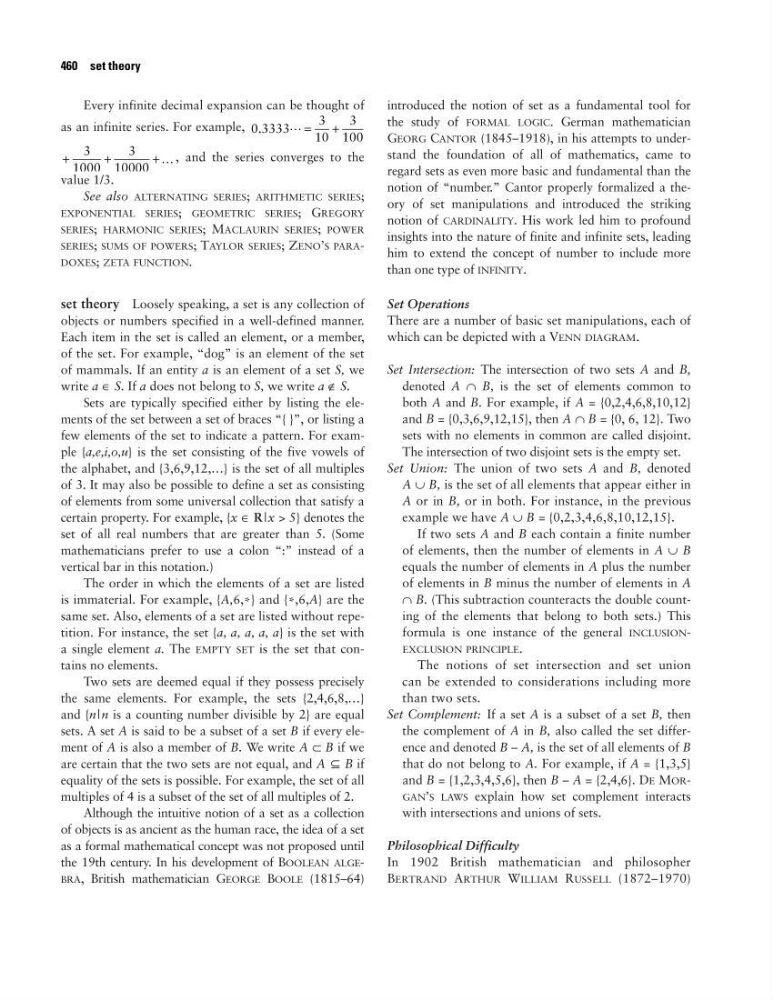
Every infinite decimal expansion can be thought of
as an infinite series. For example,
, and the series converges to the
value 1/3.
See also ALTERNATING SERIES; ARITHMETIC SERIES;
EXPONENTIAL SERIES; GEOMETRIC SERIES; GREGORY
SERIES; HARMONIC SERIES; MACLAURIN SERIES; POWER
SERIES; SUMS OF POWERS; TAYLOR SERIES; ZENO’S PARADOXES; ZETA FUNCTION.
set theory Loosely speaking, a set is any collection of
objects or numbers specified in a well-defined manner.
Each item in the set is called an element, or a member,
of the set. For example, “dog” is an element of the set
of mammals. If an entity a is an element of a set S, we
write a ∈ S. If a does not belong to S, we write a ∉ S.
Sets are typically specified either by listing the elements of the set between a set of braces “{ }”, or listing a
few elements of the set to indicate a pattern. For example {a,e,i,o,u} is the set consisting of the five vowels of
the alphabet, and {3,6,9,12,…} is the set of all multiples
of 3. It may also be possible to define a set as consisting
of elements from some universal collection that satisfy a
certain property. For example, {x ∈ R|x > 5} denotes the
set of all real numbers that are greater than 5. (Some
mathematicians prefer to use a colon “:” instead of a
vertical bar in this notation.)
The order in which the elements of a set are listed
is immaterial. For example, {A,6, * } and { * ,6,A} are the
same set. Also, elements of a set are listed without repetition. For instance, the set {a, a, a, a, a} is the set with
a single element a. The EMPTY SET is the set that contains no elements.
Two sets are deemed equal if they possess precisely
the same elements. For example, the sets {2,4,6,8,…}
and {n|n is a counting number divisible by 2} are equal
sets. A set A is said to be a subset of a set B if every element of A is also a member of B. We write A ⊂ B if we
are certain that the two sets are not equal, and A
B if
equality of the sets is possible. For example, the set of all
multiples of 4 is a subset of the set of all multiples of 2.
Although the intuitive notion of a set as a collection
of objects is as ancient as the human race, the idea of a set
as a formal mathematical concept was not proposed until
the 19th century. In his development of BOOLEAN ALGEBRA, British mathematician GEORGE BOOLE (1815–64)
introduced the notion of set as a fundamental tool for
the study of FORMAL LOGIC. German mathematician
GEORG CANTOR (1845–1918), in his attempts to understand the foundation of all of mathematics, came to
regard sets as even more basic and fundamental than the
notion of “number.” Cantor properly formalized a theory of set manipulations and introduced the striking
notion of CARDINALITY. His work led him to profound
insights into the nature of finite and infinite sets, leading
him to extend the concept of number to include more
than one type of INFINITY.
Set Operations
There are a number of basic set manipulations, each of
which can be depicted with a VENN DIAGRAM.
Set Intersection: The intersection of two sets A and B,
denoted A ∩ B, is the set of elements common to
both A and B. For example, if A = {0,2,4,6,8,10,12}
and B = {0,3,6,9,12,15}, then A ∩ B = {0, 6, 12}. Two
sets with no elements in common are called disjoint.
The intersection of two disjoint sets is the empty set.
Set Union: The union of two sets A and B, denoted
A ∪ B, is the set of all elements that appear either in
A or in B, or in both. For instance, in the previous
example we have A ∪ B = {0,2,3,4,6,8,10,12,15}.
If two sets A and B each contain a finite number
of elements, then the number of elements in A ∪ B
equals the number of elements in A plus the number
of elements in B minus the number of elements in A
∩ B. (This subtraction counteracts the double counting of the elements that belong to both sets.) This
formula is one instance of the general INCLUSIONEXCLUSION PRINCIPLE.
The notions of set intersection and set union
can be extended to considerations including more
than two sets.
Set Complement: If a set A is a subset of a set B, then
the complement of A in B, also called the set difference and denoted B – A, is the set of all elements of B
that do not belong to A. For example, if A = {1,3,5}
and B = {1,2,3,4,5,6}, then B – A = {2,4,6}. DE MORGAN’S LAWS explain how set complement interacts
with intersections and unions of sets.
Philosophical Difficulty
In 1902 British mathematician and philosopher
BERTRAND ARTHUR WILLIAM RUSSELL (1872–1970)
⊇
3
1000
3
10000 L
+
+
+
0 3333
3
10
3
100
.
L =
+
460 set theory
as an infinite series. For example,
, and the series converges to the
value 1/3.
See also ALTERNATING SERIES; ARITHMETIC SERIES;
EXPONENTIAL SERIES; GEOMETRIC SERIES; GREGORY
SERIES; HARMONIC SERIES; MACLAURIN SERIES; POWER
SERIES; SUMS OF POWERS; TAYLOR SERIES; ZENO’S PARADOXES; ZETA FUNCTION.
set theory Loosely speaking, a set is any collection of
objects or numbers specified in a well-defined manner.
Each item in the set is called an element, or a member,
of the set. For example, “dog” is an element of the set
of mammals. If an entity a is an element of a set S, we
write a ∈ S. If a does not belong to S, we write a ∉ S.
Sets are typically specified either by listing the elements of the set between a set of braces “{ }”, or listing a
few elements of the set to indicate a pattern. For example {a,e,i,o,u} is the set consisting of the five vowels of
the alphabet, and {3,6,9,12,…} is the set of all multiples
of 3. It may also be possible to define a set as consisting
of elements from some universal collection that satisfy a
certain property. For example, {x ∈ R|x > 5} denotes the
set of all real numbers that are greater than 5. (Some
mathematicians prefer to use a colon “:” instead of a
vertical bar in this notation.)
The order in which the elements of a set are listed
is immaterial. For example, {A,6, * } and { * ,6,A} are the
same set. Also, elements of a set are listed without repetition. For instance, the set {a, a, a, a, a} is the set with
a single element a. The EMPTY SET is the set that contains no elements.
Two sets are deemed equal if they possess precisely
the same elements. For example, the sets {2,4,6,8,…}
and {n|n is a counting number divisible by 2} are equal
sets. A set A is said to be a subset of a set B if every element of A is also a member of B. We write A ⊂ B if we
are certain that the two sets are not equal, and A
B if
equality of the sets is possible. For example, the set of all
multiples of 4 is a subset of the set of all multiples of 2.
Although the intuitive notion of a set as a collection
of objects is as ancient as the human race, the idea of a set
as a formal mathematical concept was not proposed until
the 19th century. In his development of BOOLEAN ALGEBRA, British mathematician GEORGE BOOLE (1815–64)
introduced the notion of set as a fundamental tool for
the study of FORMAL LOGIC. German mathematician
GEORG CANTOR (1845–1918), in his attempts to understand the foundation of all of mathematics, came to
regard sets as even more basic and fundamental than the
notion of “number.” Cantor properly formalized a theory of set manipulations and introduced the striking
notion of CARDINALITY. His work led him to profound
insights into the nature of finite and infinite sets, leading
him to extend the concept of number to include more
than one type of INFINITY.
Set Operations
There are a number of basic set manipulations, each of
which can be depicted with a VENN DIAGRAM.
Set Intersection: The intersection of two sets A and B,
denoted A ∩ B, is the set of elements common to
both A and B. For example, if A = {0,2,4,6,8,10,12}
and B = {0,3,6,9,12,15}, then A ∩ B = {0, 6, 12}. Two
sets with no elements in common are called disjoint.
The intersection of two disjoint sets is the empty set.
Set Union: The union of two sets A and B, denoted
A ∪ B, is the set of all elements that appear either in
A or in B, or in both. For instance, in the previous
example we have A ∪ B = {0,2,3,4,6,8,10,12,15}.
If two sets A and B each contain a finite number
of elements, then the number of elements in A ∪ B
equals the number of elements in A plus the number
of elements in B minus the number of elements in A
∩ B. (This subtraction counteracts the double counting of the elements that belong to both sets.) This
formula is one instance of the general INCLUSIONEXCLUSION PRINCIPLE.
The notions of set intersection and set union
can be extended to considerations including more
than two sets.
Set Complement: If a set A is a subset of a set B, then
the complement of A in B, also called the set difference and denoted B – A, is the set of all elements of B
that do not belong to A. For example, if A = {1,3,5}
and B = {1,2,3,4,5,6}, then B – A = {2,4,6}. DE MORGAN’S LAWS explain how set complement interacts
with intersections and unions of sets.
Philosophical Difficulty
In 1902 British mathematician and philosopher
BERTRAND ARTHUR WILLIAM RUSSELL (1872–1970)
⊇
3
1000
3
10000 L
+
+
+
0 3333
3
10
3
100
.
L =
+
460 set theory