

stunned the mathematical community with his construction of a simple paradox, today called RUSSELL’S
PARADOX, that shows that our naïve understanding of
the notion of set is fundamentally flawed. Although
Cantor believed that set theory is the foundation on
which all of mathematics is built, it became clear to
mathematicians that the concept of a set and what it
means to be an “element of” must remain as undefined terms. In the decades that followed, mathematicians such as ERNST FRIEDRICH FERDINAND ZERMELO
(1871–1953) attempted to develop an axiomatic theory of sets (based on undefined terms) that successfully avoids Russell’s paradox. To this day, not all
mathematicians agree that this goal has yet been
achieved.
See also ARGUMENT; AXIOM OF CHOICE; CARDINALITY; CARTESIAN PRODUCT; DIFFERENCE; FINITE.
seven bridges of Königsberg problem See GRAPH
THEORY.
sexagesimal See BASE OF A NUMBER SYSTEM.
Shanks, William (1812–1882) British Computation
Born on January 25, 1812, in Northumberland, England, William Shanks is remembered for extraordinarily accurate computations of mathematical constants,
all done by hand. Shanks evaluated the natural LOGARITHMs of the numbers 2, 3, 5, and 10, each to 137
decimal places, published a table of all the prime numbers up to 60,000, and evaluated all the powers of two
of the form 2
12n+1 for n from 1 to 60. He also evaluated e and EULER’S CONSTANT γ to a large number of
decimal places, but he is best remembered for his computation of π to many hundreds of decimal places. He
published this result in 1873.
Little is known of Shanks’s life. His methods of
computation were essentially nothing more than a
matter of patience and BRUTE FORCE. For example,
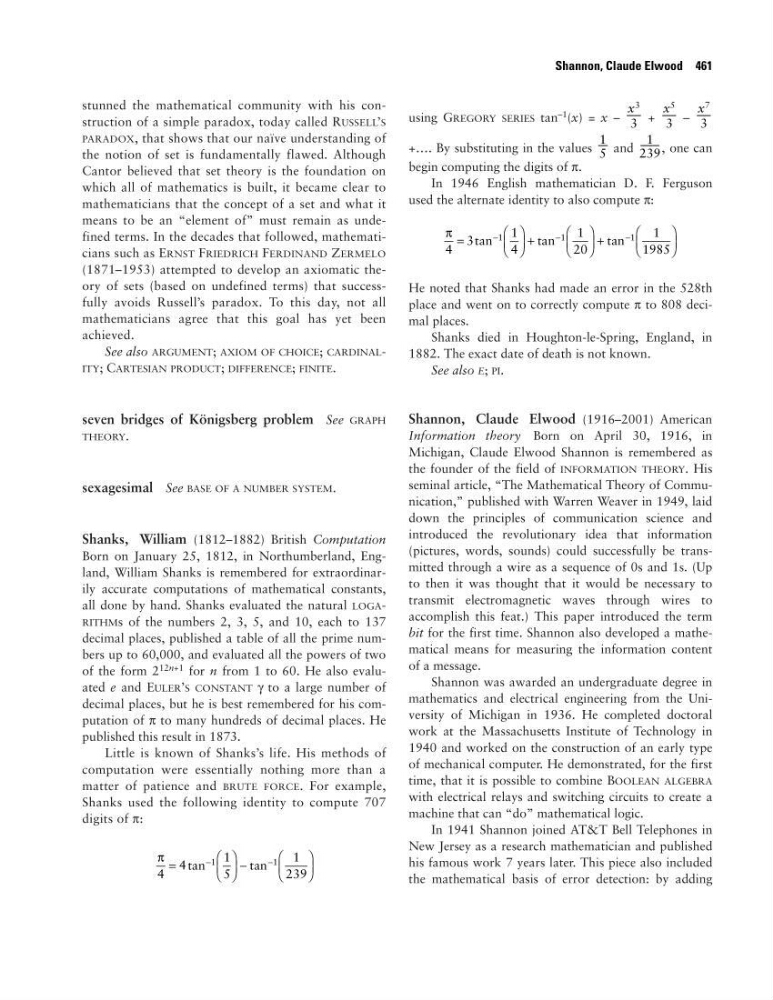
Shanks used the following identity to compute 707
digits of π:
using GREGORY SERIES tan
–1 (x) = x –
+
–
+…. By substituting in the values
and
, one can
begin computing the digits of π.
In 1946 English mathematician D. F. Ferguson
used the alternate identity to also compute π:
He noted that Shanks had made an error in the 528th
place and went on to correctly compute π to 808 decimal places.
Shanks died in Houghton-le-Spring, England, in
1882. The exact date of death is not known.
See also E; PI.
Shannon, Claude Elwood (1916–2001) American
Information theory Born on April 30, 1916, in
Michigan, Claude Elwood Shannon is remembered as
the founder of the field of INFORMATION THEORY. His
seminal article, “The Mathematical Theory of Communication,” published with Warren Weaver in 1949, laid
down the principles of communication science and
introduced the revolutionary idea that information
(pictures, words, sounds) could successfully be transmitted through a wire as a sequence of 0s and 1s. (Up
to then it was thought that it would be necessary to
transmit electromagnetic waves through wires to
accomplish this feat.) This paper introduced the term
bit for the first time. Shannon also developed a mathematical means for measuring the information content
of a message.
Shannon was awarded an undergraduate degree in
mathematics and electrical engineering from the University of Michigan in 1936. He completed doctoral
work at the Massachusetts Institute of Technology in
1940 and worked on the construction of an early type
of mechanical computer. He demonstrated, for the first
time, that it is possible to combine BOOLEAN ALGEBRA
with electrical relays and switching circuits to create a
machine that can “do” mathematical logic.
In 1941 Shannon joined AT&T Bell Telephones in
New Jersey as a research mathematician and published
his famous work 7 years later. This piece also included
the mathematical basis of error detection: by adding
π
4
3
1
4
1
20
1
1985
1
1
1
=
+
+
−
−
−
tan
tan
tan
1
––
239
1
–
5
x
7
––
3
x
5
––
3
x
3
––
3
π
4
4
1
5
1
239
1
1
=
−
−
−
tan
tan
Shannon, Claude Elwood 461
PARADOX, that shows that our naïve understanding of
the notion of set is fundamentally flawed. Although
Cantor believed that set theory is the foundation on
which all of mathematics is built, it became clear to
mathematicians that the concept of a set and what it
means to be an “element of” must remain as undefined terms. In the decades that followed, mathematicians such as ERNST FRIEDRICH FERDINAND ZERMELO
(1871–1953) attempted to develop an axiomatic theory of sets (based on undefined terms) that successfully avoids Russell’s paradox. To this day, not all
mathematicians agree that this goal has yet been
achieved.
See also ARGUMENT; AXIOM OF CHOICE; CARDINALITY; CARTESIAN PRODUCT; DIFFERENCE; FINITE.
seven bridges of Königsberg problem See GRAPH
THEORY.
sexagesimal See BASE OF A NUMBER SYSTEM.
Shanks, William (1812–1882) British Computation
Born on January 25, 1812, in Northumberland, England, William Shanks is remembered for extraordinarily accurate computations of mathematical constants,
all done by hand. Shanks evaluated the natural LOGARITHMs of the numbers 2, 3, 5, and 10, each to 137
decimal places, published a table of all the prime numbers up to 60,000, and evaluated all the powers of two
of the form 2
12n+1 for n from 1 to 60. He also evaluated e and EULER’S CONSTANT γ to a large number of
decimal places, but he is best remembered for his computation of π to many hundreds of decimal places. He
published this result in 1873.
Little is known of Shanks’s life. His methods of
computation were essentially nothing more than a
matter of patience and BRUTE FORCE. For example,
Shanks used the following identity to compute 707
digits of π:
using GREGORY SERIES tan
–1 (x) = x –
+
–
+…. By substituting in the values
and
, one can
begin computing the digits of π.
In 1946 English mathematician D. F. Ferguson
used the alternate identity to also compute π:
He noted that Shanks had made an error in the 528th
place and went on to correctly compute π to 808 decimal places.
Shanks died in Houghton-le-Spring, England, in
1882. The exact date of death is not known.
See also E; PI.
Shannon, Claude Elwood (1916–2001) American
Information theory Born on April 30, 1916, in
Michigan, Claude Elwood Shannon is remembered as
the founder of the field of INFORMATION THEORY. His
seminal article, “The Mathematical Theory of Communication,” published with Warren Weaver in 1949, laid
down the principles of communication science and
introduced the revolutionary idea that information
(pictures, words, sounds) could successfully be transmitted through a wire as a sequence of 0s and 1s. (Up
to then it was thought that it would be necessary to
transmit electromagnetic waves through wires to
accomplish this feat.) This paper introduced the term
bit for the first time. Shannon also developed a mathematical means for measuring the information content
of a message.
Shannon was awarded an undergraduate degree in
mathematics and electrical engineering from the University of Michigan in 1936. He completed doctoral
work at the Massachusetts Institute of Technology in
1940 and worked on the construction of an early type
of mechanical computer. He demonstrated, for the first
time, that it is possible to combine BOOLEAN ALGEBRA
with electrical relays and switching circuits to create a
machine that can “do” mathematical logic.
In 1941 Shannon joined AT&T Bell Telephones in
New Jersey as a research mathematician and published
his famous work 7 years later. This piece also included
the mathematical basis of error detection: by adding
π
4
3
1
4
1
20
1
1985
1
1
1
=
+
+
−
−
−
tan
tan
tan
1
––
239
1
–
5
x
7
––
3
x
5
––
3
x
3
––
3
π
4
4
1
5
1
239
1
1
=
−
−
−
tan
tan
Shannon, Claude Elwood 461