

numbers. (For instance, √
–
2 is the limit of the sequence 1,
1.4, 1.41, 1.414, 1.4142,…) As such, it is possible to
define a quantity raised to an irrational power as a limit
of rational powers, which are well defined. (For example,
3
√
–
2 is the limit of the sequence
.) Any infinite sum that is a SERIES can be
thought of as a LIMIT of a sequence of PARTIAL SUMs,
and any INFINITE PRODUCT can be considered to be the
limit of a sequence of partial products.
See also ARITHMETIC SEQUENCE; BOUND; GEOMETRIC SEQUENCE; HARMONIC SEQUENCE.
series A sum of numbers is called a series. The sum
could be finite, such as 2 + 4 + 6 + 8 + 10, for example,
or it could be an infinite sum, as for 2 + 5 + 8 + 11 +
14 + … for instance. Each number in the sum is called
a term of the series.
In 1755 LEONHARD EULER introduced use of the
Greek letter sigma Σ (S for “sum”) to abbreviate the
writing of a series. For example, the sum of the first
five even numbers can be written
and the sum of
all numbers 1 less than a multiple of three as
.
(See SUMMATION.)
There are no conceptual difficulties with the notion
of summing just a finite collection of numbers. However, understanding what we mean by an infinite sum is
a delicate matter—such sums can exhibit very different
characters. Some series clearly do not add to a finite
value (as for 2 + 5 + 8 + 11 + 14, …, for example),
whereas one could argue that other infinite series do.
(The act of walking from one side of the room to the
other, for instance, suggests that the series
+
+
+
+
+… “adds” to the value 1: first walk
halfway across the room, and then half the remaining
distance, and then the half the distance that remains,
and so on.)
In some cases the situation is not at all clear. For
example, the series 1 – 1 + 1 – 1 + 1 – 1 + … of positive
and negative terms seems to oscillate: an even number
of terms add to zero, an odd number to 1, and it does
not seem possible to assign a single sum to this series.
(Some mathematicians in the past argued that the sum
of this series should be
1
/ 2 , a value between zero and 1.)
These different behaviors of infinite series caused
scholars much confusion over the centuries. Matters
were not properly resolved until AUGUSTIN-LOUIS
CAUCHY (1789–1857) introduced the notion of a
LIMIT, and was able to apply it to the study of infinite
sums. Today we say that an infinite series
= a 1 +
a 2 + a 3 +… converges to a finite value L if the SEQUENCE
of PARTIAL SUMS:
S 1 = a 1
S 2 = a 1 + a 2
S 3 = a 1 + a 2 + a 3
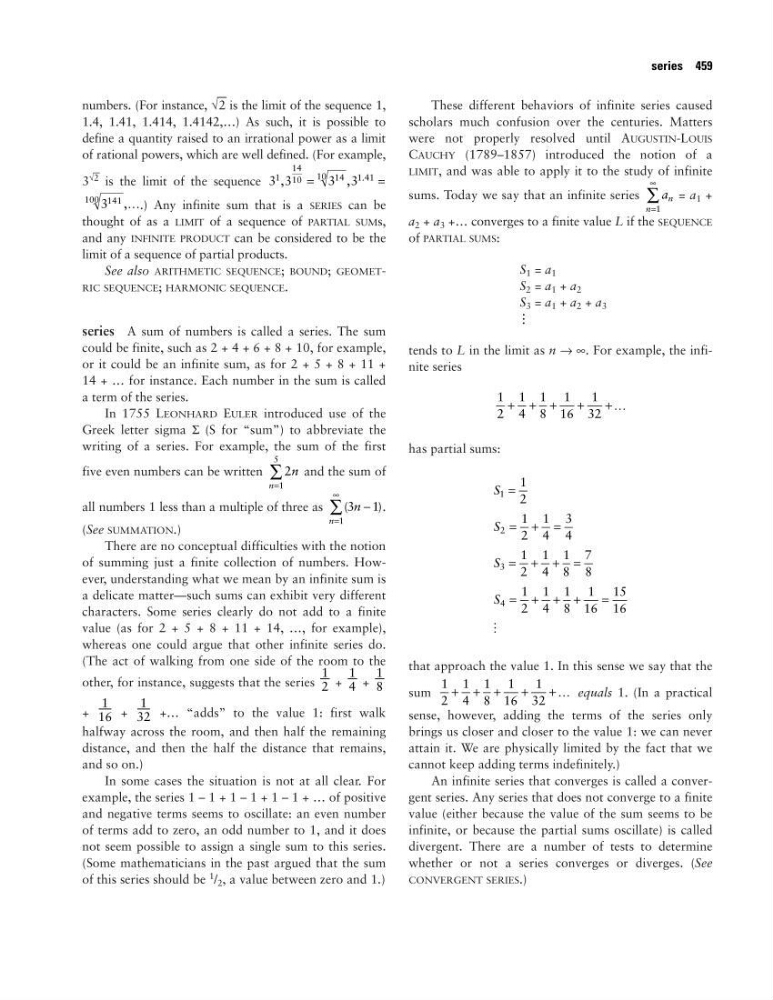
tends to L in the limit as n → ∞. For example, the infinite series
has partial sums:
that approach the value 1. In this sense we say that the
sum
equals 1. (In a practical
sense, however, adding the terms of the series only
brings us closer and closer to the value 1: we can never
attain it. We are physically limited by the fact that we
cannot keep adding terms indefinitely.)
An infinite series that converges is called a convergent series. Any series that does not converge to a finite
value (either because the value of the sum seems to be
infinite, or because the partial sums oscillate) is called
divergent. There are a number of tests to determine
whether or not a series converges or diverges. (See
CONVERGENT SERIES.)
1
2
1
4
1
8
1
16
1
32
+ + +
+
+ L
S
S
S
S
1
2
3
4
1
2
1
2
1
4
3
4
1
2
1
4
1
8
7
8
1
2
1
4
1
8
1
16
15
16
=
= + =
= + + =
= + + +
=
M
1
2
1
4
1
8
1
16
1
32
+ + +
+
+ L
…
a n
n=
∞
∑
1
1
–
32
1
–
16
1
–
8
1
–
4
1
–
2
(
)
3 1
1
n
n
−
=
∞
∑
2
1
5
n
n=
∑
3
141
100
,K
3 3
3 3
1
14
10
14
10
1 41
,
,
.
=
=
series 459
–
2 is the limit of the sequence 1,
1.4, 1.41, 1.414, 1.4142,…) As such, it is possible to
define a quantity raised to an irrational power as a limit
of rational powers, which are well defined. (For example,
3
√
–
2 is the limit of the sequence
.) Any infinite sum that is a SERIES can be
thought of as a LIMIT of a sequence of PARTIAL SUMs,
and any INFINITE PRODUCT can be considered to be the
limit of a sequence of partial products.
See also ARITHMETIC SEQUENCE; BOUND; GEOMETRIC SEQUENCE; HARMONIC SEQUENCE.
series A sum of numbers is called a series. The sum
could be finite, such as 2 + 4 + 6 + 8 + 10, for example,
or it could be an infinite sum, as for 2 + 5 + 8 + 11 +
14 + … for instance. Each number in the sum is called
a term of the series.
In 1755 LEONHARD EULER introduced use of the
Greek letter sigma Σ (S for “sum”) to abbreviate the
writing of a series. For example, the sum of the first
five even numbers can be written
and the sum of
all numbers 1 less than a multiple of three as
.
(See SUMMATION.)
There are no conceptual difficulties with the notion
of summing just a finite collection of numbers. However, understanding what we mean by an infinite sum is
a delicate matter—such sums can exhibit very different
characters. Some series clearly do not add to a finite
value (as for 2 + 5 + 8 + 11 + 14, …, for example),
whereas one could argue that other infinite series do.
(The act of walking from one side of the room to the
other, for instance, suggests that the series
+
+
+
+
+… “adds” to the value 1: first walk
halfway across the room, and then half the remaining
distance, and then the half the distance that remains,
and so on.)
In some cases the situation is not at all clear. For
example, the series 1 – 1 + 1 – 1 + 1 – 1 + … of positive
and negative terms seems to oscillate: an even number
of terms add to zero, an odd number to 1, and it does
not seem possible to assign a single sum to this series.
(Some mathematicians in the past argued that the sum
of this series should be
1
/ 2 , a value between zero and 1.)
These different behaviors of infinite series caused
scholars much confusion over the centuries. Matters
were not properly resolved until AUGUSTIN-LOUIS
CAUCHY (1789–1857) introduced the notion of a
LIMIT, and was able to apply it to the study of infinite
sums. Today we say that an infinite series
= a 1 +
a 2 + a 3 +… converges to a finite value L if the SEQUENCE
of PARTIAL SUMS:
S 1 = a 1
S 2 = a 1 + a 2
S 3 = a 1 + a 2 + a 3
tends to L in the limit as n → ∞. For example, the infinite series
has partial sums:
that approach the value 1. In this sense we say that the
sum
equals 1. (In a practical
sense, however, adding the terms of the series only
brings us closer and closer to the value 1: we can never
attain it. We are physically limited by the fact that we
cannot keep adding terms indefinitely.)
An infinite series that converges is called a convergent series. Any series that does not converge to a finite
value (either because the value of the sum seems to be
infinite, or because the partial sums oscillate) is called
divergent. There are a number of tests to determine
whether or not a series converges or diverges. (See
CONVERGENT SERIES.)
1
2
1
4
1
8
1
16
1
32
+ + +
+
+ L
S
S
S
S
1
2
3
4
1
2
1
2
1
4
3
4
1
2
1
4
1
8
7
8
1
2
1
4
1
8
1
16
15
16
=
= + =
= + + =
= + + +
=
M
1
2
1
4
1
8
1
16
1
32
+ + +
+
+ L
…
a n
n=
∞
∑
1
1
–
32
1
–
16
1
–
8
1
–
4
1
–
2
(
)
3 1
1
n
n
−
=
∞
∑
2
1
5
n
n=
∑
3
141
100
,K
3 3
3 3
1
14
10
14
10
1 41
,
,
.
=
=
series 459