

falsehood. Although the statement given above is
clearly true, the truth-value of “This sentence is false,”
for example, is unclear: it cannot be true, for then the
statement says it is false, nor can it be false, for then
the statement is true! (This example forms the basis for
the LIAR’S PARADOX.) The statement “This sentence is
true” is equally problematic: it can be both true and
false. Self-referential statements are forbidden in formal
systems of logic.
Austrian mathematician KURT GÖDEL (1906–78)
made clever use of a self-referential statement to prove
his famous incompleteness theorems.
See also FORMAL LOGIC; GÖDEL’S INCOMPLETENESS
THEOREM; HALTING PROBLEM; JOURDAIN’S PARADOX.
semi-magic square A square array of numbers in
which the sum of the numbers in any row or column is
the same is called a semi-magic square. (The array is
dubbed “fully magic” if, in addition, the numbers in
each of the two diagonals also add to this same sum.)
The common sum of the rows and columns of the
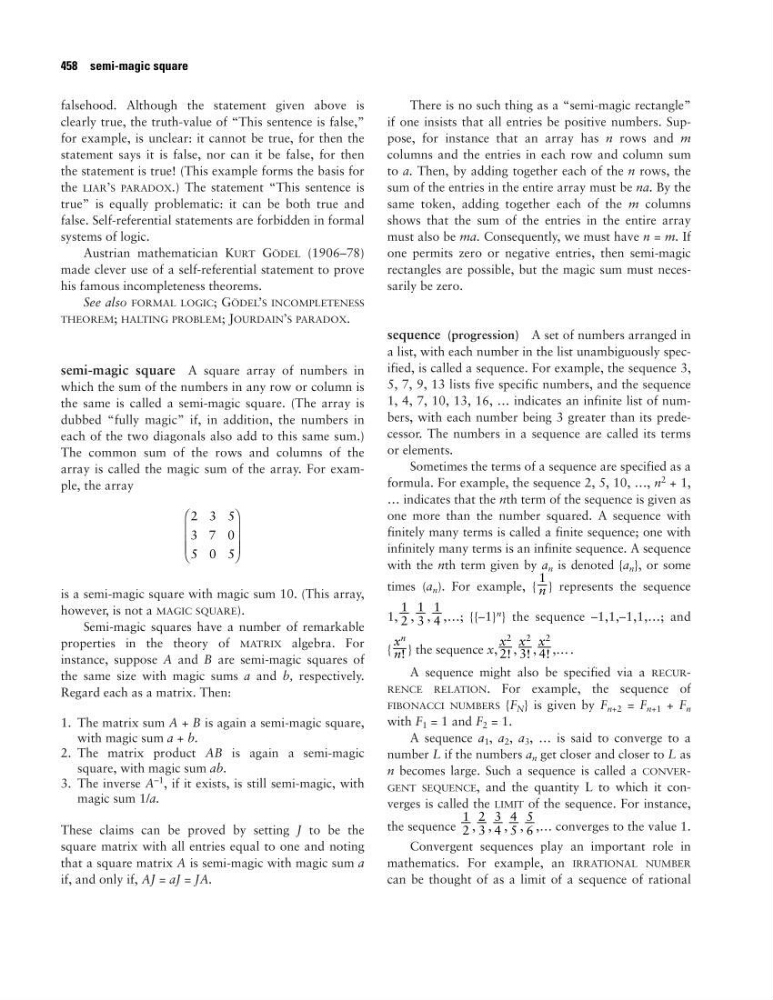
array is called the magic sum of the array. For example, the array
is a semi-magic square with magic sum 10. (This array,
however, is not a MAGIC SQUARE).
Semi-magic squares have a number of remarkable
properties in the theory of MATRIX algebra. For
instance, suppose A and B are semi-magic squares of
the same size with magic sums a and b, respectively.
Regard each as a matrix. Then:
1. The matrix sum A + B is again a semi-magic square,
with magic sum a + b.
2. The matrix product AB is again a semi-magic
square, with magic sum ab.
3. The inverse A
–1
, if it exists, is still semi-magic, with
magic sum 1/a.
These claims can be proved by setting J to be the
square matrix with all entries equal to one and noting
that a square matrix A is semi-magic with magic sum a
if, and only if, AJ = aJ = JA.
There is no such thing as a “semi-magic rectangle”
if one insists that all entries be positive numbers. Suppose, for instance that an array has n rows and m
columns and the entries in each row and column sum
to a. Then, by adding together each of the n rows, the
sum of the entries in the entire array must be na. By the
same token, adding together each of the m columns
shows that the sum of the entries in the entire array
must also be ma. Consequently, we must have n = m. If
one permits zero or negative entries, then semi-magic
rectangles are possible, but the magic sum must necessarily be zero.
sequence (progression) A set of numbers arranged in
a list, with each number in the list unambiguously specified, is called a sequence. For example, the sequence 3,
5, 7, 9, 13 lists five specific numbers, and the sequence
1, 4, 7, 10, 13, 16, … indicates an infinite list of numbers, with each number being 3 greater than its predecessor. The numbers in a sequence are called its terms
or elements.
Sometimes the terms of a sequence are specified as a
formula. For example, the sequence 2, 5, 10, …, n
2 + 1,
… indicates that the nth term of the sequence is given as
one more than the number squared. A sequence with
finitely many terms is called a finite sequence; one with
infinitely many terms is an infinite sequence. A sequence
with the nth term given by a n is denoted {a n }, or some
times (a n ). For example, { } represents the sequence
1, , , ,…; {{–1}
n } the sequence –1,1,–1,1,…; and
{ } the sequence x, , , ,….
A sequence might also be specified via a RECURRENCE RELATION. For example, the sequence of
FIBONACCI NUMBERS {F N } is given by F n+2 = F n+1 + F n
with F 1 = 1 and F 2 = 1.
A sequence a 1 , a 2 , a 3 , … is said to converge to a
number L if the numbers a n get closer and closer to L as
n becomes large. Such a sequence is called a CONVERGENT SEQUENCE, and the quantity L to which it converges is called the LIMIT of the sequence. For instance,
the sequence , , , , ,… converges to the value 1.
Convergent sequences play an important role in
mathematics. For example, an IRRATIONAL NUMBER
can be thought of as a limit of a sequence of rational
5
–
6
4
–
5
3
–
4
2
–
3
1
–
2
x
2
–
4!
x
2
–
3!
x
2
–
2!
x
n
– n!
1
–
4
1
–
3
1
–
2
1
– n
2 3 5
3 7 0
5 0 5
458 semi-magic square
clearly true, the truth-value of “This sentence is false,”
for example, is unclear: it cannot be true, for then the
statement says it is false, nor can it be false, for then
the statement is true! (This example forms the basis for
the LIAR’S PARADOX.) The statement “This sentence is
true” is equally problematic: it can be both true and
false. Self-referential statements are forbidden in formal
systems of logic.
Austrian mathematician KURT GÖDEL (1906–78)
made clever use of a self-referential statement to prove
his famous incompleteness theorems.
See also FORMAL LOGIC; GÖDEL’S INCOMPLETENESS
THEOREM; HALTING PROBLEM; JOURDAIN’S PARADOX.
semi-magic square A square array of numbers in
which the sum of the numbers in any row or column is
the same is called a semi-magic square. (The array is
dubbed “fully magic” if, in addition, the numbers in
each of the two diagonals also add to this same sum.)
The common sum of the rows and columns of the
array is called the magic sum of the array. For example, the array
is a semi-magic square with magic sum 10. (This array,
however, is not a MAGIC SQUARE).
Semi-magic squares have a number of remarkable
properties in the theory of MATRIX algebra. For
instance, suppose A and B are semi-magic squares of
the same size with magic sums a and b, respectively.
Regard each as a matrix. Then:
1. The matrix sum A + B is again a semi-magic square,
with magic sum a + b.
2. The matrix product AB is again a semi-magic
square, with magic sum ab.
3. The inverse A
–1
, if it exists, is still semi-magic, with
magic sum 1/a.
These claims can be proved by setting J to be the
square matrix with all entries equal to one and noting
that a square matrix A is semi-magic with magic sum a
if, and only if, AJ = aJ = JA.
There is no such thing as a “semi-magic rectangle”
if one insists that all entries be positive numbers. Suppose, for instance that an array has n rows and m
columns and the entries in each row and column sum
to a. Then, by adding together each of the n rows, the
sum of the entries in the entire array must be na. By the
same token, adding together each of the m columns
shows that the sum of the entries in the entire array
must also be ma. Consequently, we must have n = m. If
one permits zero or negative entries, then semi-magic
rectangles are possible, but the magic sum must necessarily be zero.
sequence (progression) A set of numbers arranged in
a list, with each number in the list unambiguously specified, is called a sequence. For example, the sequence 3,
5, 7, 9, 13 lists five specific numbers, and the sequence
1, 4, 7, 10, 13, 16, … indicates an infinite list of numbers, with each number being 3 greater than its predecessor. The numbers in a sequence are called its terms
or elements.
Sometimes the terms of a sequence are specified as a
formula. For example, the sequence 2, 5, 10, …, n
2 + 1,
… indicates that the nth term of the sequence is given as
one more than the number squared. A sequence with
finitely many terms is called a finite sequence; one with
infinitely many terms is an infinite sequence. A sequence
with the nth term given by a n is denoted {a n }, or some
times (a n ). For example, { } represents the sequence
1, , , ,…; {{–1}
n } the sequence –1,1,–1,1,…; and
{ } the sequence x, , , ,….
A sequence might also be specified via a RECURRENCE RELATION. For example, the sequence of
FIBONACCI NUMBERS {F N } is given by F n+2 = F n+1 + F n
with F 1 = 1 and F 2 = 1.
A sequence a 1 , a 2 , a 3 , … is said to converge to a
number L if the numbers a n get closer and closer to L as
n becomes large. Such a sequence is called a CONVERGENT SEQUENCE, and the quantity L to which it converges is called the LIMIT of the sequence. For instance,
the sequence , , , , ,… converges to the value 1.
Convergent sequences play an important role in
mathematics. For example, an IRRATIONAL NUMBER
can be thought of as a limit of a sequence of rational
5
–
6
4
–
5
3
–
4
2
–
3
1
–
2
x
2
–
4!
x
2
–
3!
x
2
–
2!
x
n
– n!
1
–
4
1
–
3
1
–
2
1
– n
2 3 5
3 7 0
5 0 5
458 semi-magic square