

value of a CORRELATION COEFFICIENT. If the points
seem to lie on another type of curve, then they are nonlinearly correlated. Variables that are not correlated
will likely produce a diagram with points randomly
scattered across the graph. If all but one point seems to
follow a well-defined curve, then that exceptional point
is called an OUTLIER.
See also LEAST SQUARES METHOD.
scientific notation (exponential notation, standard
form) A number x is said to be written in scientific
notation if it is expressed as a number between 1 and
10 multiplied by a power of 10:
x = p × 10
n
with 1 ≤ p < 10 and n an integer, positive or negative.
For example, the number 547 is written 5.47 × 10
2 in
scientific notation. The number 0.00106 is written
1.06 × 10
–3 .
Scientific notation is useful for writing, comparing
and manipulating very large and very small numbers.
For example, Sir Henry Cavendish computed the mass
of the Earth in 1798 as 6,600,000,000,000,000,000,000
tons. This number is compactly written 6.6 × 10
21 .
The diameter of an atomic nucleus is about
0.000000000000075 or 7.5 × 10
–14 m.
The power of 10 used in scientific notation indicates the number of times that 10 is used as a factor if
the exponent is positive, or the number of times 1/10 is
used as a factor if the exponent is negative. For example, 3.2 × 10
3
is 3.2 × 10 × 10 × 10, which equals 3,200,
and 0.0402 is the number 4.02 divided by 10 two
times, and so 0.0402 = 4.02 ×
×
=4.02 × 10
–2 .
When the value of a quantity is expressed in scientific notation, then the power of 10 used is called the
order of magnitude of the quantity. For example, the
speed of light is 3.00 × 10
8 m/sec, and the speed of
sound in air is 3.32 × 10
2 m/sec. We can readily see
that light is about 10
6
, or 1 million, times faster than
sound. The diameter of the Milky Way galaxy is on the
order of 10
20 m.
In writing the measurement of a quantity in scientific notation, it is assumed that all digits recorded are
significant. This makes the ERROR of the measurement
apparent. Calculators use the symbol E to display a
quantity in scientific notation. For example, on a calculator, the expression 1.2345E37 is to be interpreted
as 1.2345 × 10
37 . The letter E is an abbreviation for
“exponent.”
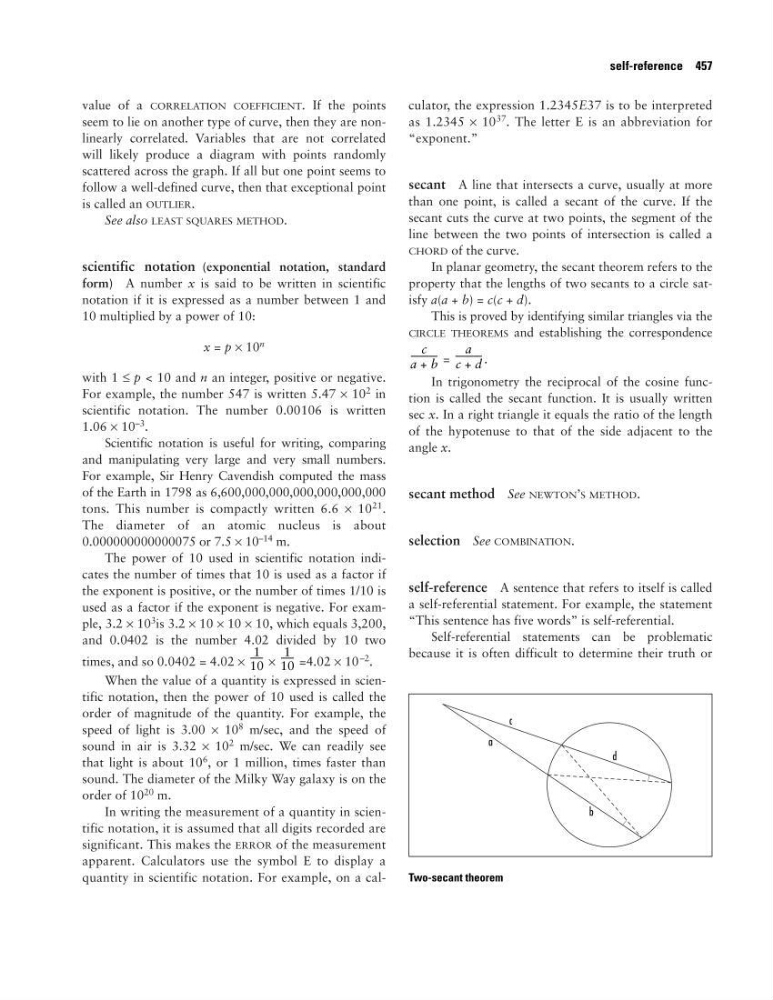
secant A line that intersects a curve, usually at more
than one point, is called a secant of the curve. If the
secant cuts the curve at two points, the segment of the
line between the two points of intersection is called a
CHORD of the curve.
In planar geometry, the secant theorem refers to the
property that the lengths of two secants to a circle satisfy a(a + b) = c(c + d).
This is proved by identifying similar triangles via the
CIRCLE THEOREMS and establishing the correspondence
=
.
In trigonometry the reciprocal of the cosine function is called the secant function. It is usually written
sec x. In a right triangle it equals the ratio of the length
of the hypotenuse to that of the side adjacent to the
angle x.
secant method See NEWTON’S METHOD.
selection See COMBINATION.
self-reference A sentence that refers to itself is called
a self-referential statement. For example, the statement
“This sentence has five words” is self-referential.
Self-referential statements can be problematic
because it is often difficult to determine their truth or
a
–––
c + d
c
–––
a + b
1
––
10
1
––
10
self-reference 457
Two-secant theorem
seem to lie on another type of curve, then they are nonlinearly correlated. Variables that are not correlated
will likely produce a diagram with points randomly
scattered across the graph. If all but one point seems to
follow a well-defined curve, then that exceptional point
is called an OUTLIER.
See also LEAST SQUARES METHOD.
scientific notation (exponential notation, standard
form) A number x is said to be written in scientific
notation if it is expressed as a number between 1 and
10 multiplied by a power of 10:
x = p × 10
n
with 1 ≤ p < 10 and n an integer, positive or negative.
For example, the number 547 is written 5.47 × 10
2 in
scientific notation. The number 0.00106 is written
1.06 × 10
–3 .
Scientific notation is useful for writing, comparing
and manipulating very large and very small numbers.
For example, Sir Henry Cavendish computed the mass
of the Earth in 1798 as 6,600,000,000,000,000,000,000
tons. This number is compactly written 6.6 × 10
21 .
The diameter of an atomic nucleus is about
0.000000000000075 or 7.5 × 10
–14 m.
The power of 10 used in scientific notation indicates the number of times that 10 is used as a factor if
the exponent is positive, or the number of times 1/10 is
used as a factor if the exponent is negative. For example, 3.2 × 10
3
is 3.2 × 10 × 10 × 10, which equals 3,200,
and 0.0402 is the number 4.02 divided by 10 two
times, and so 0.0402 = 4.02 ×
×
=4.02 × 10
–2 .
When the value of a quantity is expressed in scientific notation, then the power of 10 used is called the
order of magnitude of the quantity. For example, the
speed of light is 3.00 × 10
8 m/sec, and the speed of
sound in air is 3.32 × 10
2 m/sec. We can readily see
that light is about 10
6
, or 1 million, times faster than
sound. The diameter of the Milky Way galaxy is on the
order of 10
20 m.
In writing the measurement of a quantity in scientific notation, it is assumed that all digits recorded are
significant. This makes the ERROR of the measurement
apparent. Calculators use the symbol E to display a
quantity in scientific notation. For example, on a calculator, the expression 1.2345E37 is to be interpreted
as 1.2345 × 10
37 . The letter E is an abbreviation for
“exponent.”
secant A line that intersects a curve, usually at more
than one point, is called a secant of the curve. If the
secant cuts the curve at two points, the segment of the
line between the two points of intersection is called a
CHORD of the curve.
In planar geometry, the secant theorem refers to the
property that the lengths of two secants to a circle satisfy a(a + b) = c(c + d).
This is proved by identifying similar triangles via the
CIRCLE THEOREMS and establishing the correspondence
=
.
In trigonometry the reciprocal of the cosine function is called the secant function. It is usually written
sec x. In a right triangle it equals the ratio of the length
of the hypotenuse to that of the side adjacent to the
angle x.
secant method See NEWTON’S METHOD.
selection See COMBINATION.
self-reference A sentence that refers to itself is called
a self-referential statement. For example, the statement
“This sentence has five words” is self-referential.
Self-referential statements can be problematic
because it is often difficult to determine their truth or
a
–––
c + d
c
–––
a + b
1
––
10
1
––
10
self-reference 457
Two-secant theorem