

HINDU-ARABIC NUMERALS (the numbers we use today)
rather than ROMAN NUMERALS.
Maintaining an interest in mathematics throughout
his life, Recorde wrote a series of instructional texts in
mathematics. His first piece, The Grounde of Artes,
published in 1543, discussed the advantages of the
Hindu-Arabic numerals and general arithmetic techniques useful for commerce. He later published an
extended version of this work with the same name in
1552, which also explored the theory of WHOLE NUMBERS and RATIONAL NUMBERS. Around this time Recorde
also published Pathwaie to Knowledge, an abridged version of Euclid’s famous work, THE ELEMENTS.
Recorde is perhaps best remembered for his 1557
piece The Whetstone of Witte, considered the first significant text on the topic of algebra written in English.
Its title is a pun not understood today. Early algebraists
used the Latin word cosa for “thing,” meaning the
unknown variable in an equation. This word closely
resembles the Latin word cos for “whetstone,” a stone
for sharpening tools. Thus Recorde’s title is referring to
the art of algebra as a device for sharpening one’s wit.
In this famous text, Recorde explains the theory of
equations and the arithmetic of square roots. He solves
QUADRATIC equations (but dismisses negative solutions). He notes, in particular, that for an equation of
the form x
2 = ax – b, the term a equals the sum of the
two roots of the equation, and the term b their product. (We see this today by noting that (x – r 1 )(x – r 2 ) =
x
2 – (r 1 + r 2 )x + r 1 r 2 .) It is in this piece that Recorde
introduces the symbol “=” for equality, noting that the
use of two parallel line segments is apt “bicause noe 2
thynges can be moare equalle.”
Recorde died in London, England, in 1558. The
exact date of death is not known.
rectangle A QUADRILATERAL with all four angles
being right angles is called a rectangle. A SQUARE is
considered a rectangle.
The AREA of a rectangle is the product of its length
and its breadth, and its PERIMETER is double the sum of
these two quantities:
area = length × breadth
perimeter = 2 × length + 2 × breadth
There are only two rectangles with integer sidelengths whose areas and perimeters have the same
numerical value: the 3 × 6 rectangle of area/perimeter
18, and 4 × 4 square of area/perimeter 16.
The two DIAGONALs of a rectangle are equal in
length and bisect each other, and the rectangle is the
only quadrilateral with this property. Carpenters measure diagonal lengths to check that their work is rectangular. One can also use this observation to draw
surprisingly accurate rectangles on the ground using
only two pieces of rope equal in length and a piece of
sidewalk chalk: tie the two ropes together at their midpoints and pull them taut to form the two bisecting
diagonals of a rectangle. Mark the endpoints of the
ropes, these are the corners of the rectangle, and draw
its sides using a taut rope as a guide.
See also GOLDEN RECTANGLE.
recurrence relation (recursive relation, reduction formula) An equation that allows one to calculate the
successive values of a FUNCTION or a SEQUENCE once an
initial set of values is given is called a recurrence relation. For example, the FIBONACCI NUMBERS F n are completely specified by the recurrence relation F n = F n–1 +
F n–2 for n > 2 once we are told that F 1 = 1 and F 2 = 1.
The number of moves required to solve the TOWER OF
HANOI PUZZLE with N discs, T(N), is given by the
recurrence relation T(N + 1) = 2T(N) + 1 with T(1) = 1.
The recurrence relation a n+1 = a n + 3 with a 1 = 7 defines
the arithmetic sequence 7, 10, 13, 16,…
In INTEGRAL CALCULUS, the method of INTEGRATION
BY PARTS is often used to establish important reduction
formulae. For example, setting u = x
n and v′ = e
x in the
integral below establishes the relation ∫x
n
e
x
dx = x
n
e
x –
n∫x
n–1
e
x
dx. Repeated application of this formula allows
one to eventually evaluate the given integral.
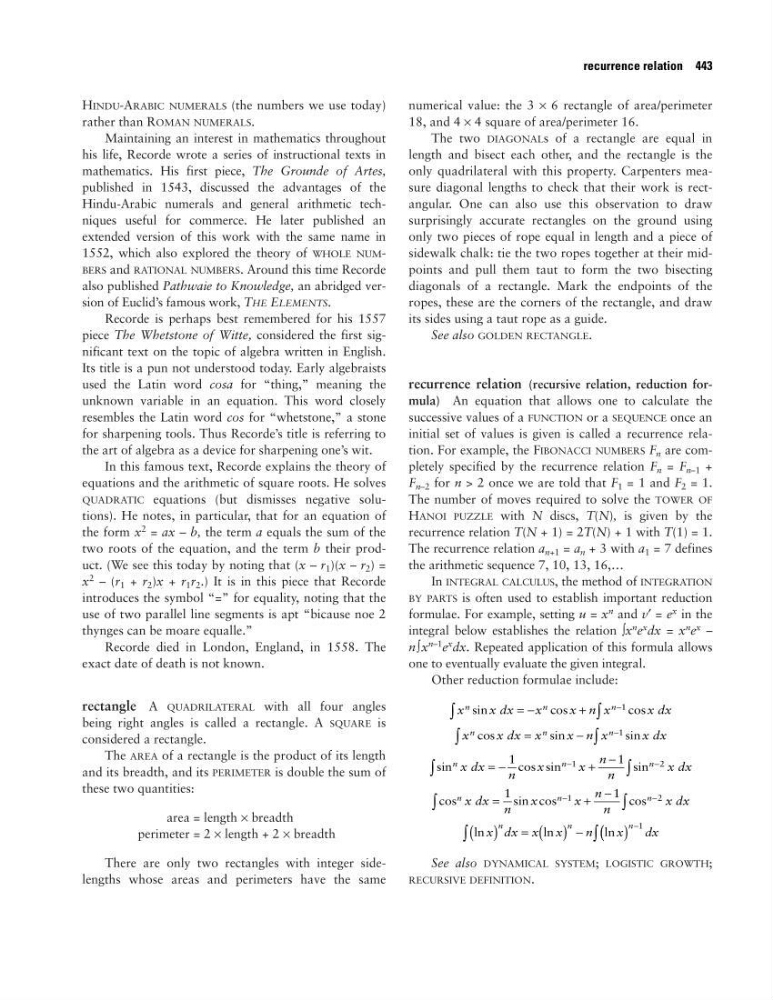
Other reduction formulae include:
See also DYNAMICAL SYSTEM; LOGISTIC GROWTH;
RECURSIVE DEFINITION.
x
x dx
x
x n x
x dx
x
x dx x
x n x
x dx
x dx
n
x
x
n
n
x dx
x dx n
x
x
n
n
x dx
x dx x x
n
x
n
n
n
n
n
n
n
n
n
n
n
n
n
n
sin
cos
cos
cos
sin
sin
sin
cos sin
sin
cos
sin cos
cos
ln
ln
ln
= −
+
=
−
= −
+
−
=
+
−
( ) = ( ) −
−
−
−
−
−
−
∫
∫
∫
∫
∫
∫
∫
∫
1
1
1
2
1
2
1
1
1
1
( ( )
−
∫
∫
n dx
1
recurrence relation 443
rather than ROMAN NUMERALS.
Maintaining an interest in mathematics throughout
his life, Recorde wrote a series of instructional texts in
mathematics. His first piece, The Grounde of Artes,
published in 1543, discussed the advantages of the
Hindu-Arabic numerals and general arithmetic techniques useful for commerce. He later published an
extended version of this work with the same name in
1552, which also explored the theory of WHOLE NUMBERS and RATIONAL NUMBERS. Around this time Recorde
also published Pathwaie to Knowledge, an abridged version of Euclid’s famous work, THE ELEMENTS.
Recorde is perhaps best remembered for his 1557
piece The Whetstone of Witte, considered the first significant text on the topic of algebra written in English.
Its title is a pun not understood today. Early algebraists
used the Latin word cosa for “thing,” meaning the
unknown variable in an equation. This word closely
resembles the Latin word cos for “whetstone,” a stone
for sharpening tools. Thus Recorde’s title is referring to
the art of algebra as a device for sharpening one’s wit.
In this famous text, Recorde explains the theory of
equations and the arithmetic of square roots. He solves
QUADRATIC equations (but dismisses negative solutions). He notes, in particular, that for an equation of
the form x
2 = ax – b, the term a equals the sum of the
two roots of the equation, and the term b their product. (We see this today by noting that (x – r 1 )(x – r 2 ) =
x
2 – (r 1 + r 2 )x + r 1 r 2 .) It is in this piece that Recorde
introduces the symbol “=” for equality, noting that the
use of two parallel line segments is apt “bicause noe 2
thynges can be moare equalle.”
Recorde died in London, England, in 1558. The
exact date of death is not known.
rectangle A QUADRILATERAL with all four angles
being right angles is called a rectangle. A SQUARE is
considered a rectangle.
The AREA of a rectangle is the product of its length
and its breadth, and its PERIMETER is double the sum of
these two quantities:
area = length × breadth
perimeter = 2 × length + 2 × breadth
There are only two rectangles with integer sidelengths whose areas and perimeters have the same
numerical value: the 3 × 6 rectangle of area/perimeter
18, and 4 × 4 square of area/perimeter 16.
The two DIAGONALs of a rectangle are equal in
length and bisect each other, and the rectangle is the
only quadrilateral with this property. Carpenters measure diagonal lengths to check that their work is rectangular. One can also use this observation to draw
surprisingly accurate rectangles on the ground using
only two pieces of rope equal in length and a piece of
sidewalk chalk: tie the two ropes together at their midpoints and pull them taut to form the two bisecting
diagonals of a rectangle. Mark the endpoints of the
ropes, these are the corners of the rectangle, and draw
its sides using a taut rope as a guide.
See also GOLDEN RECTANGLE.
recurrence relation (recursive relation, reduction formula) An equation that allows one to calculate the
successive values of a FUNCTION or a SEQUENCE once an
initial set of values is given is called a recurrence relation. For example, the FIBONACCI NUMBERS F n are completely specified by the recurrence relation F n = F n–1 +
F n–2 for n > 2 once we are told that F 1 = 1 and F 2 = 1.
The number of moves required to solve the TOWER OF
HANOI PUZZLE with N discs, T(N), is given by the
recurrence relation T(N + 1) = 2T(N) + 1 with T(1) = 1.
The recurrence relation a n+1 = a n + 3 with a 1 = 7 defines
the arithmetic sequence 7, 10, 13, 16,…
In INTEGRAL CALCULUS, the method of INTEGRATION
BY PARTS is often used to establish important reduction
formulae. For example, setting u = x
n and v′ = e
x in the
integral below establishes the relation ∫x
n
e
x
dx = x
n
e
x –
n∫x
n–1
e
x
dx. Repeated application of this formula allows
one to eventually evaluate the given integral.
Other reduction formulae include:
See also DYNAMICAL SYSTEM; LOGISTIC GROWTH;
RECURSIVE DEFINITION.
x
x dx
x
x n x
x dx
x
x dx x
x n x
x dx
x dx
n
x
x
n
n
x dx
x dx n
x
x
n
n
x dx
x dx x x
n
x
n
n
n
n
n
n
n
n
n
n
n
n
n
n
sin
cos
cos
cos
sin
sin
sin
cos sin
sin
cos
sin cos
cos
ln
ln
ln
= −
+
=
−
= −
+
−
=
+
−
( ) = ( ) −
−
−
−
−
−
−
∫
∫
∫
∫
∫
∫
∫
∫
1
1
1
2
1
2
1
1
1
1
( ( )
−
∫
∫
n dx
1
recurrence relation 443