

recursive definition (inductive definition, recursion)
A SEQUENCE a n is said to be defined recursively if:
1. The first term a 0 is given.
2. An algorithm for computing any term from its predecessor is presented.
For instance, the sequence of powers 1, x, x
2
, x
3
, …
can be defined recursively by:
a 0 = 1
a n+1 = xa n
and the FACTORIAL function n! can be defined as:
0! = 1
(n + 1)! = (n + 1) × n!
See also DYNAMICAL SYSTEM; RECURRENCE RELATION.
reduced form (lowest terms) A FRACTION is said to
be in reduced form if its numerator and denominator
share no common factor (other than one). For example, the fraction 12/25 is in reduced form, whereas
14/21 is not. (The numerator and denominator share 7
as a factor.) Canceling all factors common to the
numerator and denominator of a fraction reduces the
fraction to one of reduced form. For instance, 14/21 is
equivalent to the reduced fraction 2/3.
Mathematicians have proved that if the numerator
and denominator of a fraction are chosen at random,
then the PROBABILITY that the resultant fraction is in
reduced form is precisely
(about 61 percent).
See also CANCELLATION.
reflection See GEOMETRIC TRANSFORMATION; LINEAR
TRANSFORMATION.
Regiomontanus (1436–1476) German Trigonometry, Astronomy Born on June 6, 1436, in Königsberg, Prussia (now Germany), scholar Regiomontanus
is remembered as author of De triangulis omnimodis
(On all classes of triangles), published posthumously
in 1533, which was the first modern account of
TRIGONOMETRY as a discipline independent of astronomy. This work was extremely influential in the
revival of the subject in the West.
Although born Johann Müller, Regiomontanus
took the name of his birthplace. (Königsberg means
“the king’s mountain,” which translates into Latin as
“Regiomontanus.”) Trained as an astronomer, he was
appointed a professorship in the field at the University
of Vienna in 1641, and, seven years later, was made
astronomer to King Matthias Corvinus of Hungary.
Up until this time, trigonometry was considered
only a part of astronomy. Although aware of the Arabic use of the tangent function, Regiomontanus discussed only the sine function in his famous piece.
Unlike the ancient Indian mathematicians, he did not
think of the sine as a ratio, but instead as a length of
a particular line segment drawn for a circle of fixed
radius. Using a circle of radius 60,000 units, Regiomontanus presented a large table of sine values, and
6
––
π
2
444 recursive definition
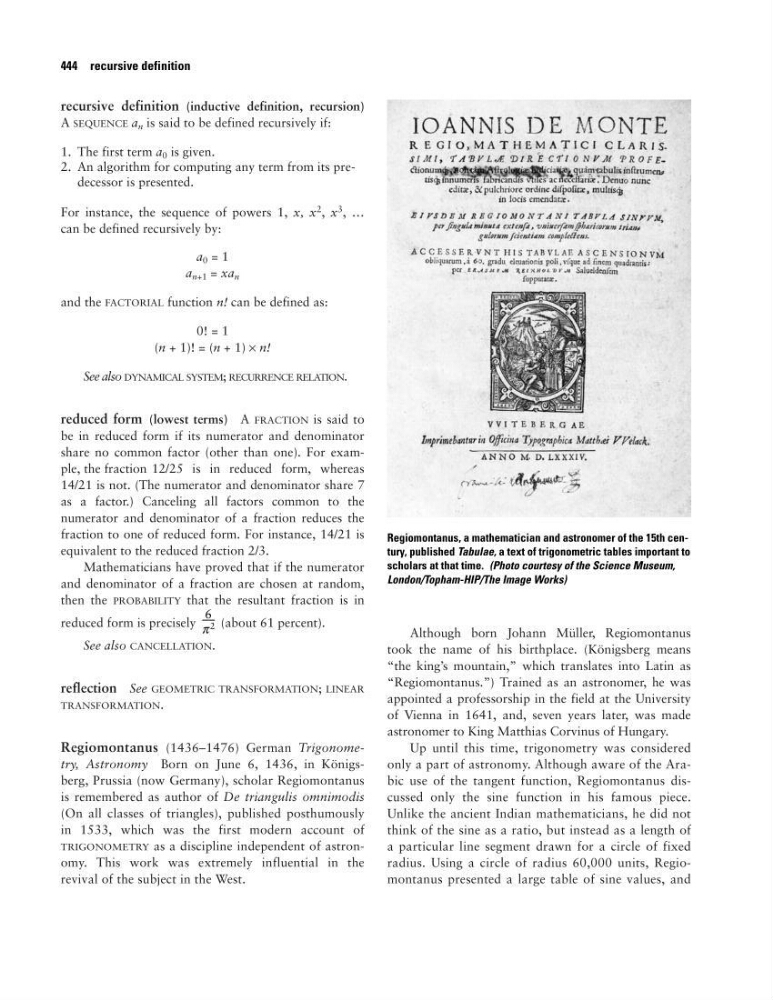
Regiomontanus, a mathematician and astronomer of the 15th century, published Tabulae, a text of trigonometric tables important to
scholars at that time. (Photo courtesy of the Science Museum,
London/Topham-HIP/The Image Works)
A SEQUENCE a n is said to be defined recursively if:
1. The first term a 0 is given.
2. An algorithm for computing any term from its predecessor is presented.
For instance, the sequence of powers 1, x, x
2
, x
3
, …
can be defined recursively by:
a 0 = 1
a n+1 = xa n
and the FACTORIAL function n! can be defined as:
0! = 1
(n + 1)! = (n + 1) × n!
See also DYNAMICAL SYSTEM; RECURRENCE RELATION.
reduced form (lowest terms) A FRACTION is said to
be in reduced form if its numerator and denominator
share no common factor (other than one). For example, the fraction 12/25 is in reduced form, whereas
14/21 is not. (The numerator and denominator share 7
as a factor.) Canceling all factors common to the
numerator and denominator of a fraction reduces the
fraction to one of reduced form. For instance, 14/21 is
equivalent to the reduced fraction 2/3.
Mathematicians have proved that if the numerator
and denominator of a fraction are chosen at random,
then the PROBABILITY that the resultant fraction is in
reduced form is precisely
(about 61 percent).
See also CANCELLATION.
reflection See GEOMETRIC TRANSFORMATION; LINEAR
TRANSFORMATION.
Regiomontanus (1436–1476) German Trigonometry, Astronomy Born on June 6, 1436, in Königsberg, Prussia (now Germany), scholar Regiomontanus
is remembered as author of De triangulis omnimodis
(On all classes of triangles), published posthumously
in 1533, which was the first modern account of
TRIGONOMETRY as a discipline independent of astronomy. This work was extremely influential in the
revival of the subject in the West.
Although born Johann Müller, Regiomontanus
took the name of his birthplace. (Königsberg means
“the king’s mountain,” which translates into Latin as
“Regiomontanus.”) Trained as an astronomer, he was
appointed a professorship in the field at the University
of Vienna in 1641, and, seven years later, was made
astronomer to King Matthias Corvinus of Hungary.
Up until this time, trigonometry was considered
only a part of astronomy. Although aware of the Arabic use of the tangent function, Regiomontanus discussed only the sine function in his famous piece.
Unlike the ancient Indian mathematicians, he did not
think of the sine as a ratio, but instead as a length of
a particular line segment drawn for a circle of fixed
radius. Using a circle of radius 60,000 units, Regiomontanus presented a large table of sine values, and
6
––
π
2
444 recursive definition
Regiomontanus, a mathematician and astronomer of the 15th century, published Tabulae, a text of trigonometric tables important to
scholars at that time. (Photo courtesy of the Science Museum,
London/Topham-HIP/The Image Works)