

digit if necessary, and proceeds to the next column digits
one place to the left to repeat this process again. It is not
clear, then, how one should proceed when asked to add
two infinite decimal expansions. (What is the rightmost
digit with which to begin?)
In the mid-1800s, as mathematicians attempted to
establish a sound theoretical footing for CALCULUS,
scholars came to realize the necessity of a rigorous
understanding of what is meant by a “real number.” In
particular, in order to validate the three key theorems
on which calculus rests (namely, the EXTREME-VALUE
THEOREM, the INTERMEDIATE-VALUE THEOREM, and the
MEAN-VALUE THEOREM), it was essential that the realnumber system be proved “complete,” in the sense that
no numbers are “missing” from the system. (For example, the square root of 2 is missing from the set of
rational numbers).
French mathematician AUGUSTIN-LOUIS CAUCHY
(1789–1857) proposed a definition of a real number
using Cauchy sequences. (This approach is based on
the idea that every irrational number is the LIMIT of a
sequence of rational numbers.) Although it is easy to
perform arithmetic operations on Cauchy sequences,
the completeness of the real-number system created is
not immediately clear. In 1872, German scholar JULIUS
WILHELM RICHARD DEDEKIND (1831–1916) proposed
the notion of a DEDEKIND CUT as a means of defining
the real numbers. This approach has the advantage of
making the completeness of the real-number system
readily apparent, but the disadvantage of making the
arithmetic manipulations of the real numbers less natural. Nonetheless, both approaches are valid and are
used today as the means for defining the real numbers.
The work of GEORG CANTOR (1845–1918), with his
famous DIAGONAL ARGUMENT, shows that the CARDINALITY of the reals is greater than that of the rationals.
It is not surprising then that a more sophisticated
approach to understand the real-number system is
needed than that for understanding the rationals.
Today the set of real numbers is denoted R and is
depicted geometrically as the set of points on a NUMBER
LINE. The real numbers constitute a mathematical FIELD.
See also NUMBER; ORDER PROPERTIES.
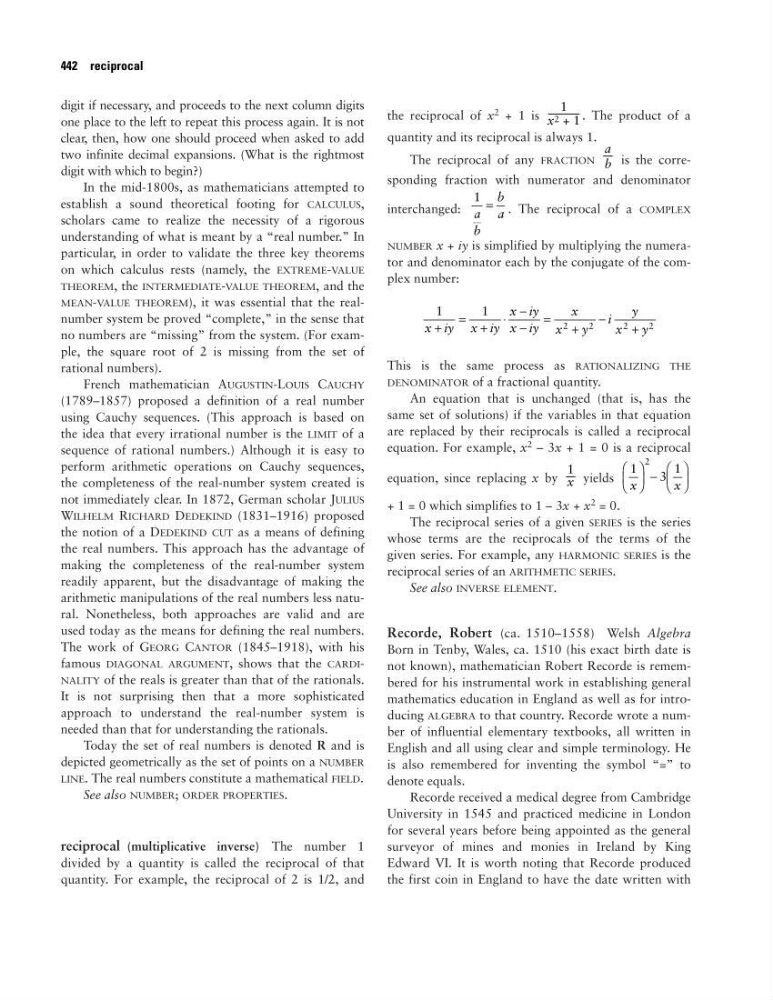
reciprocal (multiplicative inverse) The number 1
divided by a quantity is called the reciprocal of that
quantity. For example, the reciprocal of 2 is 1/2, and
the reciprocal of x
2 + 1 is
. The product of a
quantity and its reciprocal is always 1.
The reciprocal of any FRACTION
is the corresponding fraction with numerator and denominator
interchanged:
. The reciprocal of a COMPLEX
NUMBER x + iy is simplified by multiplying the numerator and denominator each by the conjugate of the complex number:
This is the same process as RATIONALIZING THE
DENOMINATOR of a fractional quantity.
An equation that is unchanged (that is, has the
same set of solutions) if the variables in that equation
are replaced by their reciprocals is called a reciprocal
equation. For example, x
2 – 3x + 1 = 0 is a reciprocal
equation, since replacing x by
yields
+ 1 = 0 which simplifies to 1 – 3x + x
2 = 0.
The reciprocal series of a given SERIES is the series
whose terms are the reciprocals of the terms of the
given series. For example, any HARMONIC SERIES is the
reciprocal series of an ARITHMETIC SERIES.
See also INVERSE ELEMENT.
Recorde, Robert (ca. 1510–1558) Welsh Algebra
Born in Tenby, Wales, ca. 1510 (his exact birth date is
not known), mathematician Robert Recorde is remembered for his instrumental work in establishing general
mathematics education in England as well as for introducing ALGEBRA to that country. Recorde wrote a number of influential elementary textbooks, all written in
English and all using clear and simple terminology. He
is also remembered for inventing the symbol “=” to
denote equals.
Recorde received a medical degree from Cambridge
University in 1545 and practiced medicine in London
for several years before being appointed as the general
surveyor of mines and monies in Ireland by King
Edward VI. It is worth noting that Recorde produced
the first coin in England to have the date written with
1
3
1
2
x
x
−
1
– x
1
1
2
2
2
2
x iy x iy
x iy
x iy
x
x
y
i
y
x
y
+
= +
⋅
−
−
=
+
−
+
1
a
b
b
a
=
a
–
b
1
––
x 2 + 1
442 reciprocal
one place to the left to repeat this process again. It is not
clear, then, how one should proceed when asked to add
two infinite decimal expansions. (What is the rightmost
digit with which to begin?)
In the mid-1800s, as mathematicians attempted to
establish a sound theoretical footing for CALCULUS,
scholars came to realize the necessity of a rigorous
understanding of what is meant by a “real number.” In
particular, in order to validate the three key theorems
on which calculus rests (namely, the EXTREME-VALUE
THEOREM, the INTERMEDIATE-VALUE THEOREM, and the
MEAN-VALUE THEOREM), it was essential that the realnumber system be proved “complete,” in the sense that
no numbers are “missing” from the system. (For example, the square root of 2 is missing from the set of
rational numbers).
French mathematician AUGUSTIN-LOUIS CAUCHY
(1789–1857) proposed a definition of a real number
using Cauchy sequences. (This approach is based on
the idea that every irrational number is the LIMIT of a
sequence of rational numbers.) Although it is easy to
perform arithmetic operations on Cauchy sequences,
the completeness of the real-number system created is
not immediately clear. In 1872, German scholar JULIUS
WILHELM RICHARD DEDEKIND (1831–1916) proposed
the notion of a DEDEKIND CUT as a means of defining
the real numbers. This approach has the advantage of
making the completeness of the real-number system
readily apparent, but the disadvantage of making the
arithmetic manipulations of the real numbers less natural. Nonetheless, both approaches are valid and are
used today as the means for defining the real numbers.
The work of GEORG CANTOR (1845–1918), with his
famous DIAGONAL ARGUMENT, shows that the CARDINALITY of the reals is greater than that of the rationals.
It is not surprising then that a more sophisticated
approach to understand the real-number system is
needed than that for understanding the rationals.
Today the set of real numbers is denoted R and is
depicted geometrically as the set of points on a NUMBER
LINE. The real numbers constitute a mathematical FIELD.
See also NUMBER; ORDER PROPERTIES.
reciprocal (multiplicative inverse) The number 1
divided by a quantity is called the reciprocal of that
quantity. For example, the reciprocal of 2 is 1/2, and
the reciprocal of x
2 + 1 is
. The product of a
quantity and its reciprocal is always 1.
The reciprocal of any FRACTION
is the corresponding fraction with numerator and denominator
interchanged:
. The reciprocal of a COMPLEX
NUMBER x + iy is simplified by multiplying the numerator and denominator each by the conjugate of the complex number:
This is the same process as RATIONALIZING THE
DENOMINATOR of a fractional quantity.
An equation that is unchanged (that is, has the
same set of solutions) if the variables in that equation
are replaced by their reciprocals is called a reciprocal
equation. For example, x
2 – 3x + 1 = 0 is a reciprocal
equation, since replacing x by
yields
+ 1 = 0 which simplifies to 1 – 3x + x
2 = 0.
The reciprocal series of a given SERIES is the series
whose terms are the reciprocals of the terms of the
given series. For example, any HARMONIC SERIES is the
reciprocal series of an ARITHMETIC SERIES.
See also INVERSE ELEMENT.
Recorde, Robert (ca. 1510–1558) Welsh Algebra
Born in Tenby, Wales, ca. 1510 (his exact birth date is
not known), mathematician Robert Recorde is remembered for his instrumental work in establishing general
mathematics education in England as well as for introducing ALGEBRA to that country. Recorde wrote a number of influential elementary textbooks, all written in
English and all using clear and simple terminology. He
is also remembered for inventing the symbol “=” to
denote equals.
Recorde received a medical degree from Cambridge
University in 1545 and practiced medicine in London
for several years before being appointed as the general
surveyor of mines and monies in Ireland by King
Edward VI. It is worth noting that Recorde produced
the first coin in England to have the date written with
1
3
1
2
x
x
−
1
– x
1
1
2
2
2
2
x iy x iy
x iy
x iy
x
x
y
i
y
x
y
+
= +
⋅
−
−
=
+
−
+
1
a
b
b
a
=
a
–
b
1
––
x 2 + 1
442 reciprocal