

Machinery to the Computation of Astronomical and
Mathematical Tables.”
Although the machine was capable of performing
relatively simple, but highly accurate, computations
(using the method of FINITE DIFFERENCES to compute
values of POLYNOMIAL functions), his invention was
well received and was understood to be a first step
toward a new era in computational capabilities. Babbage was awarded a gold medal from the Astronomical
Society and was given a grant from the Chancellor of
the Exchequer to construct a larger, more complex, difference engine.
In 1801 Joseph-Marie Jacquard invented a loom
capable of weaving complex patterns by making use of
a set of instructions set out on cards punched with
holes. Two decades later Babbage decided to follow the
same idea and design a steam-powered engine that
would accept instructions and data from punched
cards. With the assistance of Lord Byron’s daughter,
LADY AUGUSTA ADA LOVELACE, Babbage took to work
on creating a sophisticated calculating device. In 1832
he published a book, On the Economy of Machinery
and Manufactures, offering a theoretical discussion on
the topic. This could be considered the first published
work in the field of OPERATIONS RESEARCH.
Unfortunately, due to financial and technological
difficulties, the machine was never completed. (The
metalwork technology of the mid-1800s was not capable of the levels of precision Babbage’s machine
demanded.) The device in its unfinished state is preserved today in the Science Museum of London.
Although he never realized his dream of building an
operational, mechanical computer, his design concepts
have since been proved correct. It is not an exaggeration to say that the modern computers constructed on
Babbage’s theoretical design have revolutionized almost
all aspects of 20th-century life.
Babbage died in London, England, on October
18, 1871.
Babylonian mathematics The Babylonians of 2000
B.C.E. lived in Mesopotamia, the fertile plain between the
Euphrates and Tigris Rivers in what is now Iraq. We are
fortunate that the peoples of this region kept extensive
records of their society—and their mathematics—on
hardy sun-baked clay tablets. A large number of these
tablets survive today. The Babylonians used a simple stylus to make marks in the clay and developed a form of
writing based on cuneiform (wedge shaped) symbols.
The mathematical activity of the Babylonians seems
to have been motivated, at first, by the practical everyday needs of running their society. Many problems
described in early tablets are concerned with calculating
the number of workers needed for building irrigation
canals and the total expense of wages, for instance. But
many problems described in later texts have no apparent practical application and clearly indicate an interest
in pursuing mathematics for its own sake.
The Babylonians used only two symbols to represent numbers: the symbol
to represent a unit and the
symbol
to represent a group of ten. A simple additive system was used to represent the numbers 1
through 59. For example, the cluster
represents
“32.” A base-60 PLACE-VALUE SYSTEM was then used to
represent numbers greater than 59. For instance, the
number 40,992, which equals 11 × 60
2 + 23 × 60 + 12,
was written:
. Spaces were inserted
between clusters of symbols.
Babylonian mathematics 33
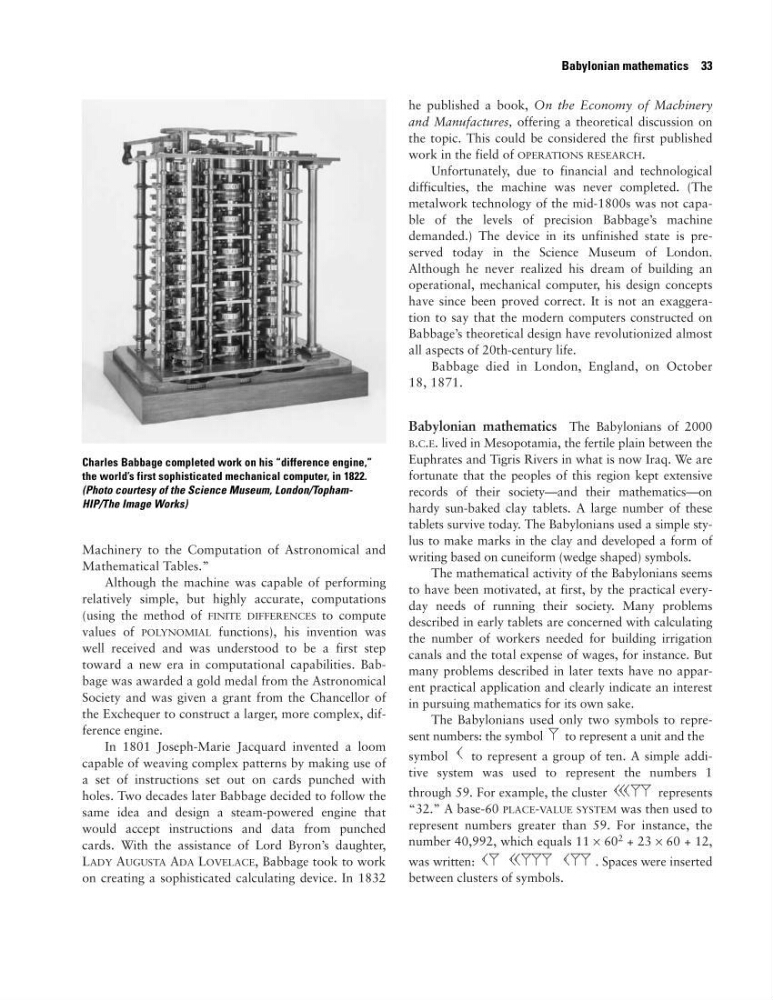
Charles Babbage completed work on his “difference engine,”
the world’s first sophisticated mechanical computer, in 1822.
(Photo courtesy of the Science Museum, London/TophamHIP/The Image Works)
Mathematical Tables.”
Although the machine was capable of performing
relatively simple, but highly accurate, computations
(using the method of FINITE DIFFERENCES to compute
values of POLYNOMIAL functions), his invention was
well received and was understood to be a first step
toward a new era in computational capabilities. Babbage was awarded a gold medal from the Astronomical
Society and was given a grant from the Chancellor of
the Exchequer to construct a larger, more complex, difference engine.
In 1801 Joseph-Marie Jacquard invented a loom
capable of weaving complex patterns by making use of
a set of instructions set out on cards punched with
holes. Two decades later Babbage decided to follow the
same idea and design a steam-powered engine that
would accept instructions and data from punched
cards. With the assistance of Lord Byron’s daughter,
LADY AUGUSTA ADA LOVELACE, Babbage took to work
on creating a sophisticated calculating device. In 1832
he published a book, On the Economy of Machinery
and Manufactures, offering a theoretical discussion on
the topic. This could be considered the first published
work in the field of OPERATIONS RESEARCH.
Unfortunately, due to financial and technological
difficulties, the machine was never completed. (The
metalwork technology of the mid-1800s was not capable of the levels of precision Babbage’s machine
demanded.) The device in its unfinished state is preserved today in the Science Museum of London.
Although he never realized his dream of building an
operational, mechanical computer, his design concepts
have since been proved correct. It is not an exaggeration to say that the modern computers constructed on
Babbage’s theoretical design have revolutionized almost
all aspects of 20th-century life.
Babbage died in London, England, on October
18, 1871.
Babylonian mathematics The Babylonians of 2000
B.C.E. lived in Mesopotamia, the fertile plain between the
Euphrates and Tigris Rivers in what is now Iraq. We are
fortunate that the peoples of this region kept extensive
records of their society—and their mathematics—on
hardy sun-baked clay tablets. A large number of these
tablets survive today. The Babylonians used a simple stylus to make marks in the clay and developed a form of
writing based on cuneiform (wedge shaped) symbols.
The mathematical activity of the Babylonians seems
to have been motivated, at first, by the practical everyday needs of running their society. Many problems
described in early tablets are concerned with calculating
the number of workers needed for building irrigation
canals and the total expense of wages, for instance. But
many problems described in later texts have no apparent practical application and clearly indicate an interest
in pursuing mathematics for its own sake.
The Babylonians used only two symbols to represent numbers: the symbol
to represent a unit and the
symbol
to represent a group of ten. A simple additive system was used to represent the numbers 1
through 59. For example, the cluster
represents
“32.” A base-60 PLACE-VALUE SYSTEM was then used to
represent numbers greater than 59. For instance, the
number 40,992, which equals 11 × 60
2 + 23 × 60 + 12,
was written:
. Spaces were inserted
between clusters of symbols.
Babylonian mathematics 33
Charles Babbage completed work on his “difference engine,”
the world’s first sophisticated mechanical computer, in 1822.
(Photo courtesy of the Science Museum, London/TophamHIP/The Image Works)