

Historians are not clear as to why the Babylonians
chose to work with a SEXAGESIMAL system. A popular
theory suggests that this number system is based on
the observation that there are 365 days in the year.
When rounded to the more convenient (highly divisible) value of 360, we have a multiple of 60. Vestiges of
this number system remain with us today. For example, we use the number 360 for the number of degrees
in a circle, and we count 60 seconds in a minute and
60 minutes per hour.
There were two points of possible confusion with
the Babylonian numeral system. With no symbol for
zero, it is not clear whether the numeral
represents 61 (as one unit of 60 plus a single unit), 3601 (as
one unit of 60
2 plus a single unit), or even 216,060, for
instance. Also, the Babylonians were comfortable with
fractions and used negative powers of 60 to represent
them (just as we use negative powers of 10 to write
fractions in decimal notation). But with no notation for
the equivalent of a decimal point, the symbol
could also be interpreted to mean 1 + (1/60), or (1/60)
+ (1/60
2
), or even 60 + (1/60
4
), for instance. As the
Babylonians never developed a method for resolving
such ambiguity, we assume then that it was never considered a problem for scholars of the time. (Historians
suggest that the context of the text always made the
interpretation of the numeral apparent.)
The Babylonians compiled extensive tables of powers of numbers and their reciprocals, which they used in
ingenious ways to perform arithmetic computations.
(For instance, a tablet dated from 2000 B.C.E. lists all the
squares of the numbers from one to 59, and all the cubes
of the numbers from one to 32.) To compute the product
of two numbers a and b, Babylonian scholars first computed their sum and their difference, read the squares of
those numbers from a table, and divided their difference
by four. (In modern notation, this corresponds to the
computation: ab = (1/4) [(a + b)
2 – (a – b)
2
].) To divide a
number a by b, scholars computed the product of a and
the reciprocal 1/b (recorded in a table): ab = a × (1/b).
The same table of reciprocals also provided the means to
solve LINEAR EQUATIONs: bx = a. (Multiply a by the
reciprocal of b.)
Problems in geometry and the computation of area
often lead to the need to solve QUADRATIC equations.
For instance, a problem from one tablet asks for the
width of a rectangle whose area is 60 and whose length
is seven units longer than the width. In modern notation,
this amounts to solving the equation x(x + 7) = x
2 + 7x =
60. The scribe who wrote the tablet then proffers a solution that is equivalent to the famous quadratic formula:
x =
– (7/2) = 5. (Square roots were computed by examining a table of squares.)
Problems about volume lead to cubic equations,
and the Babylonians were adept at solving special
equations of the form: ax
3 + bx
2 = c. (They solved these
by setting n = (ax)/b, from which the equation can be
rewritten as n
3 + n
2 = ca
2
/b
3
. By examining a table of
values for n
3 + n
2
, the solution can be deduced.)
It is clear that Babylonian scholars knew of
PYTHAGORAS’S THEOREM, although they wrote no
general proof of the result. For example, a tablet now
housed in the British museum, provides the following
problem and solution:
√(7/2)
2 + 60
34 Babylonian mathematics
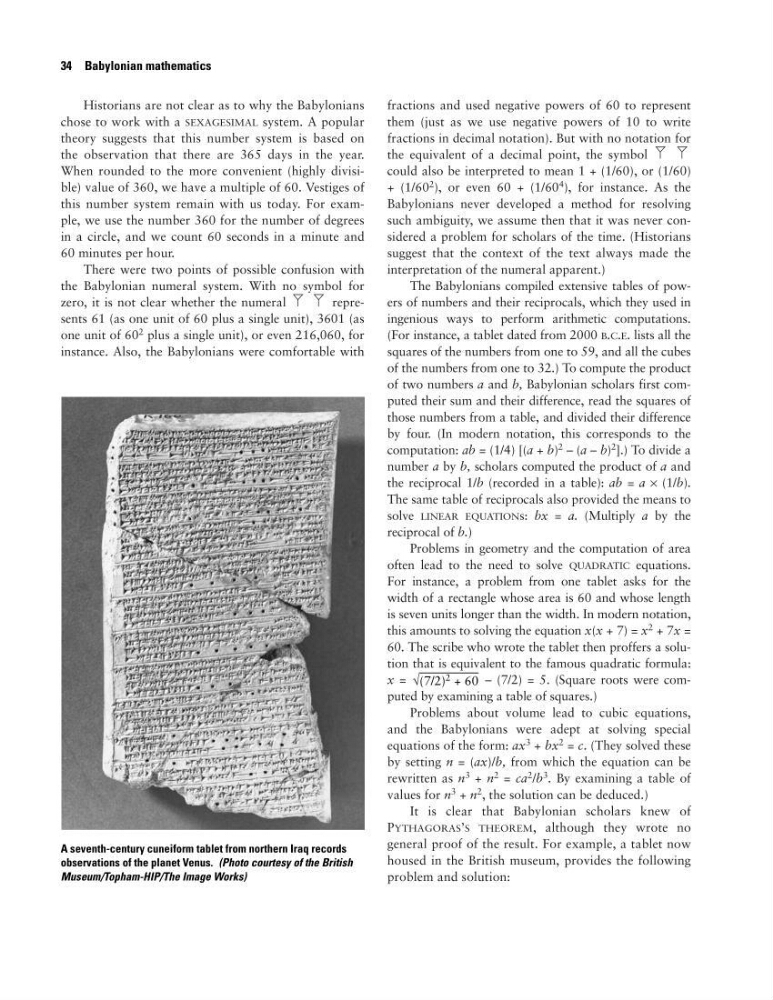
A seventh-century cuneiform tablet from northern Iraq records
observations of the planet Venus. (Photo courtesy of the British
Museum/Topham-HIP/The Image Works)
chose to work with a SEXAGESIMAL system. A popular
theory suggests that this number system is based on
the observation that there are 365 days in the year.
When rounded to the more convenient (highly divisible) value of 360, we have a multiple of 60. Vestiges of
this number system remain with us today. For example, we use the number 360 for the number of degrees
in a circle, and we count 60 seconds in a minute and
60 minutes per hour.
There were two points of possible confusion with
the Babylonian numeral system. With no symbol for
zero, it is not clear whether the numeral
represents 61 (as one unit of 60 plus a single unit), 3601 (as
one unit of 60
2 plus a single unit), or even 216,060, for
instance. Also, the Babylonians were comfortable with
fractions and used negative powers of 60 to represent
them (just as we use negative powers of 10 to write
fractions in decimal notation). But with no notation for
the equivalent of a decimal point, the symbol
could also be interpreted to mean 1 + (1/60), or (1/60)
+ (1/60
2
), or even 60 + (1/60
4
), for instance. As the
Babylonians never developed a method for resolving
such ambiguity, we assume then that it was never considered a problem for scholars of the time. (Historians
suggest that the context of the text always made the
interpretation of the numeral apparent.)
The Babylonians compiled extensive tables of powers of numbers and their reciprocals, which they used in
ingenious ways to perform arithmetic computations.
(For instance, a tablet dated from 2000 B.C.E. lists all the
squares of the numbers from one to 59, and all the cubes
of the numbers from one to 32.) To compute the product
of two numbers a and b, Babylonian scholars first computed their sum and their difference, read the squares of
those numbers from a table, and divided their difference
by four. (In modern notation, this corresponds to the
computation: ab = (1/4) [(a + b)
2 – (a – b)
2
].) To divide a
number a by b, scholars computed the product of a and
the reciprocal 1/b (recorded in a table): ab = a × (1/b).
The same table of reciprocals also provided the means to
solve LINEAR EQUATIONs: bx = a. (Multiply a by the
reciprocal of b.)
Problems in geometry and the computation of area
often lead to the need to solve QUADRATIC equations.
For instance, a problem from one tablet asks for the
width of a rectangle whose area is 60 and whose length
is seven units longer than the width. In modern notation,
this amounts to solving the equation x(x + 7) = x
2 + 7x =
60. The scribe who wrote the tablet then proffers a solution that is equivalent to the famous quadratic formula:
x =
– (7/2) = 5. (Square roots were computed by examining a table of squares.)
Problems about volume lead to cubic equations,
and the Babylonians were adept at solving special
equations of the form: ax
3 + bx
2 = c. (They solved these
by setting n = (ax)/b, from which the equation can be
rewritten as n
3 + n
2 = ca
2
/b
3
. By examining a table of
values for n
3 + n
2
, the solution can be deduced.)
It is clear that Babylonian scholars knew of
PYTHAGORAS’S THEOREM, although they wrote no
general proof of the result. For example, a tablet now
housed in the British museum, provides the following
problem and solution:
√(7/2)
2 + 60
34 Babylonian mathematics
A seventh-century cuneiform tablet from northern Iraq records
observations of the planet Venus. (Photo courtesy of the British
Museum/Topham-HIP/The Image Works)