

Babbage, Charles (1791–1871) British Computation
Born on December 26, 1791, in London, England,
Charles Babbage is best remembered for his work on
the design and manufacture of a mechanical calculator,
the forerunner of a computer. After first constructing a
“difference machine,” Babbage devoted the remainder
of his life to the construction of a superior “analytic
engine” capable of performing all mathematical operations. His work toward this goal laid the foundations
of computer design used today. Partly due to lack of
funding, however, the machine was never completed.
Babbage entered Trinity College, Cambridge, in
1810. While a student, he and a fellow undergraduate
coauthored Differential and Integral Calculus, an influential memoir on the history of calculus. After transferring to Peterhouse College, Babbage received his
bachelor’s degree in mathematics in 1814 to then begin
a career in mathematical research. Babbage published a
number of influential papers on the topic of functional
equations and was honored with election to the ROYAL
SOCIETY in 1816. In 1827 he became the Lucasian Professor of Mathematics at Cambridge.
Much of Babbage’s theoretical work relied on
consulting tables of logarithms and trigonometric
functions. Aware of the inaccuracy of human calculation, Babbage became interested in the problem of
using a mechanical device to perform complex computations. In 1819 he began work on a small “difference engine,” which he completed three years later.
He announced his invention to the scientific community in an 1822 paper, “Note on the Application of
32
B
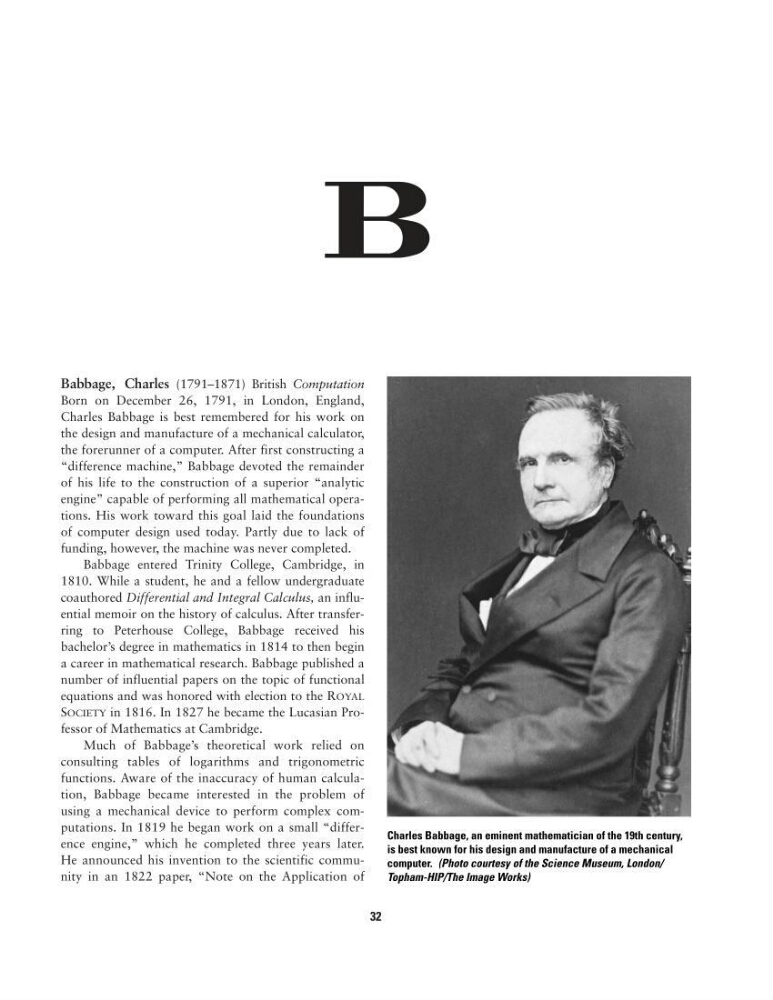
Charles Babbage, an eminent mathematician of the 19th century,
is best known for his design and manufacture of a mechanical
computer. (Photo courtesy of the Science Museum, London/
Topham-HIP/The Image Works)
Born on December 26, 1791, in London, England,
Charles Babbage is best remembered for his work on
the design and manufacture of a mechanical calculator,
the forerunner of a computer. After first constructing a
“difference machine,” Babbage devoted the remainder
of his life to the construction of a superior “analytic
engine” capable of performing all mathematical operations. His work toward this goal laid the foundations
of computer design used today. Partly due to lack of
funding, however, the machine was never completed.
Babbage entered Trinity College, Cambridge, in
1810. While a student, he and a fellow undergraduate
coauthored Differential and Integral Calculus, an influential memoir on the history of calculus. After transferring to Peterhouse College, Babbage received his
bachelor’s degree in mathematics in 1814 to then begin
a career in mathematical research. Babbage published a
number of influential papers on the topic of functional
equations and was honored with election to the ROYAL
SOCIETY in 1816. In 1827 he became the Lucasian Professor of Mathematics at Cambridge.
Much of Babbage’s theoretical work relied on
consulting tables of logarithms and trigonometric
functions. Aware of the inaccuracy of human calculation, Babbage became interested in the problem of
using a mechanical device to perform complex computations. In 1819 he began work on a small “difference engine,” which he completed three years later.
He announced his invention to the scientific community in an 1822 paper, “Note on the Application of
32
B
Charles Babbage, an eminent mathematician of the 19th century,
is best known for his design and manufacture of a mechanical
computer. (Photo courtesy of the Science Museum, London/
Topham-HIP/The Image Works)