

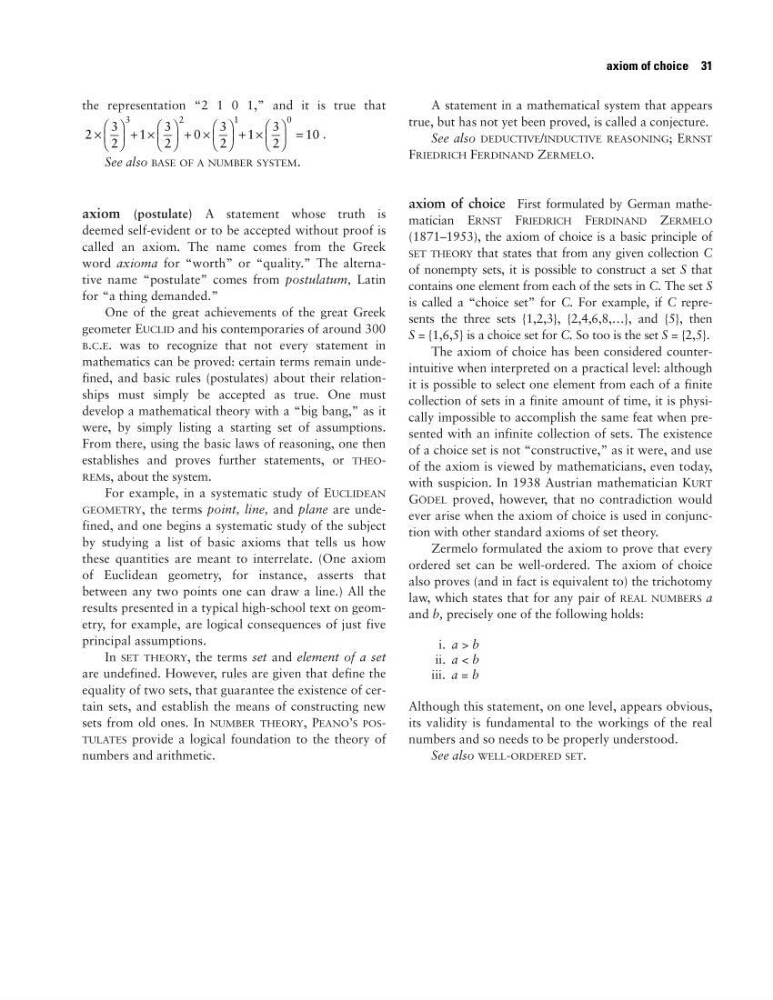
the representation “2 1 0 1,” and it is true that
.
See also BASE OF A NUMBER SYSTEM.
axiom (postulate) A statement whose truth is
deemed self-evident or to be accepted without proof is
called an axiom. The name comes from the Greek
word axioma for “worth” or “quality.” The alternative name “postulate” comes from postulatum, Latin
for “a thing demanded.”
One of the great achievements of the great Greek
geometer EUCLID and his contemporaries of around 300
B.C.E. was to recognize that not every statement in
mathematics can be proved: certain terms remain undefined, and basic rules (postulates) about their relationships must simply be accepted as true. One must
develop a mathematical theory with a “big bang,” as it
were, by simply listing a starting set of assumptions.
From there, using the basic laws of reasoning, one then
establishes and proves further statements, or THEOREMs, about the system.
For example, in a systematic study of EUCLIDEAN
GEOMETRY, the terms point, line, and plane are undefined, and one begins a systematic study of the subject
by studying a list of basic axioms that tells us how
these quantities are meant to interrelate. (One axiom
of Euclidean geometry, for instance, asserts that
between any two points one can draw a line.) All the
results presented in a typical high-school text on geometry, for example, are logical consequences of just five
principal assumptions.
In SET THEORY, the terms set and element of a set
are undefined. However, rules are given that define the
equality of two sets, that guarantee the existence of certain sets, and establish the means of constructing new
sets from old ones. In NUMBER THEORY, PEANO’S POSTULATES provide a logical foundation to the theory of
numbers and arithmetic.
A statement in a mathematical system that appears
true, but has not yet been proved, is called a conjecture.
See also DEDUCTIVE/INDUCTIVE REASONING; ERNST
FRIEDRICH FERDINAND ZERMELO.
axiom of choice First formulated by German mathematician ERNST FRIEDRICH FERDINAND ZERMELO
(1871–1953), the axiom of choice is a basic principle of
SET THEORY that states that from any given collection C
of nonempty sets, it is possible to construct a set S that
contains one element from each of the sets in C. The set S
is called a “choice set” for C. For example, if C represents the three sets {1,2,3}, {2,4,6,8,…}, and {5}, then
S = {1,6,5} is a choice set for C. So too is the set S = {2,5}.
The axiom of choice has been considered counterintuitive when interpreted on a practical level: although
it is possible to select one element from each of a finite
collection of sets in a finite amount of time, it is physically impossible to accomplish the same feat when presented with an infinite collection of sets. The existence
of a choice set is not “constructive,” as it were, and use
of the axiom is viewed by mathematicians, even today,
with suspicion. In 1938 Austrian mathematician KURT
GÖDEL proved, however, that no contradiction would
ever arise when the axiom of choice is used in conjunction with other standard axioms of set theory.
Zermelo formulated the axiom to prove that every
ordered set can be well-ordered. The axiom of choice
also proves (and in fact is equivalent to) the trichotomy
law, which states that for any pair of REAL NUMBERS a
and b, precisely one of the following holds:
i. a > b
ii. a < b
iii. a = b
Although this statement, on one level, appears obvious,
its validity is fundamental to the workings of the real
numbers and so needs to be properly understood.
See also WELL-ORDERED SET.
2
3
2
1
3
2
0
3
2
1
3
2
10
3
2
1
0
×
+ ×
+ ×
+ ×
=
axiom of choice 31
.
See also BASE OF A NUMBER SYSTEM.
axiom (postulate) A statement whose truth is
deemed self-evident or to be accepted without proof is
called an axiom. The name comes from the Greek
word axioma for “worth” or “quality.” The alternative name “postulate” comes from postulatum, Latin
for “a thing demanded.”
One of the great achievements of the great Greek
geometer EUCLID and his contemporaries of around 300
B.C.E. was to recognize that not every statement in
mathematics can be proved: certain terms remain undefined, and basic rules (postulates) about their relationships must simply be accepted as true. One must
develop a mathematical theory with a “big bang,” as it
were, by simply listing a starting set of assumptions.
From there, using the basic laws of reasoning, one then
establishes and proves further statements, or THEOREMs, about the system.
For example, in a systematic study of EUCLIDEAN
GEOMETRY, the terms point, line, and plane are undefined, and one begins a systematic study of the subject
by studying a list of basic axioms that tells us how
these quantities are meant to interrelate. (One axiom
of Euclidean geometry, for instance, asserts that
between any two points one can draw a line.) All the
results presented in a typical high-school text on geometry, for example, are logical consequences of just five
principal assumptions.
In SET THEORY, the terms set and element of a set
are undefined. However, rules are given that define the
equality of two sets, that guarantee the existence of certain sets, and establish the means of constructing new
sets from old ones. In NUMBER THEORY, PEANO’S POSTULATES provide a logical foundation to the theory of
numbers and arithmetic.
A statement in a mathematical system that appears
true, but has not yet been proved, is called a conjecture.
See also DEDUCTIVE/INDUCTIVE REASONING; ERNST
FRIEDRICH FERDINAND ZERMELO.
axiom of choice First formulated by German mathematician ERNST FRIEDRICH FERDINAND ZERMELO
(1871–1953), the axiom of choice is a basic principle of
SET THEORY that states that from any given collection C
of nonempty sets, it is possible to construct a set S that
contains one element from each of the sets in C. The set S
is called a “choice set” for C. For example, if C represents the three sets {1,2,3}, {2,4,6,8,…}, and {5}, then
S = {1,6,5} is a choice set for C. So too is the set S = {2,5}.
The axiom of choice has been considered counterintuitive when interpreted on a practical level: although
it is possible to select one element from each of a finite
collection of sets in a finite amount of time, it is physically impossible to accomplish the same feat when presented with an infinite collection of sets. The existence
of a choice set is not “constructive,” as it were, and use
of the axiom is viewed by mathematicians, even today,
with suspicion. In 1938 Austrian mathematician KURT
GÖDEL proved, however, that no contradiction would
ever arise when the axiom of choice is used in conjunction with other standard axioms of set theory.
Zermelo formulated the axiom to prove that every
ordered set can be well-ordered. The axiom of choice
also proves (and in fact is equivalent to) the trichotomy
law, which states that for any pair of REAL NUMBERS a
and b, precisely one of the following holds:
i. a > b
ii. a < b
iii. a = b
Although this statement, on one level, appears obvious,
its validity is fundamental to the workings of the real
numbers and so needs to be properly understood.
See also WELL-ORDERED SET.
2
3
2
1
3
2
0
3
2
1
3
2
10
3
2
1
0
×
+ ×
+ ×
+ ×
=
axiom of choice 31