

one of two possible states: moving from A to B to C
could either have a clockwise or counterclockwise
sense. Every time a hockey player hits one puck
between the other two, the parity of the system changes.
This shows, for instance, that a hockey player will never
be able to return the three pucks to their original positions if she performs hits of this type 33 times.
As another example, it is impossible for 25 people
standing in a 5 × 5 grid of squares, one person per cell,
to shift places if each person is asked to move one place
over to a neighboring vertical or horizontal cell. A parity argument explains why. If we imagine the cells colored black and white according to a checkerboard
pattern, then the 13 people standing in black cells are
required to occupy just 12 white cells, rendering the
challenge unsolvable. (If, however, players are permitted
to take diagonal steps, then the puzzle can be solved.)
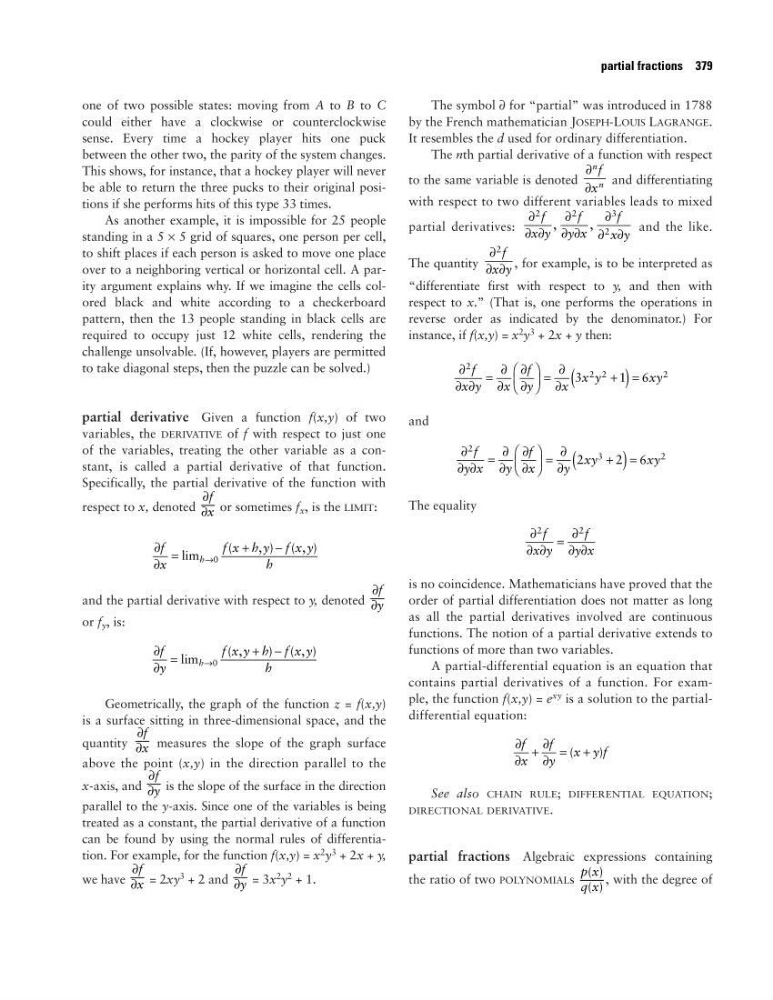
partial derivative Given a function f(x,y) of two
variables, the DERIVATIVE of f with respect to just one
of the variables, treating the other variable as a constant, is called a partial derivative of that function.
Specifically, the partial derivative of the function with
respect to x, denoted
or sometimes f x , is the LIMIT:
and the partial derivative with respect to y, denoted
or f y , is:
Geometrically, the graph of the function z = f(x,y)
is a surface sitting in three-dimensional space, and the
quantity
measures the slope of the graph surface
above the point (x,y) in the direction parallel to the
x-axis, and
is the slope of the surface in the direction
parallel to the y-axis. Since one of the variables is being
treated as a constant, the partial derivative of a function
can be found by using the normal rules of differentiation. For example, for the function f(x,y) = x
2
y
3 + 2x + y,
we have
= 2xy
3 + 2 and
= 3x
2
y
2 + 1.
The symbol ∂ for “partial” was introduced in 1788
by the French mathematician JOSEPH-LOUIS LAGRANGE.
It resembles the d used for ordinary differentiation.
The nth partial derivative of a function with respect
to the same variable is denoted
and differentiating
with respect to two different variables leads to mixed
partial derivatives:
and the like.
The quantity
, for example, is to be interpreted as
“differentiate first with respect to y, and then with
respect to x.” (That is, one performs the operations in
reverse order as indicated by the denominator.) For
instance, if f(x,y) = x
2
y
3 + 2x + y then:
and
The equality
is no coincidence. Mathematicians have proved that the
order of partial differentiation does not matter as long
as all the partial derivatives involved are continuous
functions. The notion of a partial derivative extends to
functions of more than two variables.
A partial-differential equation is an equation that
contains partial derivatives of a function. For example, the function f(x,y) = e
xy is a solution to the partialdifferential equation:
See also CHAIN RULE; DIFFERENTIAL EQUATION;
DIRECTIONAL DERIVATIVE.
partial fractions Algebraic expressions containing
the ratio of two POLYNOMIALs
, with the degree of
p(x)
––
q(x)
∂
∂
+
∂
∂
= +
f
x
f
y
x y f
(
)
∂
∂ ∂
=
∂
∂ ∂
2
2
f
x y
f
y x
∂
∂ ∂
=
∂
∂
∂
∂
=
∂
∂
+
(
) =
2
3
2
2
2 6
f
y x
y
f
x
y
xy
xy
∂
∂ ∂
=
∂
∂
∂
∂
=
∂
∂
+
(
) =
2
2 2
2
3
1 6
f
x y
x
f
y
x
x y
xy
∂
∂ ∂
2 f
x y
∂
∂ ∂
∂
∂ ∂
∂
∂ ∂
2
2
3
2
f
x y
f
y x
f
x y
,
,
∂
∂
n
n
f
x
∂f
––
∂y
∂f
––
∂x
∂f
––
∂y
∂f
––
∂x
∂
∂
=
+ −
→
f
y
f x y h f x y
h
h
lim
( ,
) ( , )
0
∂f
––
∂y
∂
∂
=
+
−
→
f
x
f x h y f x y
h
h
lim
(
, ) ( , )
0
∂f
––
∂x
partial fractions 379
could either have a clockwise or counterclockwise
sense. Every time a hockey player hits one puck
between the other two, the parity of the system changes.
This shows, for instance, that a hockey player will never
be able to return the three pucks to their original positions if she performs hits of this type 33 times.
As another example, it is impossible for 25 people
standing in a 5 × 5 grid of squares, one person per cell,
to shift places if each person is asked to move one place
over to a neighboring vertical or horizontal cell. A parity argument explains why. If we imagine the cells colored black and white according to a checkerboard
pattern, then the 13 people standing in black cells are
required to occupy just 12 white cells, rendering the
challenge unsolvable. (If, however, players are permitted
to take diagonal steps, then the puzzle can be solved.)
partial derivative Given a function f(x,y) of two
variables, the DERIVATIVE of f with respect to just one
of the variables, treating the other variable as a constant, is called a partial derivative of that function.
Specifically, the partial derivative of the function with
respect to x, denoted
or sometimes f x , is the LIMIT:
and the partial derivative with respect to y, denoted
or f y , is:
Geometrically, the graph of the function z = f(x,y)
is a surface sitting in three-dimensional space, and the
quantity
measures the slope of the graph surface
above the point (x,y) in the direction parallel to the
x-axis, and
is the slope of the surface in the direction
parallel to the y-axis. Since one of the variables is being
treated as a constant, the partial derivative of a function
can be found by using the normal rules of differentiation. For example, for the function f(x,y) = x
2
y
3 + 2x + y,
we have
= 2xy
3 + 2 and
= 3x
2
y
2 + 1.
The symbol ∂ for “partial” was introduced in 1788
by the French mathematician JOSEPH-LOUIS LAGRANGE.
It resembles the d used for ordinary differentiation.
The nth partial derivative of a function with respect
to the same variable is denoted
and differentiating
with respect to two different variables leads to mixed
partial derivatives:
and the like.
The quantity
, for example, is to be interpreted as
“differentiate first with respect to y, and then with
respect to x.” (That is, one performs the operations in
reverse order as indicated by the denominator.) For
instance, if f(x,y) = x
2
y
3 + 2x + y then:
and
The equality
is no coincidence. Mathematicians have proved that the
order of partial differentiation does not matter as long
as all the partial derivatives involved are continuous
functions. The notion of a partial derivative extends to
functions of more than two variables.
A partial-differential equation is an equation that
contains partial derivatives of a function. For example, the function f(x,y) = e
xy is a solution to the partialdifferential equation:
See also CHAIN RULE; DIFFERENTIAL EQUATION;
DIRECTIONAL DERIVATIVE.
partial fractions Algebraic expressions containing
the ratio of two POLYNOMIALs
, with the degree of
p(x)
––
q(x)
∂
∂
+
∂
∂
= +
f
x
f
y
x y f
(
)
∂
∂ ∂
=
∂
∂ ∂
2
2
f
x y
f
y x
∂
∂ ∂
=
∂
∂
∂
∂
=
∂
∂
+
(
) =
2
3
2
2
2 6
f
y x
y
f
x
y
xy
xy
∂
∂ ∂
=
∂
∂
∂
∂
=
∂
∂
+
(
) =
2
2 2
2
3
1 6
f
x y
x
f
y
x
x y
xy
∂
∂ ∂
2 f
x y
∂
∂ ∂
∂
∂ ∂
∂
∂ ∂
2
2
3
2
f
x y
f
y x
f
x y
,
,
∂
∂
n
n
f
x
∂f
––
∂y
∂f
––
∂x
∂f
––
∂y
∂f
––
∂x
∂
∂
=
+ −
→
f
y
f x y h f x y
h
h
lim
( ,
) ( , )
0
∂f
––
∂y
∂
∂
=
+
−
→
f
x
f x h y f x y
h
h
lim
(
, ) ( , )
0
∂f
––
∂x
partial fractions 379