

p(x) less than the degree of q(x), can be split into partial
fractions for easier handling. This first requires splitting
the denominator q(x) into linear and irreducible
quadratic factors, each to some index, and then writing
as a sum of terms of each of the following type:
1. Corresponding to each (repeated) linear term (x – k)
n
in q(x), there is a sum of terms
.
2. Corresponding to each (repeated) irreducible
quadratic terms (ax
2 + bx + c)
m in q(x), there is a
sum of terms
.
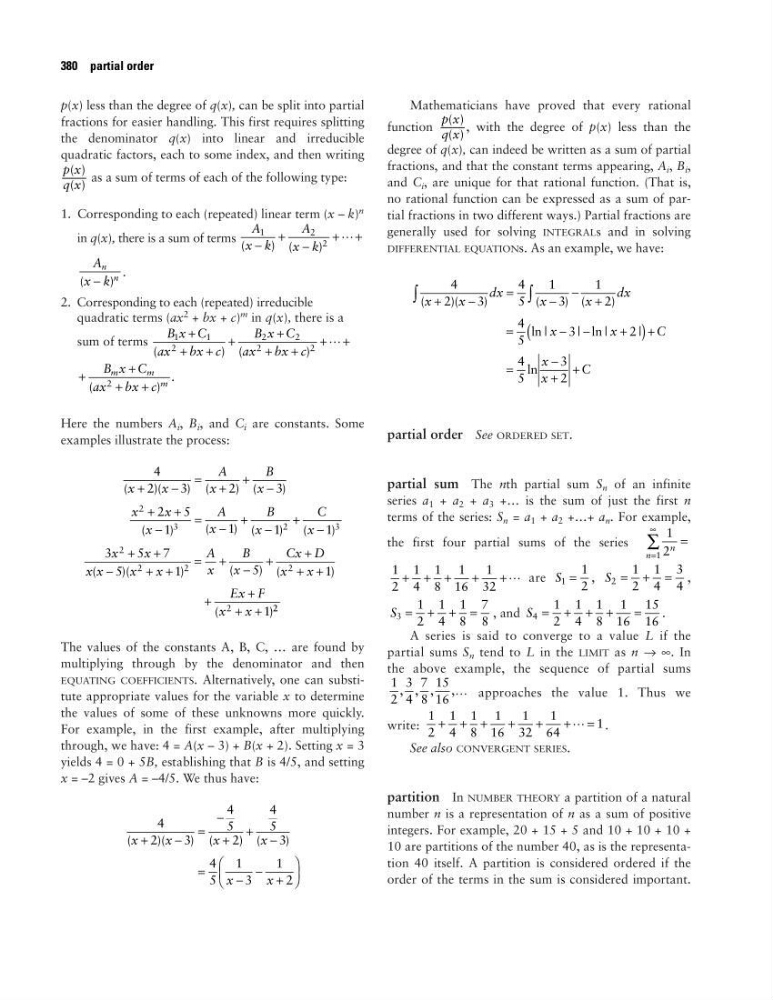
Here the numbers A i , B i , and C i are constants. Some
examples illustrate the process:
The values of the constants A, B, C, … are found by
multiplying through by the denominator and then
EQUATING COEFFICIENTS. Alternatively, one can substitute appropriate values for the variable x to determine
the values of some of these unknowns more quickly.
For example, in the first example, after multiplying
through, we have: 4 = A(x – 3) + B(x + 2). Setting x = 3
yields 4 = 0 + 5B, establishing that B is 4/5, and setting
x = –2 gives A = –4/5. We thus have:
Mathematicians have proved that every rational
function
, with the degree of p(x) less than the
degree of q(x), can indeed be written as a sum of partial
fractions, and that the constant terms appearing, A i , B i ,
and C i , are unique for that rational function. (That is,
no rational function can be expressed as a sum of partial fractions in two different ways.) Partial fractions are
generally used for solving INTEGRALs and in solving
DIFFERENTIAL EQUATIONs. As an example, we have:
partial order See ORDERED SET.
partial sum The nth partial sum S n of an infinite
series a 1 + a 2 + a 3 +… is the sum of just the first n
terms of the series: S n = a 1 + a 2 +…+ a n . For example,
the first four partial sums of the series
are
,
,
, and
.
A series is said to converge to a value L if the
partial sums S n tend to L in the LIMIT as n → ∞. In
the above example, the sequence of partial sums
approaches the value 1. Thus we
write:
.
See also CONVERGENT SERIES.
partition In NUMBER THEORY a partition of a natural
number n is a representation of n as a sum of positive
integers. For example, 20 + 15 + 5 and 10 + 10 + 10 +
10 are partitions of the number 40, as is the representation 40 itself. A partition is considered ordered if the
order of the terms in the sum is considered important.
1
2
1
4
1
8
1
16
1
32
1
64
1
+ + +
+
+
+ =
L
1
2
3
4
7
8
15
16
, , , ,K
S 4
1
2
1
4
1
8
1
16
15
16
= + + +
=
S 3
1
2
1
4
1
8
7
8
= + + =
S 2
1
2
1
4
3
4
= + =
S 1
1
2
=
1
2
1
4
1
8
1
16
1
32
+ + +
+
+L
1
2
1
n
n=
∞
∑ =
4
2
3
4
5
1
3
1
2
4
5
3
2
4
5
3
2
(
)(
)
(
) (
)
ln |
| ln |
|
ln
x
x
dx
x
x
dx
x
x
C
x
x
C
+
−
=
−
− +
=
− −
+
(
) +
=
−
+
+
∫
∫
p(x)
––
q(x)
4
2
3
4
5
2
4
5
3
4
5
1
3
1
2
(
)(
) (
) (
)
x
x
x
x
x
x
+
−
=
−
+
+ −
=
−
− +
4
2
3
2
3
2
5
1
1
1
1
3
5 7
5
1
5
1
1
2
3
2
3
2
2
2
2
2
(
)(
) (
) (
)
(
)
(
) (
)
(
)
(
)(
)
(
) (
)
(
)
x
x
A
x
B
x
x
x
x
A
x
B
x
C
x
x
x
x x
x
x
A
x
B
x
Cx D
x
x
Ex F
x
x
+
−
= +
+ −
+
+
−
= −
+ −
+ −
+
+
−
+ +
= + −
+
+
+ +
+
+
+ + 2 2
B x C
ax bx c
m
m
m
2
+
+
+
+
(
)
B x C
ax bx c
B x C
ax bx c
1
1
2
2
2
2
2
+
+
+
+
+
+
+
+ +
(
) (
)
L
A
x k
n
n
(
)
−
A
x k
A
x k
1
2
2
(
) (
)
−
+ −
+ +
L
p(x)
––
q(x)
380 partial order
fractions for easier handling. This first requires splitting
the denominator q(x) into linear and irreducible
quadratic factors, each to some index, and then writing
as a sum of terms of each of the following type:
1. Corresponding to each (repeated) linear term (x – k)
n
in q(x), there is a sum of terms
.
2. Corresponding to each (repeated) irreducible
quadratic terms (ax
2 + bx + c)
m in q(x), there is a
sum of terms
.
Here the numbers A i , B i , and C i are constants. Some
examples illustrate the process:
The values of the constants A, B, C, … are found by
multiplying through by the denominator and then
EQUATING COEFFICIENTS. Alternatively, one can substitute appropriate values for the variable x to determine
the values of some of these unknowns more quickly.
For example, in the first example, after multiplying
through, we have: 4 = A(x – 3) + B(x + 2). Setting x = 3
yields 4 = 0 + 5B, establishing that B is 4/5, and setting
x = –2 gives A = –4/5. We thus have:
Mathematicians have proved that every rational
function
, with the degree of p(x) less than the
degree of q(x), can indeed be written as a sum of partial
fractions, and that the constant terms appearing, A i , B i ,
and C i , are unique for that rational function. (That is,
no rational function can be expressed as a sum of partial fractions in two different ways.) Partial fractions are
generally used for solving INTEGRALs and in solving
DIFFERENTIAL EQUATIONs. As an example, we have:
partial order See ORDERED SET.
partial sum The nth partial sum S n of an infinite
series a 1 + a 2 + a 3 +… is the sum of just the first n
terms of the series: S n = a 1 + a 2 +…+ a n . For example,
the first four partial sums of the series
are
,
,
, and
.
A series is said to converge to a value L if the
partial sums S n tend to L in the LIMIT as n → ∞. In
the above example, the sequence of partial sums
approaches the value 1. Thus we
write:
.
See also CONVERGENT SERIES.
partition In NUMBER THEORY a partition of a natural
number n is a representation of n as a sum of positive
integers. For example, 20 + 15 + 5 and 10 + 10 + 10 +
10 are partitions of the number 40, as is the representation 40 itself. A partition is considered ordered if the
order of the terms in the sum is considered important.
1
2
1
4
1
8
1
16
1
32
1
64
1
+ + +
+
+
+ =
L
1
2
3
4
7
8
15
16
, , , ,K
S 4
1
2
1
4
1
8
1
16
15
16
= + + +
=
S 3
1
2
1
4
1
8
7
8
= + + =
S 2
1
2
1
4
3
4
= + =
S 1
1
2
=
1
2
1
4
1
8
1
16
1
32
+ + +
+
+L
1
2
1
n
n=
∞
∑ =
4
2
3
4
5
1
3
1
2
4
5
3
2
4
5
3
2
(
)(
)
(
) (
)
ln |
| ln |
|
ln
x
x
dx
x
x
dx
x
x
C
x
x
C
+
−
=
−
− +
=
− −
+
(
) +
=
−
+
+
∫
∫
p(x)
––
q(x)
4
2
3
4
5
2
4
5
3
4
5
1
3
1
2
(
)(
) (
) (
)
x
x
x
x
x
x
+
−
=
−
+
+ −
=
−
− +
4
2
3
2
3
2
5
1
1
1
1
3
5 7
5
1
5
1
1
2
3
2
3
2
2
2
2
2
(
)(
) (
) (
)
(
)
(
) (
)
(
)
(
)(
)
(
) (
)
(
)
x
x
A
x
B
x
x
x
x
A
x
B
x
C
x
x
x
x x
x
x
A
x
B
x
Cx D
x
x
Ex F
x
x
+
−
= +
+ −
+
+
−
= −
+ −
+ −
+
+
−
+ +
= + −
+
+
+ +
+
+
+ + 2 2
B x C
ax bx c
m
m
m
2
+
+
+
+
(
)
B x C
ax bx c
B x C
ax bx c
1
1
2
2
2
2
2
+
+
+
+
+
+
+
+ +
(
) (
)
L
A
x k
n
n
(
)
−
A
x k
A
x k
1
2
2
(
) (
)
−
+ −
+ +
L
p(x)
––
q(x)
380 partial order