

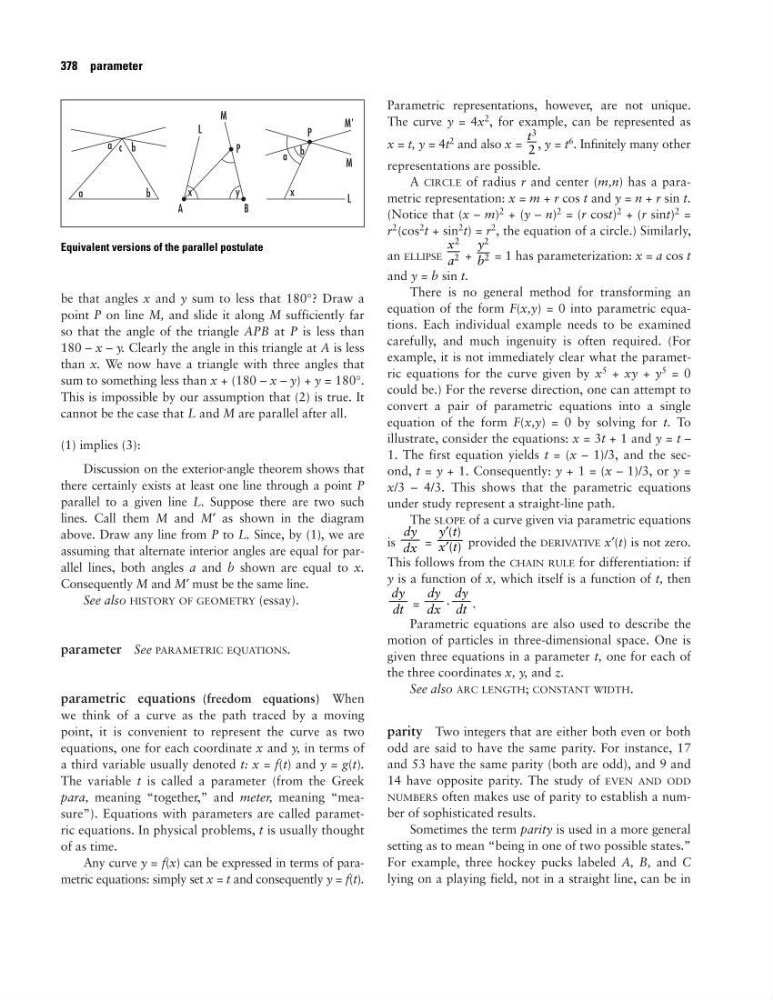
be that angles x and y sum to less that 180°? Draw a
point P on line M, and slide it along M sufficiently far
so that the angle of the triangle APB at P is less than
180 – x – y. Clearly the angle in this triangle at A is less
than x. We now have a triangle with three angles that
sum to something less than x + (180 – x – y) + y = 180°.
This is impossible by our assumption that (2) is true. It
cannot be the case that L and M are parallel after all.
(1) implies (3):
Discussion on the exterior-angle theorem shows that
there certainly exists at least one line through a point P
parallel to a given line L. Suppose there are two such
lines. Call them M and M′ as shown in the diagram
above. Draw any line from P to L. Since, by (1), we are
assuming that alternate interior angles are equal for parallel lines, both angles a and b shown are equal to x.
Consequently M and M′ must be the same line.
See also HISTORY OF GEOMETRY (essay).
parameter See PARAMETRIC EQUATIONS.
parametric equations (freedom equations) When
we think of a curve as the path traced by a moving
point, it is convenient to represent the curve as two
equations, one for each coordinate x and y, in terms of
a third variable usually denoted t: x = f(t) and y = g(t).
The variable t is called a parameter (from the Greek
para, meaning “together,” and meter, meaning “measure”). Equations with parameters are called parametric equations. In physical problems, t is usually thought
of as time.
Any curve y = f(x) can be expressed in terms of parametric equations: simply set x = t and consequently y = f(t).
Parametric representations, however, are not unique.
The curve y = 4x 2 , for example, can be represented as
x = t, y = 4t
2 and also x = , y = t
6
. Infinitely many other
representations are possible.
A CIRCLE of radius r and center (m,n) has a parametric representation: x = m + r cos t and y = n + r sin t.
(Notice that (x – m)
2 + (y – n)
2 = (r cost)
2 + (r sint)
2 =
r
2 (cos
2
t + sin
2
t) = r
2
, the equation of a circle.) Similarly,
an ELLIPSE
+
= 1 has parameterization: x = a cos t
and y = b sin t.
There is no general method for transforming an
equation of the form F(x,y) = 0 into parametric equations. Each individual example needs to be examined
carefully, and much ingenuity is often required. (For
example, it is not immediately clear what the parametric equations for the curve given by x
5 + xy + y
5 = 0
could be.) For the reverse direction, one can attempt to
convert a pair of parametric equations into a single
equation of the form F(x,y) = 0 by solving for t. To
illustrate, consider the equations: x = 3t + 1 and y = t –
1. The first equation yields t = (x – 1)/3, and the second, t = y + 1. Consequently: y + 1 = (x – 1)/3, or y =
x/3 – 4/3. This shows that the parametric equations
under study represent a straight-line path.
The SLOPE of a curve given via parametric equations
is
=
provided the DERIVATIVE x′(t) is not zero.
This follows from the CHAIN RULE for differentiation: if
y is a function of x, which itself is a function of t, then
=
·
.
Parametric equations are also used to describe the
motion of particles in three-dimensional space. One is
given three equations in a parameter t, one for each of
the three coordinates x, y, and z.
See also ARC LENGTH; CONSTANT WIDTH.
parity Two integers that are either both even or both
odd are said to have the same parity. For instance, 17
and 53 have the same parity (both are odd), and 9 and
14 have opposite parity. The study of EVEN AND ODD
NUMBERS often makes use of parity to establish a number of sophisticated results.
Sometimes the term parity is used in a more general
setting as to mean “being in one of two possible states.”
For example, three hockey pucks labeled A, B, and C
lying on a playing field, not in a straight line, can be in
dy
––
dt
dy
––
dx
dy
––
dt
y′(t)
––
x′(t)
dy
––
dx
y
2
–
b
2
x
2
–
a
2
t
3
–
2
378 parameter
Equivalent versions of the parallel postulate
point P on line M, and slide it along M sufficiently far
so that the angle of the triangle APB at P is less than
180 – x – y. Clearly the angle in this triangle at A is less
than x. We now have a triangle with three angles that
sum to something less than x + (180 – x – y) + y = 180°.
This is impossible by our assumption that (2) is true. It
cannot be the case that L and M are parallel after all.
(1) implies (3):
Discussion on the exterior-angle theorem shows that
there certainly exists at least one line through a point P
parallel to a given line L. Suppose there are two such
lines. Call them M and M′ as shown in the diagram
above. Draw any line from P to L. Since, by (1), we are
assuming that alternate interior angles are equal for parallel lines, both angles a and b shown are equal to x.
Consequently M and M′ must be the same line.
See also HISTORY OF GEOMETRY (essay).
parameter See PARAMETRIC EQUATIONS.
parametric equations (freedom equations) When
we think of a curve as the path traced by a moving
point, it is convenient to represent the curve as two
equations, one for each coordinate x and y, in terms of
a third variable usually denoted t: x = f(t) and y = g(t).
The variable t is called a parameter (from the Greek
para, meaning “together,” and meter, meaning “measure”). Equations with parameters are called parametric equations. In physical problems, t is usually thought
of as time.
Any curve y = f(x) can be expressed in terms of parametric equations: simply set x = t and consequently y = f(t).
Parametric representations, however, are not unique.
The curve y = 4x 2 , for example, can be represented as
x = t, y = 4t
2 and also x = , y = t
6
. Infinitely many other
representations are possible.
A CIRCLE of radius r and center (m,n) has a parametric representation: x = m + r cos t and y = n + r sin t.
(Notice that (x – m)
2 + (y – n)
2 = (r cost)
2 + (r sint)
2 =
r
2 (cos
2
t + sin
2
t) = r
2
, the equation of a circle.) Similarly,
an ELLIPSE
+
= 1 has parameterization: x = a cos t
and y = b sin t.
There is no general method for transforming an
equation of the form F(x,y) = 0 into parametric equations. Each individual example needs to be examined
carefully, and much ingenuity is often required. (For
example, it is not immediately clear what the parametric equations for the curve given by x
5 + xy + y
5 = 0
could be.) For the reverse direction, one can attempt to
convert a pair of parametric equations into a single
equation of the form F(x,y) = 0 by solving for t. To
illustrate, consider the equations: x = 3t + 1 and y = t –
1. The first equation yields t = (x – 1)/3, and the second, t = y + 1. Consequently: y + 1 = (x – 1)/3, or y =
x/3 – 4/3. This shows that the parametric equations
under study represent a straight-line path.
The SLOPE of a curve given via parametric equations
is
=
provided the DERIVATIVE x′(t) is not zero.
This follows from the CHAIN RULE for differentiation: if
y is a function of x, which itself is a function of t, then
=
·
.
Parametric equations are also used to describe the
motion of particles in three-dimensional space. One is
given three equations in a parameter t, one for each of
the three coordinates x, y, and z.
See also ARC LENGTH; CONSTANT WIDTH.
parity Two integers that are either both even or both
odd are said to have the same parity. For instance, 17
and 53 have the same parity (both are odd), and 9 and
14 have opposite parity. The study of EVEN AND ODD
NUMBERS often makes use of parity to establish a number of sophisticated results.
Sometimes the term parity is used in a more general
setting as to mean “being in one of two possible states.”
For example, three hockey pucks labeled A, B, and C
lying on a playing field, not in a straight line, can be in
dy
––
dt
dy
––
dx
dy
––
dt
y′(t)
––
x′(t)
dy
––
dx
y
2
–
b
2
x
2
–
a
2
t
3
–
2
378 parameter
Equivalent versions of the parallel postulate