

parallel postulate (Euclid’s fifth postulate) In his
famous work THE ELEMENTS, the geometer EUCLID
(ca. 300 B.C.E.) proposed five basic postulates that
describe the principles of geometry on a flat PLANE. His
fifth postulate states:
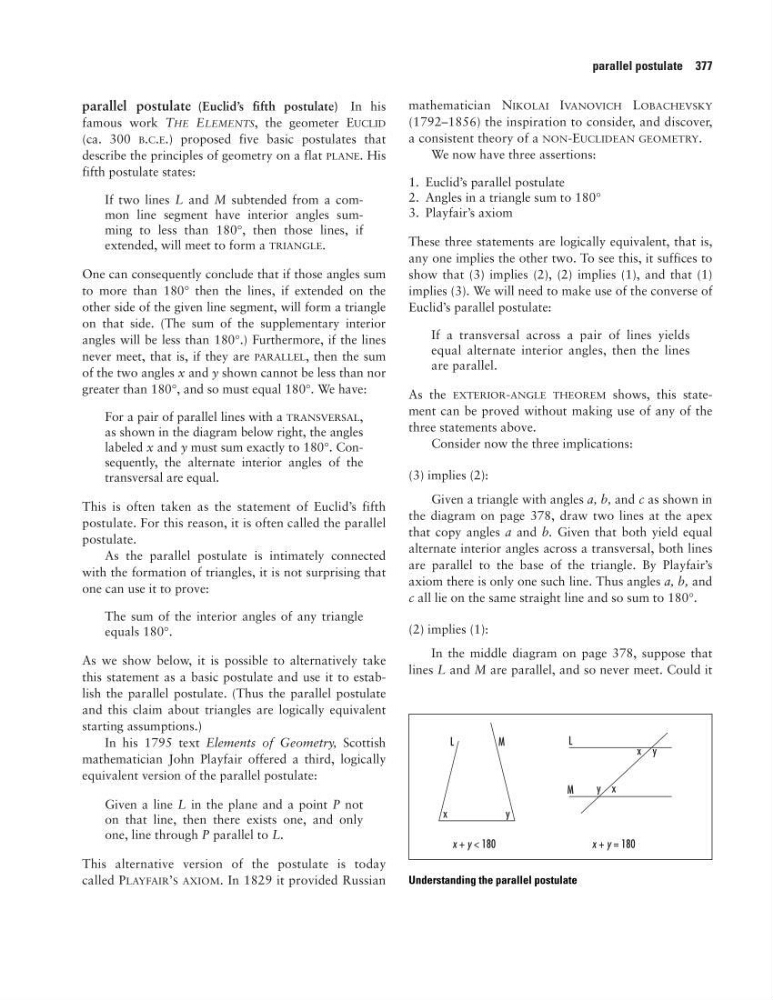
If two lines L and M subtended from a common line segment have interior angles summing to less than 180°, then those lines, if
extended, will meet to form a TRIANGLE.
One can consequently conclude that if those angles sum
to more than 180° then the lines, if extended on the
other side of the given line segment, will form a triangle
on that side. (The sum of the supplementary interior
angles will be less than 180°.) Furthermore, if the lines
never meet, that is, if they are PARALLEL, then the sum
of the two angles x and y shown cannot be less than nor
greater than 180°, and so must equal 180°. We have:
For a pair of parallel lines with a TRANSVERSAL,
as shown in the diagram below right, the angles
labeled x and y must sum exactly to 180°. Consequently, the alternate interior angles of the
transversal are equal.
This is often taken as the statement of Euclid’s fifth
postulate. For this reason, it is often called the parallel
postulate.
As the parallel postulate is intimately connected
with the formation of triangles, it is not surprising that
one can use it to prove:
The sum of the interior angles of any triangle
equals 180°.
As we show below, it is possible to alternatively take
this statement as a basic postulate and use it to establish the parallel postulate. (Thus the parallel postulate
and this claim about triangles are logically equivalent
starting assumptions.)
In his 1795 text Elements of Geometry, Scottish
mathematician John Playfair offered a third, logically
equivalent version of the parallel postulate:
Given a line L in the plane and a point P not
on that line, then there exists one, and only
one, line through P parallel to L.
This alternative version of the postulate is today
called PLAYFAIR’S AXIOM. In 1829 it provided Russian
mathematician NIKOLAI IVANOVICH LOBACHEVSKY
(1792–1856) the inspiration to consider, and discover,
a consistent theory of a NON-EUCLIDEAN GEOMETRY.
We now have three assertions:
1. Euclid’s parallel postulate
2. Angles in a triangle sum to 180°
3. Playfair’s axiom
These three statements are logically equivalent, that is,
any one implies the other two. To see this, it suffices to
show that (3) implies (2), (2) implies (1), and that (1)
implies (3). We will need to make use of the converse of
Euclid’s parallel postulate:
If a transversal across a pair of lines yields
equal alternate interior angles, then the lines
are parallel.
As the EXTERIOR-ANGLE THEOREM shows, this statement can be proved without making use of any of the
three statements above.
Consider now the three implications:
(3) implies (2):
Given a triangle with angles a, b, and c as shown in
the diagram on page 378, draw two lines at the apex
that copy angles a and b. Given that both yield equal
alternate interior angles across a transversal, both lines
are parallel to the base of the triangle. By Playfair’s
axiom there is only one such line. Thus angles a, b, and
c all lie on the same straight line and so sum to 180°.
(2) implies (1):
In the middle diagram on page 378, suppose that
lines L and M are parallel, and so never meet. Could it
parallel postulate 377
Understanding the parallel postulate
famous work THE ELEMENTS, the geometer EUCLID
(ca. 300 B.C.E.) proposed five basic postulates that
describe the principles of geometry on a flat PLANE. His
fifth postulate states:
If two lines L and M subtended from a common line segment have interior angles summing to less than 180°, then those lines, if
extended, will meet to form a TRIANGLE.
One can consequently conclude that if those angles sum
to more than 180° then the lines, if extended on the
other side of the given line segment, will form a triangle
on that side. (The sum of the supplementary interior
angles will be less than 180°.) Furthermore, if the lines
never meet, that is, if they are PARALLEL, then the sum
of the two angles x and y shown cannot be less than nor
greater than 180°, and so must equal 180°. We have:
For a pair of parallel lines with a TRANSVERSAL,
as shown in the diagram below right, the angles
labeled x and y must sum exactly to 180°. Consequently, the alternate interior angles of the
transversal are equal.
This is often taken as the statement of Euclid’s fifth
postulate. For this reason, it is often called the parallel
postulate.
As the parallel postulate is intimately connected
with the formation of triangles, it is not surprising that
one can use it to prove:
The sum of the interior angles of any triangle
equals 180°.
As we show below, it is possible to alternatively take
this statement as a basic postulate and use it to establish the parallel postulate. (Thus the parallel postulate
and this claim about triangles are logically equivalent
starting assumptions.)
In his 1795 text Elements of Geometry, Scottish
mathematician John Playfair offered a third, logically
equivalent version of the parallel postulate:
Given a line L in the plane and a point P not
on that line, then there exists one, and only
one, line through P parallel to L.
This alternative version of the postulate is today
called PLAYFAIR’S AXIOM. In 1829 it provided Russian
mathematician NIKOLAI IVANOVICH LOBACHEVSKY
(1792–1856) the inspiration to consider, and discover,
a consistent theory of a NON-EUCLIDEAN GEOMETRY.
We now have three assertions:
1. Euclid’s parallel postulate
2. Angles in a triangle sum to 180°
3. Playfair’s axiom
These three statements are logically equivalent, that is,
any one implies the other two. To see this, it suffices to
show that (3) implies (2), (2) implies (1), and that (1)
implies (3). We will need to make use of the converse of
Euclid’s parallel postulate:
If a transversal across a pair of lines yields
equal alternate interior angles, then the lines
are parallel.
As the EXTERIOR-ANGLE THEOREM shows, this statement can be proved without making use of any of the
three statements above.
Consider now the three implications:
(3) implies (2):
Given a triangle with angles a, b, and c as shown in
the diagram on page 378, draw two lines at the apex
that copy angles a and b. Given that both yield equal
alternate interior angles across a transversal, both lines
are parallel to the base of the triangle. By Playfair’s
axiom there is only one such line. Thus angles a, b, and
c all lie on the same straight line and so sum to 180°.
(2) implies (1):
In the middle diagram on page 378, suppose that
lines L and M are parallel, and so never meet. Could it
parallel postulate 377
Understanding the parallel postulate