

bers, deeming these quantities as “meaningless” and
“absurd.” This attitude generally persisted for the century that followed, even though scholars found it necessary to work with them algebraically as they solved
more sophisticated mathematical equations. By the turn
of the 18th century, however, it was generally admitted
that negative numbers are a necessary construct in mathematics. LEONHARD EULER (1707–83) was comfortable
working with negative quantities.
With the development of ABSTRACT ALGEBRA in
the 19th century, the need to assign “meaning” to
numbers became less important. Even though some
19th-century scholars such as AUGUSTUS DE MORGAN
continued to publish commentary against the validity
of negative quantities, their usefulness, and necessity,
was generally accepted.
See also BABYLONIAN MATHEMATICS; CHINESE
MATHEMATICS; EGYPTIAN MATHEMATICS; GREEK MATHEMATICS; NUMBER; POSITIVE.
nested multiplication To evaluate a POLYNOMIAL
such as p(x) = 2x
3 + 7x
2 – 4x + 3 for a particular value
x = 5, say, one simply substitutes 5 for x and performs
the required number of multiplications. In this example, 3 + 2 + 1 = 6 multiplications are needed:
p(5) = 2 × 5 × 5 × 5 + 7 × 5 × 5 – 4 × 5 + 3 = 408
(It is generally the case that a polynomial contains a
TRIANGULAR NUMBER of products.) The number of
multiplications required can be significantly reduced if
one first rewrites the polynomial in a form known as
nested multiplication. In this example we write:
p(x) = 2x
3 + 7x
2 –4x + 3
= (2x
2 + 7x – 4)x + 3
= ((2x + 7)x – 4)x + 3
Thus p(5) can be computed with just three operations
of multiplication:
p(5) = ((2 × 5 + 7) × 5 – 4) × 5 + 3
= ((10 + 7) × 5 – 4) × 5 + 3
= (85 – 4) × 5 + 3
= 408
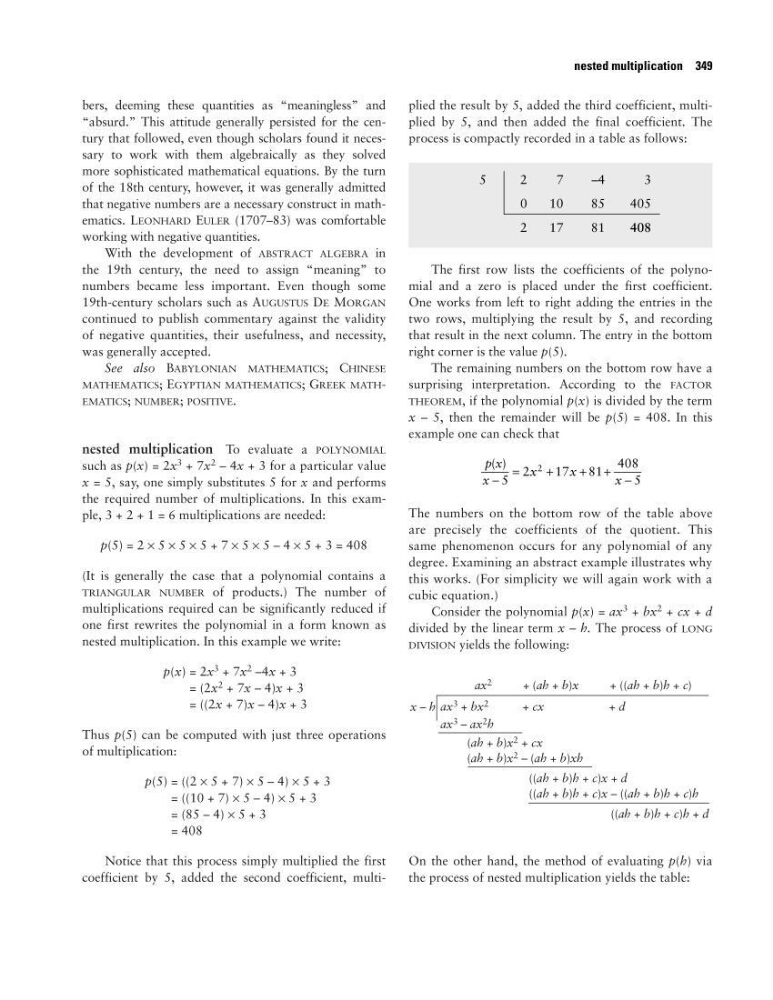
Notice that this process simply multiplied the first
coefficient by 5, added the second coefficient, multiplied the result by 5, added the third coefficient, multiplied by 5, and then added the final coefficient. The
process is compactly recorded in a table as follows:
The first row lists the coefficients of the polynomial and a zero is placed under the first coefficient.
One works from left to right adding the entries in the
two rows, multiplying the result by 5, and recording
that result in the next column. The entry in the bottom
right corner is the value p(5).
The remaining numbers on the bottom row have a
surprising interpretation. According to the FACTOR
THEOREM, if the polynomial p(x) is divided by the term
x – 5, then the remainder will be p(5) = 408. In this
example one can check that
The numbers on the bottom row of the table above
are precisely the coefficients of the quotient. This
same phenomenon occurs for any polynomial of any
degree. Examining an abstract example illustrates why
this works. (For simplicity we will again work with a
cubic equation.)
Consider the polynomial p(x) = ax
3 + bx
2 + cx + d
divided by the linear term x – h. The process of LONG
DIVISION yields the following:
On the other hand, the method of evaluating p(h) via
the process of nested multiplication yields the table:
ax 3 + bx 2
+ cx
+ d
x – h
ax 2
+ (ah + b)x
+ ((ah + b)h + c)
ax 3 – ax 2 h
(ah + b)x 2 + cx
(ah + b)x 2 – (ah + b)xh
((ah + b)h + c)x + d
((ah + b)h + c)x – ((ah + b)h + c)h
((ah + b)h + c)h + d
p x
x
x
x
x
( )
−
=
+
+ + −
5
2
17
81
408
5
2
nested multiplication 349
5
2
7
–4
3
0
10
85
405
2
17
81
408
“absurd.” This attitude generally persisted for the century that followed, even though scholars found it necessary to work with them algebraically as they solved
more sophisticated mathematical equations. By the turn
of the 18th century, however, it was generally admitted
that negative numbers are a necessary construct in mathematics. LEONHARD EULER (1707–83) was comfortable
working with negative quantities.
With the development of ABSTRACT ALGEBRA in
the 19th century, the need to assign “meaning” to
numbers became less important. Even though some
19th-century scholars such as AUGUSTUS DE MORGAN
continued to publish commentary against the validity
of negative quantities, their usefulness, and necessity,
was generally accepted.
See also BABYLONIAN MATHEMATICS; CHINESE
MATHEMATICS; EGYPTIAN MATHEMATICS; GREEK MATHEMATICS; NUMBER; POSITIVE.
nested multiplication To evaluate a POLYNOMIAL
such as p(x) = 2x
3 + 7x
2 – 4x + 3 for a particular value
x = 5, say, one simply substitutes 5 for x and performs
the required number of multiplications. In this example, 3 + 2 + 1 = 6 multiplications are needed:
p(5) = 2 × 5 × 5 × 5 + 7 × 5 × 5 – 4 × 5 + 3 = 408
(It is generally the case that a polynomial contains a
TRIANGULAR NUMBER of products.) The number of
multiplications required can be significantly reduced if
one first rewrites the polynomial in a form known as
nested multiplication. In this example we write:
p(x) = 2x
3 + 7x
2 –4x + 3
= (2x
2 + 7x – 4)x + 3
= ((2x + 7)x – 4)x + 3
Thus p(5) can be computed with just three operations
of multiplication:
p(5) = ((2 × 5 + 7) × 5 – 4) × 5 + 3
= ((10 + 7) × 5 – 4) × 5 + 3
= (85 – 4) × 5 + 3
= 408
Notice that this process simply multiplied the first
coefficient by 5, added the second coefficient, multiplied the result by 5, added the third coefficient, multiplied by 5, and then added the final coefficient. The
process is compactly recorded in a table as follows:
The first row lists the coefficients of the polynomial and a zero is placed under the first coefficient.
One works from left to right adding the entries in the
two rows, multiplying the result by 5, and recording
that result in the next column. The entry in the bottom
right corner is the value p(5).
The remaining numbers on the bottom row have a
surprising interpretation. According to the FACTOR
THEOREM, if the polynomial p(x) is divided by the term
x – 5, then the remainder will be p(5) = 408. In this
example one can check that
The numbers on the bottom row of the table above
are precisely the coefficients of the quotient. This
same phenomenon occurs for any polynomial of any
degree. Examining an abstract example illustrates why
this works. (For simplicity we will again work with a
cubic equation.)
Consider the polynomial p(x) = ax
3 + bx
2 + cx + d
divided by the linear term x – h. The process of LONG
DIVISION yields the following:
On the other hand, the method of evaluating p(h) via
the process of nested multiplication yields the table:
ax 3 + bx 2
+ cx
+ d
x – h
ax 2
+ (ah + b)x
+ ((ah + b)h + c)
ax 3 – ax 2 h
(ah + b)x 2 + cx
(ah + b)x 2 – (ah + b)xh
((ah + b)h + c)x + d
((ah + b)h + c)x – ((ah + b)h + c)h
((ah + b)h + c)h + d
p x
x
x
x
x
( )
−
=
+
+ + −
5
2
17
81
408
5
2
nested multiplication 349
5
2
7
–4
3
0
10
85
405
2
17
81
408