

Comparison of the two tables side by side show that
the two processes are identical.
The process of drawing a table for evaluating a
polynomial p(x) at a value x = h, or, equivalently, for
dividing p(x) by x – h, is called synthetic division. It is a
very simple and efficient process. As an example, the following table shows that the polynomial p(x) = 2x
4 + 3x
3
– 4x
2 + 5x + 4 has value 6 when evaluated at x = ,
and quotient 2x
3 + 4x
2 – 2x + 4 when divided by x – .
Returning to the theme of triangular numbers: Any
nested product of the form:
(9(…(9(9(9 + 1)+1)+1)…+1)+1)
is triangular. For instance, 9 + 1 = 10 = T 4 , 9(9 + 1) + 1
= 91 = T 13 , and 9(9(9 + 1) +1) + 1 = 820 = T 40 . This
follows from the relation 9T n + 1 = T 3n+1 beginning
with T 1 = 1. This relation also shows that if the number of nines present in the nested product is n, then the
-th triangular number is produced.
net In geometry, a net is a diagram drawn on a page
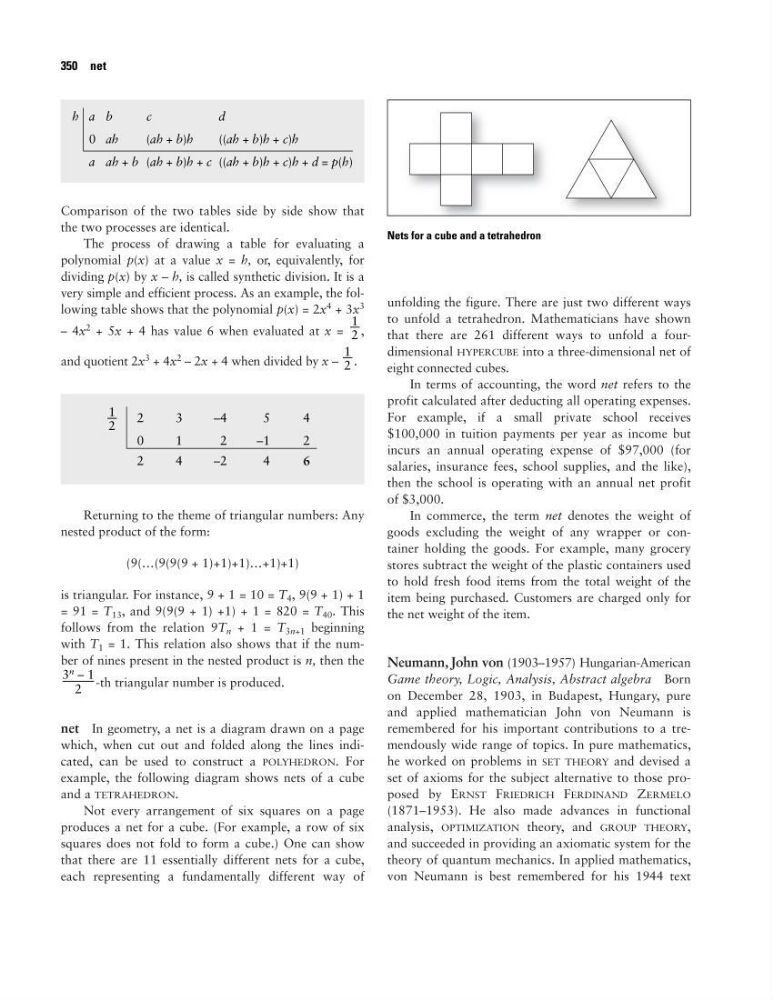
which, when cut out and folded along the lines indicated, can be used to construct a POLYHEDRON. For
example, the following diagram shows nets of a cube
and a TETRAHEDRON.
Not every arrangement of six squares on a page
produces a net for a cube. (For example, a row of six
squares does not fold to form a cube.) One can show
that there are 11 essentially different nets for a cube,
each representing a fundamentally different way of
unfolding the figure. There are just two different ways
to unfold a tetrahedron. Mathematicians have shown
that there are 261 different ways to unfold a fourdimensional HYPERCUBE into a three-dimensional net of
eight connected cubes.
In terms of accounting, the word net refers to the
profit calculated after deducting all operating expenses.
For example, if a small private school receives
$100,000 in tuition payments per year as income but
incurs an annual operating expense of $97,000 (for
salaries, insurance fees, school supplies, and the like),
then the school is operating with an annual net profit
of $3,000.
In commerce, the term net denotes the weight of
goods excluding the weight of any wrapper or container holding the goods. For example, many grocery
stores subtract the weight of the plastic containers used
to hold fresh food items from the total weight of the
item being purchased. Customers are charged only for
the net weight of the item.
Neumann, John von (1903–1957) Hungarian-American
Game theory, Logic, Analysis, Abstract algebra Born
on December 28, 1903, in Budapest, Hungary, pure
and applied mathematician John von Neumann is
remembered for his important contributions to a tremendously wide range of topics. In pure mathematics,
he worked on problems in SET THEORY and devised a
set of axioms for the subject alternative to those proposed by ERNST FRIEDRICH FERDINAND ZERMELO
(1871–1953). He also made advances in functional
analysis, OPTIMIZATION theory, and GROUP THEORY,
and succeeded in providing an axiomatic system for the
theory of quantum mechanics. In applied mathematics,
von Neumann is best remembered for his 1944 text
3
n – 1
––
2
1
–
2
1
–
2
350 net
h a b
c
d
0 ah
(ah + b)h
((ah + b)h + c)h
a ah + b (ah + b)h + c ((ah + b)h + c)h + d = p(h)
2
3
–4
5
4
0
1
2
–1
2
2
4
–2
4
6
1
–
2
Nets for a cube and a tetrahedron
the two processes are identical.
The process of drawing a table for evaluating a
polynomial p(x) at a value x = h, or, equivalently, for
dividing p(x) by x – h, is called synthetic division. It is a
very simple and efficient process. As an example, the following table shows that the polynomial p(x) = 2x
4 + 3x
3
– 4x
2 + 5x + 4 has value 6 when evaluated at x = ,
and quotient 2x
3 + 4x
2 – 2x + 4 when divided by x – .
Returning to the theme of triangular numbers: Any
nested product of the form:
(9(…(9(9(9 + 1)+1)+1)…+1)+1)
is triangular. For instance, 9 + 1 = 10 = T 4 , 9(9 + 1) + 1
= 91 = T 13 , and 9(9(9 + 1) +1) + 1 = 820 = T 40 . This
follows from the relation 9T n + 1 = T 3n+1 beginning
with T 1 = 1. This relation also shows that if the number of nines present in the nested product is n, then the
-th triangular number is produced.
net In geometry, a net is a diagram drawn on a page
which, when cut out and folded along the lines indicated, can be used to construct a POLYHEDRON. For
example, the following diagram shows nets of a cube
and a TETRAHEDRON.
Not every arrangement of six squares on a page
produces a net for a cube. (For example, a row of six
squares does not fold to form a cube.) One can show
that there are 11 essentially different nets for a cube,
each representing a fundamentally different way of
unfolding the figure. There are just two different ways
to unfold a tetrahedron. Mathematicians have shown
that there are 261 different ways to unfold a fourdimensional HYPERCUBE into a three-dimensional net of
eight connected cubes.
In terms of accounting, the word net refers to the
profit calculated after deducting all operating expenses.
For example, if a small private school receives
$100,000 in tuition payments per year as income but
incurs an annual operating expense of $97,000 (for
salaries, insurance fees, school supplies, and the like),
then the school is operating with an annual net profit
of $3,000.
In commerce, the term net denotes the weight of
goods excluding the weight of any wrapper or container holding the goods. For example, many grocery
stores subtract the weight of the plastic containers used
to hold fresh food items from the total weight of the
item being purchased. Customers are charged only for
the net weight of the item.
Neumann, John von (1903–1957) Hungarian-American
Game theory, Logic, Analysis, Abstract algebra Born
on December 28, 1903, in Budapest, Hungary, pure
and applied mathematician John von Neumann is
remembered for his important contributions to a tremendously wide range of topics. In pure mathematics,
he worked on problems in SET THEORY and devised a
set of axioms for the subject alternative to those proposed by ERNST FRIEDRICH FERDINAND ZERMELO
(1871–1953). He also made advances in functional
analysis, OPTIMIZATION theory, and GROUP THEORY,
and succeeded in providing an axiomatic system for the
theory of quantum mechanics. In applied mathematics,
von Neumann is best remembered for his 1944 text
3
n – 1
––
2
1
–
2
1
–
2
350 net
h a b
c
d
0 ah
(ah + b)h
((ah + b)h + c)h
a ah + b (ah + b)h + c ((ah + b)h + c)h + d = p(h)
2
3
–4
5
4
0
1
2
–1
2
2
4
–2
4
6
1
–
2
Nets for a cube and a tetrahedron