

Slowly, over many years, Nash began to recover and
eventually returned to teaching at Princeton and contemplating mathematical work. He delivered a paper at the
10th World Congress of Psychiatry in 1996 describing
his illness. Along with the 1994 Noble Prize, Nash was
awarded the 1999 Leroy P. Steele Prize by the American
Mathematical Association. Nash describes his 45-page
dissertation as his “most trivial work” of his career.
natural number (counting number, whole number)
Any of the positive whole numbers 1, 2, 3, … is called a
natural number or a counting number. The natural numbers are used to count separate objects. The collection of
all counting numbers {1,2,3,…}, called the set of natural
numbers, is denoted N, or sometimes IN or Z
+
. Some
mathematicians choose to include the number ZERO in
this set. (There is no standard convention on the matter.)
The set of natural numbers is closed under ADDITION and MULTIPLICATION, that is, the sum or product
of any two natural numbers is again a natural number.
The set, however, is not closed under SUBTRACTION or
DIVISION. For example, the result of subtracting 5 from
3 is no longer a natural number, nor is the result of
dividing 7 by 2.
An infinite set of objects whose elements can be
arranged in a list akin to the list of natural numbers is
said to be COUNTABLE. Not all infinite sets are countable.
See also CLOSURE PROPERTY; DISCRETE; FIGURATE
NUMBERS; NUMBER; NUMBER THEORY; ORDINAL NUMBERS; WHOLE NUMBER.
necessary condition See CONDITION—NECESSARY AND
SUFFICIENT.
negation (not statement) In FORMAL LOGIC a statement of the form “not p” is called the negation of the
statement p. For example, “Shakespeare did not write
Hamlet” is the negation of the statement that Shakespeare did. In practice it is not always necessary for the
term not to occur. For example, the negation of x > y is
x ≤ y.
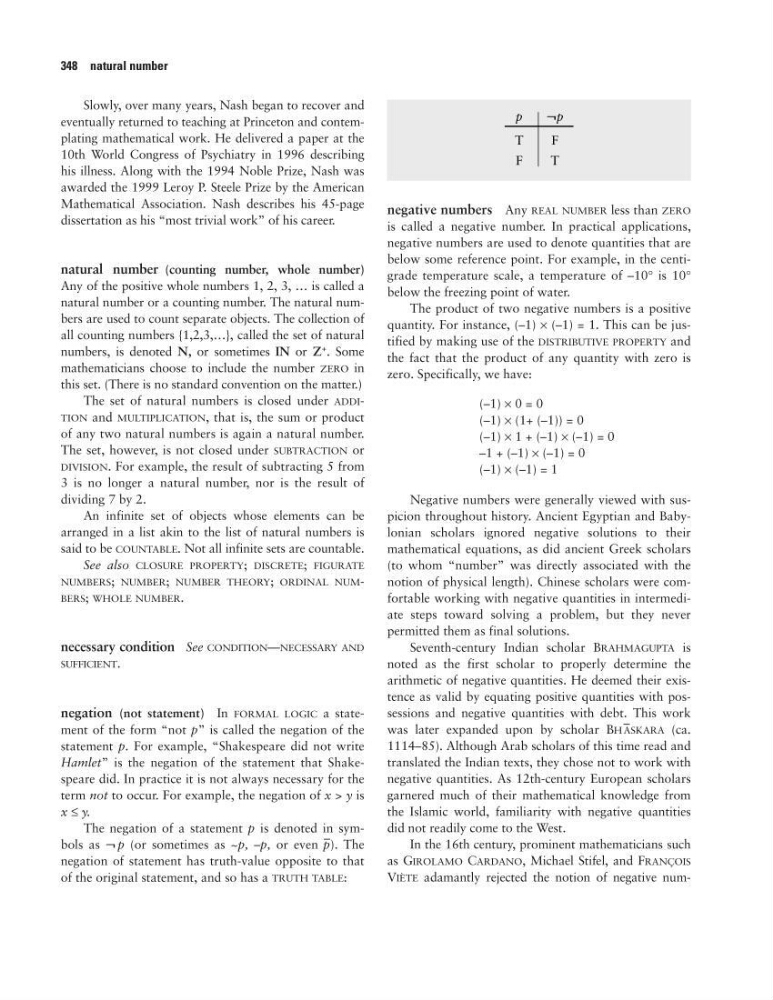
The negation of a statement p is denoted in symbols as ¬ p (or sometimes as ~p, –p, or even
–
p). The
negation of statement has truth-value opposite to that
of the original statement, and so has a TRUTH TABLE:
negative numbers Any REAL NUMBER less than ZERO
is called a negative number. In practical applications,
negative numbers are used to denote quantities that are
below some reference point. For example, in the centigrade temperature scale, a temperature of –10° is 10°
below the freezing point of water.
The product of two negative numbers is a positive
quantity. For instance, (–1) × (–1) = 1. This can be justified by making use of the DISTRIBUTIVE PROPERTY and
the fact that the product of any quantity with zero is
zero. Specifically, we have:
(–1) × 0 = 0
(–1) × (1+ (–1)) = 0
(–1) × 1 + (–1) × (–1) = 0
–1 + (–1) × (–1) = 0
(–1) × (–1) = 1
Negative numbers were generally viewed with suspicion throughout history. Ancient Egyptian and Babylonian scholars ignored negative solutions to their
mathematical equations, as did ancient Greek scholars
(to whom “number” was directly associated with the
notion of physical length). Chinese scholars were comfortable working with negative quantities in intermediate steps toward solving a problem, but they never
permitted them as final solutions.
Seventh-century Indian scholar BRAHMAGUPTA is
noted as the first scholar to properly determine the
arithmetic of negative quantities. He deemed their existence as valid by equating positive quantities with possessions and negative quantities with debt. This work
was later expanded upon by scholar BH
–
ASKARA (ca.
1114–85). Although Arab scholars of this time read and
translated the Indian texts, they chose not to work with
negative quantities. As 12th-century European scholars
garnered much of their mathematical knowledge from
the Islamic world, familiarity with negative quantities
did not readily come to the West.
In the 16th century, prominent mathematicians such
as GIROLAMO CARDANO, Michael Stifel, and FRANÇOIS
VIÈTE adamantly rejected the notion of negative num348 natural number
p
¬p
T
F
F
T
eventually returned to teaching at Princeton and contemplating mathematical work. He delivered a paper at the
10th World Congress of Psychiatry in 1996 describing
his illness. Along with the 1994 Noble Prize, Nash was
awarded the 1999 Leroy P. Steele Prize by the American
Mathematical Association. Nash describes his 45-page
dissertation as his “most trivial work” of his career.
natural number (counting number, whole number)
Any of the positive whole numbers 1, 2, 3, … is called a
natural number or a counting number. The natural numbers are used to count separate objects. The collection of
all counting numbers {1,2,3,…}, called the set of natural
numbers, is denoted N, or sometimes IN or Z
+
. Some
mathematicians choose to include the number ZERO in
this set. (There is no standard convention on the matter.)
The set of natural numbers is closed under ADDITION and MULTIPLICATION, that is, the sum or product
of any two natural numbers is again a natural number.
The set, however, is not closed under SUBTRACTION or
DIVISION. For example, the result of subtracting 5 from
3 is no longer a natural number, nor is the result of
dividing 7 by 2.
An infinite set of objects whose elements can be
arranged in a list akin to the list of natural numbers is
said to be COUNTABLE. Not all infinite sets are countable.
See also CLOSURE PROPERTY; DISCRETE; FIGURATE
NUMBERS; NUMBER; NUMBER THEORY; ORDINAL NUMBERS; WHOLE NUMBER.
necessary condition See CONDITION—NECESSARY AND
SUFFICIENT.
negation (not statement) In FORMAL LOGIC a statement of the form “not p” is called the negation of the
statement p. For example, “Shakespeare did not write
Hamlet” is the negation of the statement that Shakespeare did. In practice it is not always necessary for the
term not to occur. For example, the negation of x > y is
x ≤ y.
The negation of a statement p is denoted in symbols as ¬ p (or sometimes as ~p, –p, or even
–
p). The
negation of statement has truth-value opposite to that
of the original statement, and so has a TRUTH TABLE:
negative numbers Any REAL NUMBER less than ZERO
is called a negative number. In practical applications,
negative numbers are used to denote quantities that are
below some reference point. For example, in the centigrade temperature scale, a temperature of –10° is 10°
below the freezing point of water.
The product of two negative numbers is a positive
quantity. For instance, (–1) × (–1) = 1. This can be justified by making use of the DISTRIBUTIVE PROPERTY and
the fact that the product of any quantity with zero is
zero. Specifically, we have:
(–1) × 0 = 0
(–1) × (1+ (–1)) = 0
(–1) × 1 + (–1) × (–1) = 0
–1 + (–1) × (–1) = 0
(–1) × (–1) = 1
Negative numbers were generally viewed with suspicion throughout history. Ancient Egyptian and Babylonian scholars ignored negative solutions to their
mathematical equations, as did ancient Greek scholars
(to whom “number” was directly associated with the
notion of physical length). Chinese scholars were comfortable working with negative quantities in intermediate steps toward solving a problem, but they never
permitted them as final solutions.
Seventh-century Indian scholar BRAHMAGUPTA is
noted as the first scholar to properly determine the
arithmetic of negative quantities. He deemed their existence as valid by equating positive quantities with possessions and negative quantities with debt. This work
was later expanded upon by scholar BH
–
ASKARA (ca.
1114–85). Although Arab scholars of this time read and
translated the Indian texts, they chose not to work with
negative quantities. As 12th-century European scholars
garnered much of their mathematical knowledge from
the Islamic world, familiarity with negative quantities
did not readily come to the West.
In the 16th century, prominent mathematicians such
as GIROLAMO CARDANO, Michael Stifel, and FRANÇOIS
VIÈTE adamantly rejected the notion of negative num348 natural number
p
¬p
T
F
F
T