

As a variation of HERON’S FORMULA, the area of a
triangle can be expressed solely in terms of the lengths
of the medians of the triangle. We have:
where m A , m B , and m C are the lengths of the three
medians and s =
.
See also AAA/AAS/ASA/SAS/SSS; APOLLONIUS’S THEOREM; EULER LINE.
Menelaus of Alexandria (ca. 70–130) Greek Geometry, Trigonometry Born in Alexandria, Egypt, mathematician Menelaus is noted for his only surviving work
Sphaerica (Spheres), which contains the earliest known
results on SPHERICAL GEOMETRY and spherical trigonometry. By converting spherical results into planar ones,
Menelaus also established a number of significant theorems about planar geometry, including the famous result
that now bears his name.
Extremely little is known of Menelaus’s life.
Despite being cited throughout history as a native of
Alexandria, it is known that Menelaus spent some portion of his life in Rome. For instance, records from the
year 98 list a number of astronomical observations
made by Menelaus from that city at that time.
Menelaus’s work in spherical geometry was likely
inspired by his work in astronomy. The first of the
three volumes of Sphaerica defines the basic principles
of the subject and includes the very precise definition of
a spherical triangle as one made by three arcs of great
circles, each less than a semicircle. Following the same
level of rigor as established by the geometer EUCLID,
Menelaus developed the theory of this geometry in considerable depth with precise logical reasoning. (Curiously, Menelaus eschewed any use of PROOF BY
CONTRADICTION, an approach that Euclid freely used.)
In volume II of Sphaerica, Menelaus developed applications to astronomy, and in volume III explored spherical trigonometry and applications to plane geometry.
Arab scholars of the period 850–1500 C.E. translated Menelaus’s work and wrote many commentaries
on the piece. The same scholars also made reference to
other texts by Menelaus, including pieces called Chords
in a Circle and Elements of Geometry, as well as a
comprehensive text on the topic of mechanics. Sadly,
no copies of these works survive today.
See also ARABIC MATHEMATICS; MENELAUS’S
THEOREM.
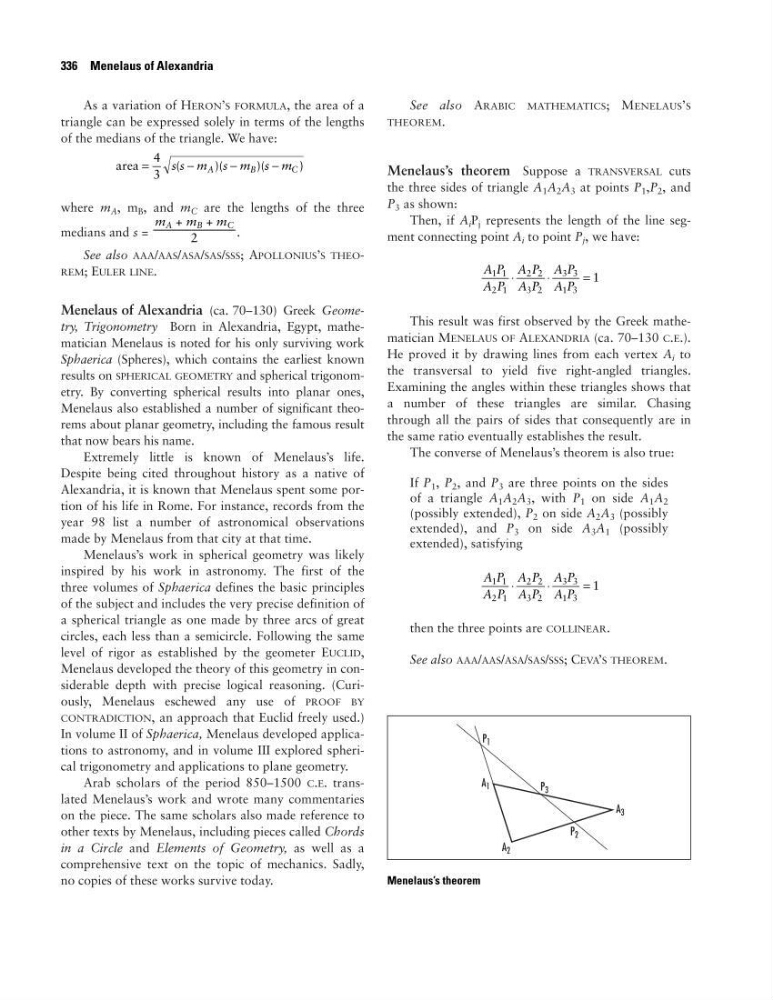
Menelaus’s theorem Suppose a TRANSVERSAL cuts
the three sides of triangle A 1 A 2 A 3 at points P 1 ,P 2 , and
P 3 as shown:
Then, if A i P j represents the length of the line segment connecting point A i to point P j , we have:
This result was first observed by the Greek mathematician MENELAUS OF ALEXANDRIA (ca. 70–130 C.E.).
He proved it by drawing lines from each vertex A i to
the transversal to yield five right-angled triangles.
Examining the angles within these triangles shows that
a number of these triangles are similar. Chasing
through all the pairs of sides that consequently are in
the same ratio eventually establishes the result.
The converse of Menelaus’s theorem is also true:
If P 1 , P 2 , and P 3 are three points on the sides
of a triangle A 1 A 2 A 3 , with P 1 on side A 1 A 2
(possibly extended), P 2 on side A 2 A 3 (possibly
extended), and P 3 on side A 3 A 1 (possibly
extended), satisfying
then the three points are COLLINEAR.
See also AAA/AAS/ASA/SAS/SSS; CEVA’S THEOREM.
A P
A P
A P
A P
A P
A P
1 1
2 1
2 2
3 2
3 3
1 3
1
⋅
⋅
=
A P
A P
A P
A P
A P
A P
1 1
2 1
2 2
3 2
3 3
1 3
1
⋅
⋅
=
m A + m B + m C
––––––
2
area =
−
−
−
4
3
s s m s m s m
A
B
C
(
)(
)(
)
336 Menelaus of Alexandria
Menelaus’s theorem
triangle can be expressed solely in terms of the lengths
of the medians of the triangle. We have:
where m A , m B , and m C are the lengths of the three
medians and s =
.
See also AAA/AAS/ASA/SAS/SSS; APOLLONIUS’S THEOREM; EULER LINE.
Menelaus of Alexandria (ca. 70–130) Greek Geometry, Trigonometry Born in Alexandria, Egypt, mathematician Menelaus is noted for his only surviving work
Sphaerica (Spheres), which contains the earliest known
results on SPHERICAL GEOMETRY and spherical trigonometry. By converting spherical results into planar ones,
Menelaus also established a number of significant theorems about planar geometry, including the famous result
that now bears his name.
Extremely little is known of Menelaus’s life.
Despite being cited throughout history as a native of
Alexandria, it is known that Menelaus spent some portion of his life in Rome. For instance, records from the
year 98 list a number of astronomical observations
made by Menelaus from that city at that time.
Menelaus’s work in spherical geometry was likely
inspired by his work in astronomy. The first of the
three volumes of Sphaerica defines the basic principles
of the subject and includes the very precise definition of
a spherical triangle as one made by three arcs of great
circles, each less than a semicircle. Following the same
level of rigor as established by the geometer EUCLID,
Menelaus developed the theory of this geometry in considerable depth with precise logical reasoning. (Curiously, Menelaus eschewed any use of PROOF BY
CONTRADICTION, an approach that Euclid freely used.)
In volume II of Sphaerica, Menelaus developed applications to astronomy, and in volume III explored spherical trigonometry and applications to plane geometry.
Arab scholars of the period 850–1500 C.E. translated Menelaus’s work and wrote many commentaries
on the piece. The same scholars also made reference to
other texts by Menelaus, including pieces called Chords
in a Circle and Elements of Geometry, as well as a
comprehensive text on the topic of mechanics. Sadly,
no copies of these works survive today.
See also ARABIC MATHEMATICS; MENELAUS’S
THEOREM.
Menelaus’s theorem Suppose a TRANSVERSAL cuts
the three sides of triangle A 1 A 2 A 3 at points P 1 ,P 2 , and
P 3 as shown:
Then, if A i P j represents the length of the line segment connecting point A i to point P j , we have:
This result was first observed by the Greek mathematician MENELAUS OF ALEXANDRIA (ca. 70–130 C.E.).
He proved it by drawing lines from each vertex A i to
the transversal to yield five right-angled triangles.
Examining the angles within these triangles shows that
a number of these triangles are similar. Chasing
through all the pairs of sides that consequently are in
the same ratio eventually establishes the result.
The converse of Menelaus’s theorem is also true:
If P 1 , P 2 , and P 3 are three points on the sides
of a triangle A 1 A 2 A 3 , with P 1 on side A 1 A 2
(possibly extended), P 2 on side A 2 A 3 (possibly
extended), and P 3 on side A 3 A 1 (possibly
extended), satisfying
then the three points are COLLINEAR.
See also AAA/AAS/ASA/SAS/SSS; CEVA’S THEOREM.
A P
A P
A P
A P
A P
A P
1 1
2 1
2 2
3 2
3 3
1 3
1
⋅
⋅
=
A P
A P
A P
A P
A P
A P
1 1
2 1
2 2
3 2
3 3
1 3
1
⋅
⋅
=
m A + m B + m C
––––––
2
area =
−
−
−
4
3
s s m s m s m
A
B
C
(
)(
)(
)
336 Menelaus of Alexandria
Menelaus’s theorem