

The mean-value theorem itself can be established
as a consequence of ROLLE’S THEOREM. One does this
by writing down the equation of the line that connects
the two endpoints (a,f(a)) and (b,f (b)) of the function f.
It is given by:
(Put in x = a and x = b to see that this is correct.) Now
consider the function:
h(k) = f(x) – g(x)
It is a differentiable function with h(a) = h(b) = 0, and
so by Rolle’s theorem, there is at least one value c
between a and b for which h′(c) = f ′(c) – g′(c) = 0. This
yields the equation asserted in the statement of the
mean-value theorem.
The mean-value theorem can be thought of as a
statement about the nature of a differentiable curve
intersecting a straight line. French mathematician
AUGUSTIN-LOUIS CAUCHY (1789–1857) later generalized the theorem to one about any two differentiable
curves intersecting at two points. The result is known
as the extended mean-value theorem or Cauchy’s meanvalue theorem.
If two functions f and g have the same values
at x = a and x = b, are continuous in the closed
interval [a,b], differentiable in the open interval (a,b), and further if g(a) ≠ g(b) and g′(x) is
never zero in (a,b), then there is at least one
value c between a and b for which:
The theorem is proved in a similar way by making use
of the support function:
See also DERIVATIVE; INCREASING/DECREASING.
median See STATISTICS: DESCRIPTIVE.
median of a triangle A line segment connecting the
MIDPOINT of one side of a triangle to the vertex opposite
to that side is called a median of the triangle. Any triangle has three medians. It is considered a fundamental
result that the three medians of a triangle always meet at
a common point (called the centroid of the triangle and
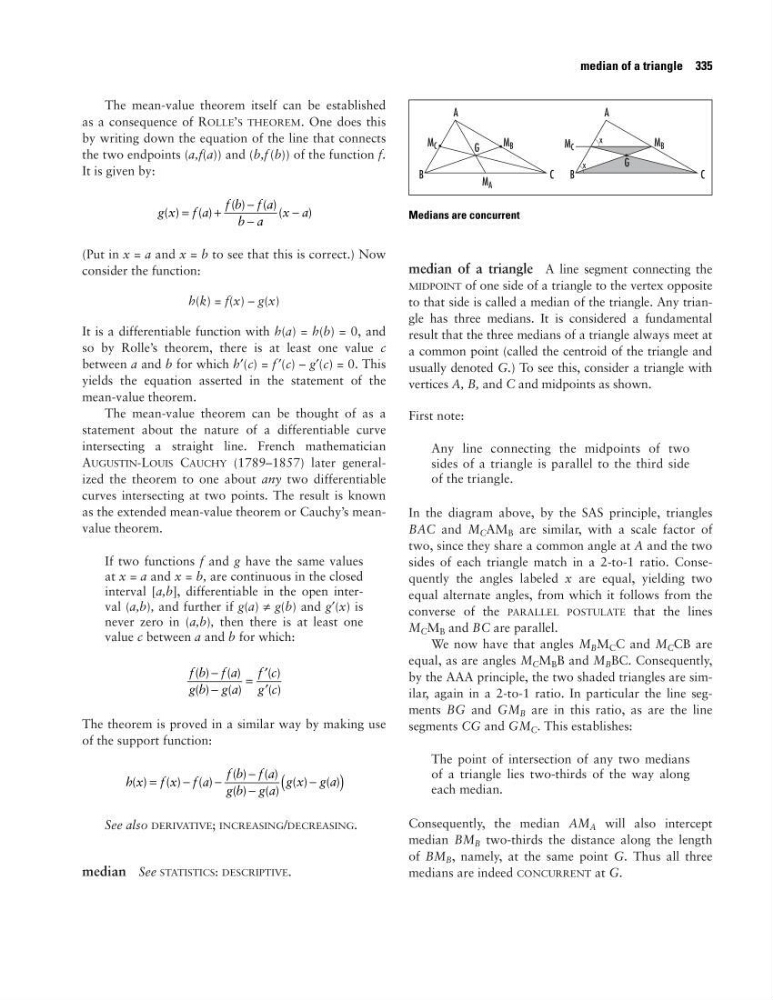
usually denoted G.) To see this, consider a triangle with
vertices A, B, and C and midpoints as shown.
First note:
Any line connecting the midpoints of two
sides of a triangle is parallel to the third side
of the triangle.
In the diagram above, by the SAS principle, triangles
BAC and M C AM B are similar, with a scale factor of
two, since they share a common angle at A and the two
sides of each triangle match in a 2-to-1 ratio. Consequently the angles labeled x are equal, yielding two
equal alternate angles, from which it follows from the
converse of the PARALLEL POSTULATE that the lines
M C M B and BC are parallel.
We now have that angles M B M C C and M C CB are
equal, as are angles M C M B B and M B BC. Consequently,
by the AAA principle, the two shaded triangles are similar, again in a 2-to-1 ratio. In particular the line segments BG and GM B are in this ratio, as are the line
segments CG and GM C . This establishes:
The point of intersection of any two medians
of a triangle lies two-thirds of the way along
each median.
Consequently, the median AM A will also intercept
median BM B two-thirds the distance along the length
of BM B , namely, at the same point G. Thus all three
medians are indeed CONCURRENT at G.
h x f x f a
f b f a
g b g a
g x g a
( ) ( ) ( )
( ) ( )
( ) ( )
( ) ( )
=
−
−
−
−
−
(
)
f b f a
g b g a
f c
g c
( ) ( )
( ) ( )
( )
( )
−
−
=
′
′
g x f a
f b f a
b a
x a
( ) ( )
( ) ( ) (
)
=
+
−
−
−
median of a triangle 335
Medians are concurrent
as a consequence of ROLLE’S THEOREM. One does this
by writing down the equation of the line that connects
the two endpoints (a,f(a)) and (b,f (b)) of the function f.
It is given by:
(Put in x = a and x = b to see that this is correct.) Now
consider the function:
h(k) = f(x) – g(x)
It is a differentiable function with h(a) = h(b) = 0, and
so by Rolle’s theorem, there is at least one value c
between a and b for which h′(c) = f ′(c) – g′(c) = 0. This
yields the equation asserted in the statement of the
mean-value theorem.
The mean-value theorem can be thought of as a
statement about the nature of a differentiable curve
intersecting a straight line. French mathematician
AUGUSTIN-LOUIS CAUCHY (1789–1857) later generalized the theorem to one about any two differentiable
curves intersecting at two points. The result is known
as the extended mean-value theorem or Cauchy’s meanvalue theorem.
If two functions f and g have the same values
at x = a and x = b, are continuous in the closed
interval [a,b], differentiable in the open interval (a,b), and further if g(a) ≠ g(b) and g′(x) is
never zero in (a,b), then there is at least one
value c between a and b for which:
The theorem is proved in a similar way by making use
of the support function:
See also DERIVATIVE; INCREASING/DECREASING.
median See STATISTICS: DESCRIPTIVE.
median of a triangle A line segment connecting the
MIDPOINT of one side of a triangle to the vertex opposite
to that side is called a median of the triangle. Any triangle has three medians. It is considered a fundamental
result that the three medians of a triangle always meet at
a common point (called the centroid of the triangle and
usually denoted G.) To see this, consider a triangle with
vertices A, B, and C and midpoints as shown.
First note:
Any line connecting the midpoints of two
sides of a triangle is parallel to the third side
of the triangle.
In the diagram above, by the SAS principle, triangles
BAC and M C AM B are similar, with a scale factor of
two, since they share a common angle at A and the two
sides of each triangle match in a 2-to-1 ratio. Consequently the angles labeled x are equal, yielding two
equal alternate angles, from which it follows from the
converse of the PARALLEL POSTULATE that the lines
M C M B and BC are parallel.
We now have that angles M B M C C and M C CB are
equal, as are angles M C M B B and M B BC. Consequently,
by the AAA principle, the two shaded triangles are similar, again in a 2-to-1 ratio. In particular the line segments BG and GM B are in this ratio, as are the line
segments CG and GM C . This establishes:
The point of intersection of any two medians
of a triangle lies two-thirds of the way along
each median.
Consequently, the median AM A will also intercept
median BM B two-thirds the distance along the length
of BM B , namely, at the same point G. Thus all three
medians are indeed CONCURRENT at G.
h x f x f a
f b f a
g b g a
g x g a
( ) ( ) ( )
( ) ( )
( ) ( )
( ) ( )
=
−
−
−
−
−
(
)
f b f a
g b g a
f c
g c
( ) ( )
( ) ( )
( )
( )
−
−
=
′
′
g x f a
f b f a
b a
x a
( ) ( )
( ) ( ) (
)
=
+
−
−
−
median of a triangle 335
Medians are concurrent