

The scalar product and the matrix sum satisfy the
relation:
k(A + B) = kA + kB
3. Matrix Multiplication: The DOT PRODUCT of two vectors provides a natural way to obtain a single numerical value from two separate lists of numbers: the
product of (x 1 ,x 2 ,…,x n ) and (y 1 ,y 2 ,…,y n ) is given by
the sum x 1 y 1 + x 2 y 2 +…+x n y n . Each row and column
of a matrix provides a list of numbers, and so one can
create from two matrices A and B a new array of
numerical values whose entries are the dot products of
the rows or columns of A with the rows or the
columns of B. It has proved to be convenient to just
use the rows of A and the columns of B, provided that
the number of entries in each row of A matches the
number of entries in each column of B. In summary:
If A is an n × m matrix and B an m × r matrix,
then the matrix product AB is the n × r matrix
whose (i,j)th entry is the dot product of the ith
row of A with the jth column of B. We have:
(AB) ij = A i1 B 1j + A i2 B 2j +…+A im B mj
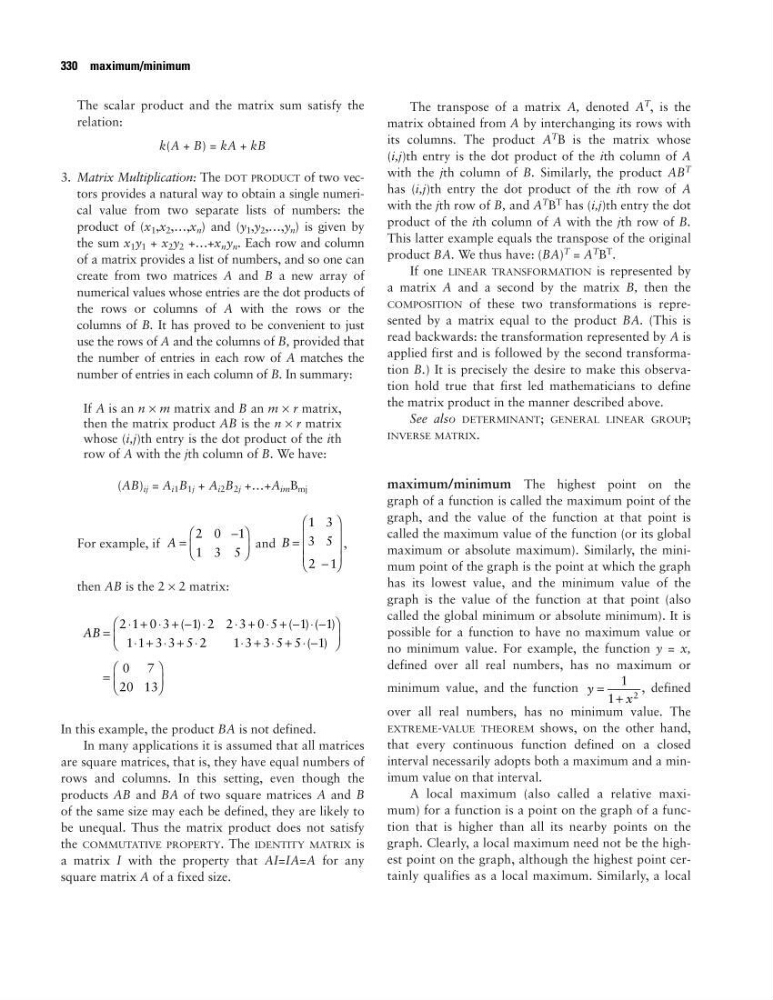
For example, if
and
,
then AB is the 2 × 2 matrix:
In this example, the product BA is not defined.
In many applications it is assumed that all matrices
are square matrices, that is, they have equal numbers of
rows and columns. In this setting, even though the
products AB and BA of two square matrices A and B
of the same size may each be defined, they are likely to
be unequal. Thus the matrix product does not satisfy
the COMMUTATIVE PROPERTY. The IDENTITY MATRIX is
a matrix I with the property that AI=IA=A for any
square matrix A of a fixed size.
The transpose of a matrix A, denoted A
T , is the
matrix obtained from A by interchanging its rows with
its columns. The product A
T B is the matrix whose
(i,j)th entry is the dot product of the ith column of A
with the jth column of B. Similarly, the product AB
T
has (i,j)th entry the dot product of the ith row of A
with the jth row of B, and A
T B
T has (i,j)th entry the dot
product of the ith column of A with the jth row of B.
This latter example equals the transpose of the original
product BA. We thus have: (BA)
T = A
T B
T .
If one LINEAR TRANSFORMATION is represented by
a matrix A and a second by the matrix B, then the
COMPOSITION of these two transformations is represented by a matrix equal to the product BA. (This is
read backwards: the transformation represented by A is
applied first and is followed by the second transformation B.) It is precisely the desire to make this observation hold true that first led mathematicians to define
the matrix product in the manner described above.
See also DETERMINANT; GENERAL LINEAR GROUP;
INVERSE MATRIX.
maximum/minimum The highest point on the
graph of a function is called the maximum point of the
graph, and the value of the function at that point is
called the maximum value of the function (or its global
maximum or absolute maximum). Similarly, the minimum point of the graph is the point at which the graph
has its lowest value, and the minimum value of the
graph is the value of the function at that point (also
called the global minimum or absolute minimum). It is
possible for a function to have no maximum value or
no minimum value. For example, the function y = x,
defined over all real numbers, has no maximum or
minimum value, and the function
, defined
over all real numbers, has no minimum value. The
EXTREME-VALUE THEOREM shows, on the other hand,
that every continuous function defined on a closed
interval necessarily adopts both a maximum and a minimum value on that interval.
A local maximum (also called a relative maximum) for a function is a point on the graph of a function that is higher than all its nearby points on the
graph. Clearly, a local maximum need not be the highest point on the graph, although the highest point certainly qualifies as a local maximum. Similarly, a local
y
x
= +
1
1
2
AB =
⋅ + ⋅ + − ⋅
⋅ + ⋅ + − ⋅ −
⋅ + ⋅ + ⋅
⋅ + ⋅ + ⋅ −
⎛
⎝
⎜
⎞
⎠
⎟
=
⎛
⎝
⎜
⎞
⎠
⎟
2 1 0 3
1 2 2 3 0 5
1
1
1 1 3 3 5 2
1 3 3 5 5 1
0 7
20 13
( )
( ) ( )
( )
B =
−
⎛
⎝
⎜
⎜
⎜
⎞
⎠
⎟
⎟
⎟
1 3
3 5
2 1
A =
−
⎛
⎝
⎜
⎞
⎠
⎟
2 0
1 3
1
5
330 maximum/minimum
relation:
k(A + B) = kA + kB
3. Matrix Multiplication: The DOT PRODUCT of two vectors provides a natural way to obtain a single numerical value from two separate lists of numbers: the
product of (x 1 ,x 2 ,…,x n ) and (y 1 ,y 2 ,…,y n ) is given by
the sum x 1 y 1 + x 2 y 2 +…+x n y n . Each row and column
of a matrix provides a list of numbers, and so one can
create from two matrices A and B a new array of
numerical values whose entries are the dot products of
the rows or columns of A with the rows or the
columns of B. It has proved to be convenient to just
use the rows of A and the columns of B, provided that
the number of entries in each row of A matches the
number of entries in each column of B. In summary:
If A is an n × m matrix and B an m × r matrix,
then the matrix product AB is the n × r matrix
whose (i,j)th entry is the dot product of the ith
row of A with the jth column of B. We have:
(AB) ij = A i1 B 1j + A i2 B 2j +…+A im B mj
For example, if
and
,
then AB is the 2 × 2 matrix:
In this example, the product BA is not defined.
In many applications it is assumed that all matrices
are square matrices, that is, they have equal numbers of
rows and columns. In this setting, even though the
products AB and BA of two square matrices A and B
of the same size may each be defined, they are likely to
be unequal. Thus the matrix product does not satisfy
the COMMUTATIVE PROPERTY. The IDENTITY MATRIX is
a matrix I with the property that AI=IA=A for any
square matrix A of a fixed size.
The transpose of a matrix A, denoted A
T , is the
matrix obtained from A by interchanging its rows with
its columns. The product A
T B is the matrix whose
(i,j)th entry is the dot product of the ith column of A
with the jth column of B. Similarly, the product AB
T
has (i,j)th entry the dot product of the ith row of A
with the jth row of B, and A
T B
T has (i,j)th entry the dot
product of the ith column of A with the jth row of B.
This latter example equals the transpose of the original
product BA. We thus have: (BA)
T = A
T B
T .
If one LINEAR TRANSFORMATION is represented by
a matrix A and a second by the matrix B, then the
COMPOSITION of these two transformations is represented by a matrix equal to the product BA. (This is
read backwards: the transformation represented by A is
applied first and is followed by the second transformation B.) It is precisely the desire to make this observation hold true that first led mathematicians to define
the matrix product in the manner described above.
See also DETERMINANT; GENERAL LINEAR GROUP;
INVERSE MATRIX.
maximum/minimum The highest point on the
graph of a function is called the maximum point of the
graph, and the value of the function at that point is
called the maximum value of the function (or its global
maximum or absolute maximum). Similarly, the minimum point of the graph is the point at which the graph
has its lowest value, and the minimum value of the
graph is the value of the function at that point (also
called the global minimum or absolute minimum). It is
possible for a function to have no maximum value or
no minimum value. For example, the function y = x,
defined over all real numbers, has no maximum or
minimum value, and the function
, defined
over all real numbers, has no minimum value. The
EXTREME-VALUE THEOREM shows, on the other hand,
that every continuous function defined on a closed
interval necessarily adopts both a maximum and a minimum value on that interval.
A local maximum (also called a relative maximum) for a function is a point on the graph of a function that is higher than all its nearby points on the
graph. Clearly, a local maximum need not be the highest point on the graph, although the highest point certainly qualifies as a local maximum. Similarly, a local
y
x
= +
1
1
2
AB =
⋅ + ⋅ + − ⋅
⋅ + ⋅ + − ⋅ −
⋅ + ⋅ + ⋅
⋅ + ⋅ + ⋅ −
⎛
⎝
⎜
⎞
⎠
⎟
=
⎛
⎝
⎜
⎞
⎠
⎟
2 1 0 3
1 2 2 3 0 5
1
1
1 1 3 3 5 2
1 3 3 5 5 1
0 7
20 13
( )
( ) ( )
( )
B =
−
⎛
⎝
⎜
⎜
⎜
⎞
⎠
⎟
⎟
⎟
1 3
3 5
2 1
A =
−
⎛
⎝
⎜
⎞
⎠
⎟
2 0
1 3
1
5
330 maximum/minimum