

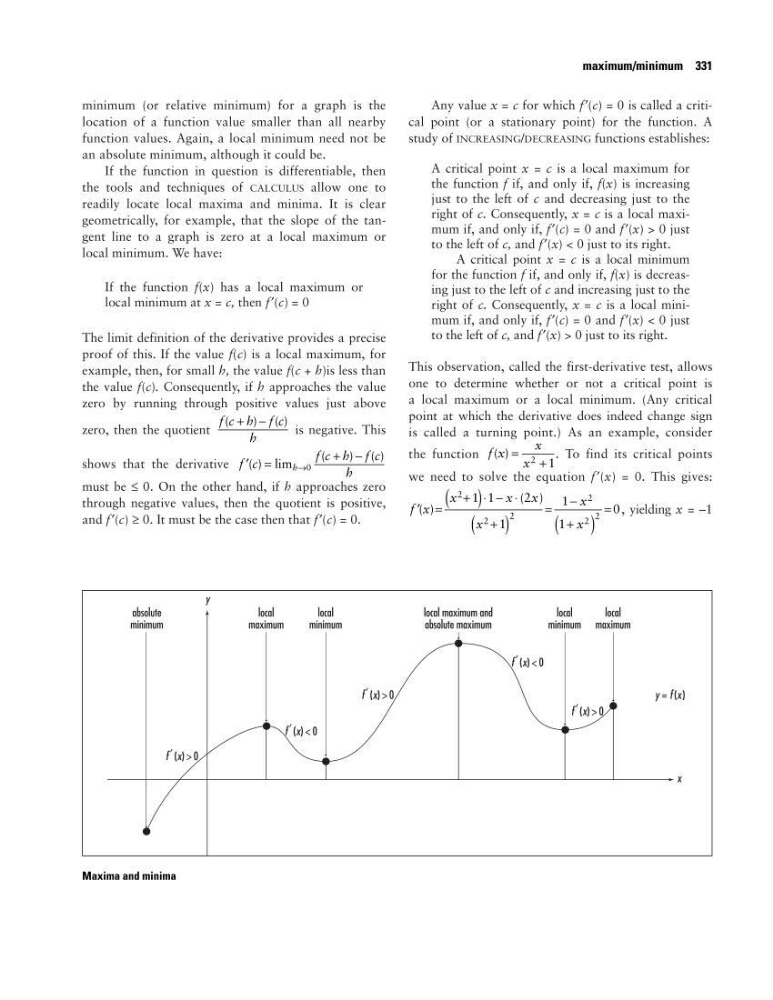
minimum (or relative minimum) for a graph is the
location of a function value smaller than all nearby
function values. Again, a local minimum need not be
an absolute minimum, although it could be.
If the function in question is differentiable, then
the tools and techniques of CALCULUS allow one to
readily locate local maxima and minima. It is clear
geometrically, for example, that the slope of the tangent line to a graph is zero at a local maximum or
local minimum. We have:
If the function f(x) has a local maximum or
local minimum at x = c, then f′(c) = 0
The limit definition of the derivative provides a precise
proof of this. If the value f(c) is a local maximum, for
example, then, for small h, the value f(c + h)is less than
the value f(c). Consequently, if h approaches the value
zero by running through positive values just above
zero, then the quotient
is negative. This
shows that the derivative
must be ≤ 0. On the other hand, if h approaches zero
through negative values, then the quotient is positive,
and f′(c) ≥ 0. It must be the case then that f′(c) = 0.
Any value x = c for which f ′(c) = 0 is called a critical point (or a stationary point) for the function. A
study of INCREASING/DECREASING functions establishes:
A critical point x = c is a local maximum for
the function f if, and only if, f(x) is increasing
just to the left of c and decreasing just to the
right of c. Consequently, x = c is a local maximum if, and only if, f′(c) = 0 and f′(x) > 0 just
to the left of c, and f′(x) < 0 just to its right.
A critical point x = c is a local minimum
for the function f if, and only if, f(x) is decreasing just to the left of c and increasing just to the
right of c. Consequently, x = c is a local minimum if, and only if, f′(c) = 0 and f′(x) < 0 just
to the left of c, and f′(x) > 0 just to its right.
This observation, called the first-derivative test, allows
one to determine whether or not a critical point is
a local maximum or a local minimum. (Any critical
point at which the derivative does indeed change sign
is called a turning point.) As an example, consider
the function
. To find its critical points
we need to solve the equation f ′(x) = 0. This gives:
, yielding x = –1
′ =
+
( ) ⋅ − ⋅
+
( )
=
−
+
( )
=
f x
x
x x
x
x
x
( )
( )
2
2
2
2
2
2
1 1
2
1
1
1
0
f x
x
x
( ) =
+
2 1
′ =
+ −
→
f c
f c h f c
h
h
( ) lim
(
) ( )
0
f c h f c
h
(
) ( )
+ −
maximum/minimum 331
Maxima and minima
location of a function value smaller than all nearby
function values. Again, a local minimum need not be
an absolute minimum, although it could be.
If the function in question is differentiable, then
the tools and techniques of CALCULUS allow one to
readily locate local maxima and minima. It is clear
geometrically, for example, that the slope of the tangent line to a graph is zero at a local maximum or
local minimum. We have:
If the function f(x) has a local maximum or
local minimum at x = c, then f′(c) = 0
The limit definition of the derivative provides a precise
proof of this. If the value f(c) is a local maximum, for
example, then, for small h, the value f(c + h)is less than
the value f(c). Consequently, if h approaches the value
zero by running through positive values just above
zero, then the quotient
is negative. This
shows that the derivative
must be ≤ 0. On the other hand, if h approaches zero
through negative values, then the quotient is positive,
and f′(c) ≥ 0. It must be the case then that f′(c) = 0.
Any value x = c for which f ′(c) = 0 is called a critical point (or a stationary point) for the function. A
study of INCREASING/DECREASING functions establishes:
A critical point x = c is a local maximum for
the function f if, and only if, f(x) is increasing
just to the left of c and decreasing just to the
right of c. Consequently, x = c is a local maximum if, and only if, f′(c) = 0 and f′(x) > 0 just
to the left of c, and f′(x) < 0 just to its right.
A critical point x = c is a local minimum
for the function f if, and only if, f(x) is decreasing just to the left of c and increasing just to the
right of c. Consequently, x = c is a local minimum if, and only if, f′(c) = 0 and f′(x) < 0 just
to the left of c, and f′(x) > 0 just to its right.
This observation, called the first-derivative test, allows
one to determine whether or not a critical point is
a local maximum or a local minimum. (Any critical
point at which the derivative does indeed change sign
is called a turning point.) As an example, consider
the function
. To find its critical points
we need to solve the equation f ′(x) = 0. This gives:
, yielding x = –1
′ =
+
( ) ⋅ − ⋅
+
( )
=
−
+
( )
=
f x
x
x x
x
x
x
( )
( )
2
2
2
2
2
2
1 1
2
1
1
1
0
f x
x
x
( ) =
+
2 1
′ =
+ −
→
f c
f c h f c
h
h
( ) lim
(
) ( )
0
f c h f c
h
(
) ( )
+ −
maximum/minimum 331
Maxima and minima