

have the same magnitude.) The magnitude of a VECTOR
is its length.
Physicists and astronomers use the phrase ORDER OF
MAGNITUDE to refer to the smallest power of 10 needed
to represent a quantity. For example, the numbers 4×10
23
and 9.78×10
23 are of the same order of magnitude.
See also SCIENTIFIC NOTATION.
Mandelbrot set See FRACTAL.
matrix (plural, matrices) A rectangular array of
numbers displayed in rows and columns and enclosed
in parentheses is called a matrix. (In science, the word
matrix is used to describe the background material, soil
or rock, that holds an object such as a fossil or a crystal in place. In mathematics, the word is used to
describe an array that “holds” numbers in place.) An m
× n matrix has m rows and n columns. For example,
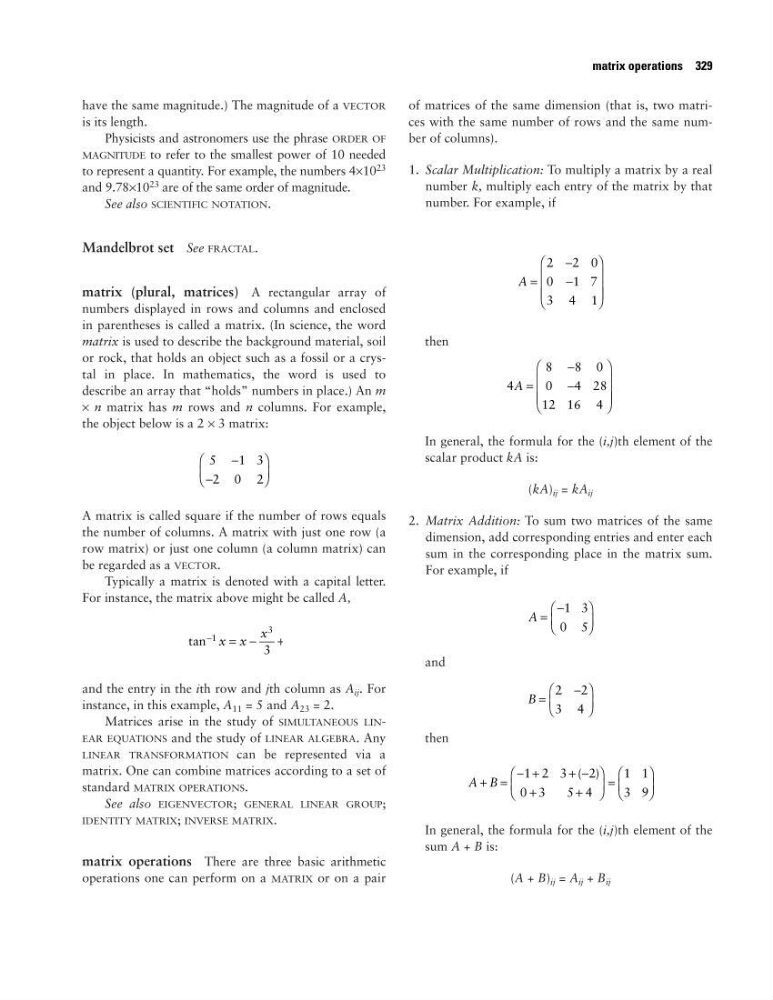
the object below is a 2 × 3 matrix:
A matrix is called square if the number of rows equals
the number of columns. A matrix with just one row (a
row matrix) or just one column (a column matrix) can
be regarded as a VECTOR.
Typically a matrix is denoted with a capital letter.
For instance, the matrix above might be called A,
and the entry in the ith row and jth column as A ij . For
instance, in this example, A 11 = 5 and A 23 = 2.
Matrices arise in the study of SIMULTANEOUS LINEAR EQUATIONS and the study of LINEAR ALGEBRA. Any
LINEAR TRANSFORMATION can be represented via a
matrix. One can combine matrices according to a set of
standard MATRIX OPERATIONS.
See also EIGENVECTOR; GENERAL LINEAR GROUP;
IDENTITY MATRIX; INVERSE MATRIX.
matrix operations There are three basic arithmetic
operations one can perform on a MATRIX or on a pair
of matrices of the same dimension (that is, two matrices with the same number of rows and the same number of columns).
1. Scalar Multiplication: To multiply a matrix by a real
number k, multiply each entry of the matrix by that
number. For example, if
then
In general, the formula for the (i,j)th element of the
scalar product kA is:
(kA) ij = kA ij
2. Matrix Addition: To sum two matrices of the same
dimension, add corresponding entries and enter each
sum in the corresponding place in the matrix sum.
For example, if
and
then
In general, the formula for the (i,j)th element of the
sum A + B is:
(A + B) ij = A ij + B ij
A B
+ =
− +
+ −
+
+
=
1 2 3
2
0 3
5 4
1 1
3 9
( )
B =
−
2 2
3 4
A =
−
1 3
0 5
4
8
8 0
0
4 28
12 16 4
A =
−
−
A =
−
−
2 2 0
0
1 7
3 4 1
tan
−
= −
+
1
3
3
x x
x
5
1
2 0
3
2
−
−
matrix operations 329
is its length.
Physicists and astronomers use the phrase ORDER OF
MAGNITUDE to refer to the smallest power of 10 needed
to represent a quantity. For example, the numbers 4×10
23
and 9.78×10
23 are of the same order of magnitude.
See also SCIENTIFIC NOTATION.
Mandelbrot set See FRACTAL.
matrix (plural, matrices) A rectangular array of
numbers displayed in rows and columns and enclosed
in parentheses is called a matrix. (In science, the word
matrix is used to describe the background material, soil
or rock, that holds an object such as a fossil or a crystal in place. In mathematics, the word is used to
describe an array that “holds” numbers in place.) An m
× n matrix has m rows and n columns. For example,
the object below is a 2 × 3 matrix:
A matrix is called square if the number of rows equals
the number of columns. A matrix with just one row (a
row matrix) or just one column (a column matrix) can
be regarded as a VECTOR.
Typically a matrix is denoted with a capital letter.
For instance, the matrix above might be called A,
and the entry in the ith row and jth column as A ij . For
instance, in this example, A 11 = 5 and A 23 = 2.
Matrices arise in the study of SIMULTANEOUS LINEAR EQUATIONS and the study of LINEAR ALGEBRA. Any
LINEAR TRANSFORMATION can be represented via a
matrix. One can combine matrices according to a set of
standard MATRIX OPERATIONS.
See also EIGENVECTOR; GENERAL LINEAR GROUP;
IDENTITY MATRIX; INVERSE MATRIX.
matrix operations There are three basic arithmetic
operations one can perform on a MATRIX or on a pair
of matrices of the same dimension (that is, two matrices with the same number of rows and the same number of columns).
1. Scalar Multiplication: To multiply a matrix by a real
number k, multiply each entry of the matrix by that
number. For example, if
then
In general, the formula for the (i,j)th element of the
scalar product kA is:
(kA) ij = kA ij
2. Matrix Addition: To sum two matrices of the same
dimension, add corresponding entries and enter each
sum in the corresponding place in the matrix sum.
For example, if
and
then
In general, the formula for the (i,j)th element of the
sum A + B is:
(A + B) ij = A ij + B ij
A B
+ =
− +
+ −
+
+
=
1 2 3
2
0 3
5 4
1 1
3 9
( )
B =
−
2 2
3 4
A =
−
1 3
0 5
4
8
8 0
0
4 28
12 16 4
A =
−
−
A =
−
−
2 2 0
0
1 7
3 4 1
tan
−
= −
+
1
3
3
x x
x
5
1
2 0
3
2
−
−
matrix operations 329