

function multiplied by a number k is just k times its
derivative, we have:
∫f (x) + g(x)dx = ∫f(x)dx + ∫g(x)dx
∫k · f (x)dx = k ∫f (x)dx
The corresponding results for definite integrals also
hold true. This follows from the fundamental theorem
of calculus (since these results are true for the
antiderivatives), but they can also be seen to be valid
by geometric arguments. (For example, if the values of
a graph are multiplied by a number k, that is, if the
function y = f(x) is replaced by y = k · f(x), then the
area under the graph increases by a factor of k.)
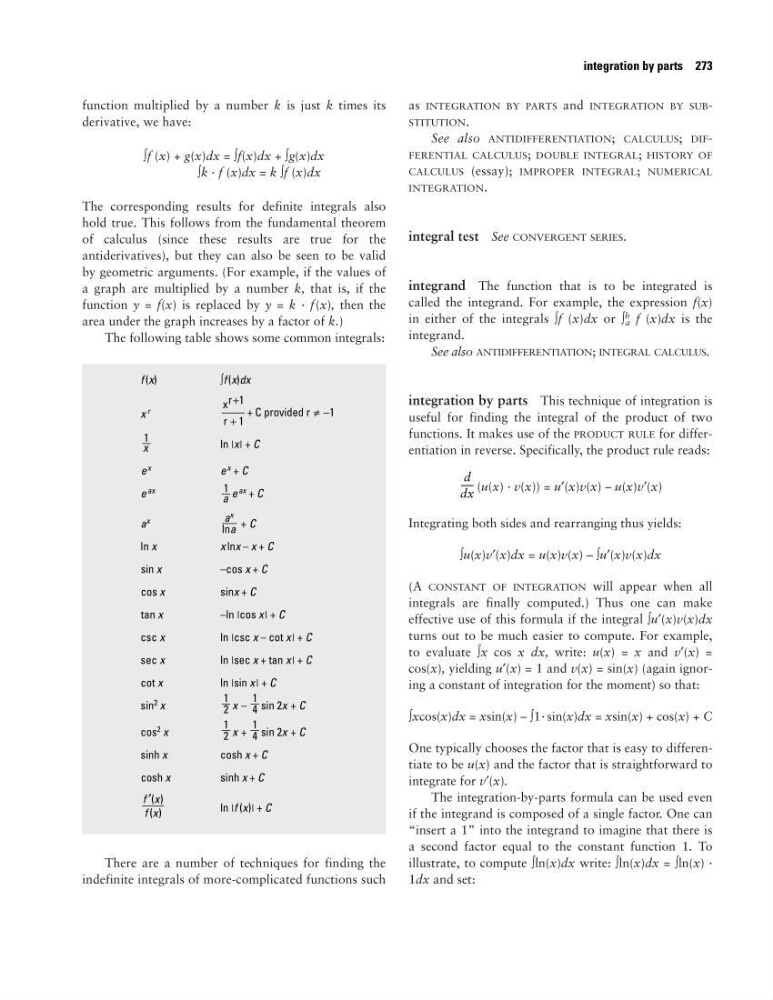
The following table shows some common integrals:
There are a number of techniques for finding the
indefinite integrals of more-complicated functions such
as INTEGRATION BY PARTS and INTEGRATION BY SUBSTITUTION.
See also ANTIDIFFERENTIATION; CALCULUS; DIFFERENTIAL CALCULUS; DOUBLE INTEGRAL; HISTORY OF
CALCULUS (essay); IMPROPER INTEGRAL; NUMERICAL
INTEGRATION.
integral test See CONVERGENT SERIES.
integrand The function that is to be integrated is
called the integrand. For example, the expression f(x)
in either of the integrals ∫f (x)dx or ∫
b
a f (x)dx is the
integrand.
See also ANTIDIFFERENTIATION; INTEGRAL CALCULUS.
integration by parts This technique of integration is
useful for finding the integral of the product of two
functions. It makes use of the PRODUCT RULE for differentiation in reverse. Specifically, the product rule reads:
(u(x) · v(x)) = u′(x)v(x) – u(x)v′(x)
Integrating both sides and rearranging thus yields:
∫u(x)v′(x)dx = u(x)v(x) – ∫u′(x)v(x)dx
(A CONSTANT OF INTEGRATION will appear when all
integrals are finally computed.) Thus one can make
effective use of this formula if the integral ∫u′(x)v(x)dx
turns out to be much easier to compute. For example,
to evaluate ∫x cos x dx, write: u(x) = x and v′(x) =
cos(x), yielding u′(x) = 1 and v(x) = sin(x) (again ignoring a constant of integration for the moment) so that:
∫xcos(x)dx = xsin(x) – ∫1· sin(x)dx = xsin(x) + cos(x) + C
One typically chooses the factor that is easy to differentiate to be u(x) and the factor that is straightforward to
integrate for v′(x).
The integration-by-parts formula can be used even
if the integrand is composed of a single factor. One can
“insert a 1” into the integrand to imagine that there is
a second factor equal to the constant function 1. To
illustrate, to compute ∫ln(x)dx write: ∫ln(x)dx = ∫ln(x) ·
1dx and set:
d
––
dx
integration by parts 273
f (x)
∫f (x)dx
x
r
ln |x| + C
e x
e
x + C
e
ax
e
ax + C
a
x
+ C
ln x
x lnx – x + C
sin x
–cos x + C
cos x
sinx + C
tan x
–ln |cos x | + C
csc x
ln |csc x – cot x| + C
sec x
ln |sec x + tan x| + C
cot x
ln |sin x| + C
sin 2 x
x – sin 2x + C
cos 2 x
x + sin 2x + C
sinh x
cosh x + C
cosh x
sinh x + C
ln |f (x)| + C
f ′(x)
––
f (x)
1
–
4
1
–
2
1
–
4
1
–
2
a
x
––
lna
1
– a
1
– x
x r 1
r 1
+ C provided r
1
+
+
≠ −
derivative, we have:
∫f (x) + g(x)dx = ∫f(x)dx + ∫g(x)dx
∫k · f (x)dx = k ∫f (x)dx
The corresponding results for definite integrals also
hold true. This follows from the fundamental theorem
of calculus (since these results are true for the
antiderivatives), but they can also be seen to be valid
by geometric arguments. (For example, if the values of
a graph are multiplied by a number k, that is, if the
function y = f(x) is replaced by y = k · f(x), then the
area under the graph increases by a factor of k.)
The following table shows some common integrals:
There are a number of techniques for finding the
indefinite integrals of more-complicated functions such
as INTEGRATION BY PARTS and INTEGRATION BY SUBSTITUTION.
See also ANTIDIFFERENTIATION; CALCULUS; DIFFERENTIAL CALCULUS; DOUBLE INTEGRAL; HISTORY OF
CALCULUS (essay); IMPROPER INTEGRAL; NUMERICAL
INTEGRATION.
integral test See CONVERGENT SERIES.
integrand The function that is to be integrated is
called the integrand. For example, the expression f(x)
in either of the integrals ∫f (x)dx or ∫
b
a f (x)dx is the
integrand.
See also ANTIDIFFERENTIATION; INTEGRAL CALCULUS.
integration by parts This technique of integration is
useful for finding the integral of the product of two
functions. It makes use of the PRODUCT RULE for differentiation in reverse. Specifically, the product rule reads:
(u(x) · v(x)) = u′(x)v(x) – u(x)v′(x)
Integrating both sides and rearranging thus yields:
∫u(x)v′(x)dx = u(x)v(x) – ∫u′(x)v(x)dx
(A CONSTANT OF INTEGRATION will appear when all
integrals are finally computed.) Thus one can make
effective use of this formula if the integral ∫u′(x)v(x)dx
turns out to be much easier to compute. For example,
to evaluate ∫x cos x dx, write: u(x) = x and v′(x) =
cos(x), yielding u′(x) = 1 and v(x) = sin(x) (again ignoring a constant of integration for the moment) so that:
∫xcos(x)dx = xsin(x) – ∫1· sin(x)dx = xsin(x) + cos(x) + C
One typically chooses the factor that is easy to differentiate to be u(x) and the factor that is straightforward to
integrate for v′(x).
The integration-by-parts formula can be used even
if the integrand is composed of a single factor. One can
“insert a 1” into the integrand to imagine that there is
a second factor equal to the constant function 1. To
illustrate, to compute ∫ln(x)dx write: ∫ln(x)dx = ∫ln(x) ·
1dx and set:
d
––
dx
integration by parts 273
f (x)
∫f (x)dx
x
r
ln |x| + C
e x
e
x + C
e
ax
e
ax + C
a
x
+ C
ln x
x lnx – x + C
sin x
–cos x + C
cos x
sinx + C
tan x
–ln |cos x | + C
csc x
ln |csc x – cot x| + C
sec x
ln |sec x + tan x| + C
cot x
ln |sin x| + C
sin 2 x
x – sin 2x + C
cos 2 x
x + sin 2x + C
sinh x
cosh x + C
cosh x
sinh x + C
ln |f (x)| + C
f ′(x)
––
f (x)
1
–
4
1
–
2
1
–
4
1
–
2
a
x
––
lna
1
– a
1
– x
x r 1
r 1
+ C provided r
1
+
+
≠ −