

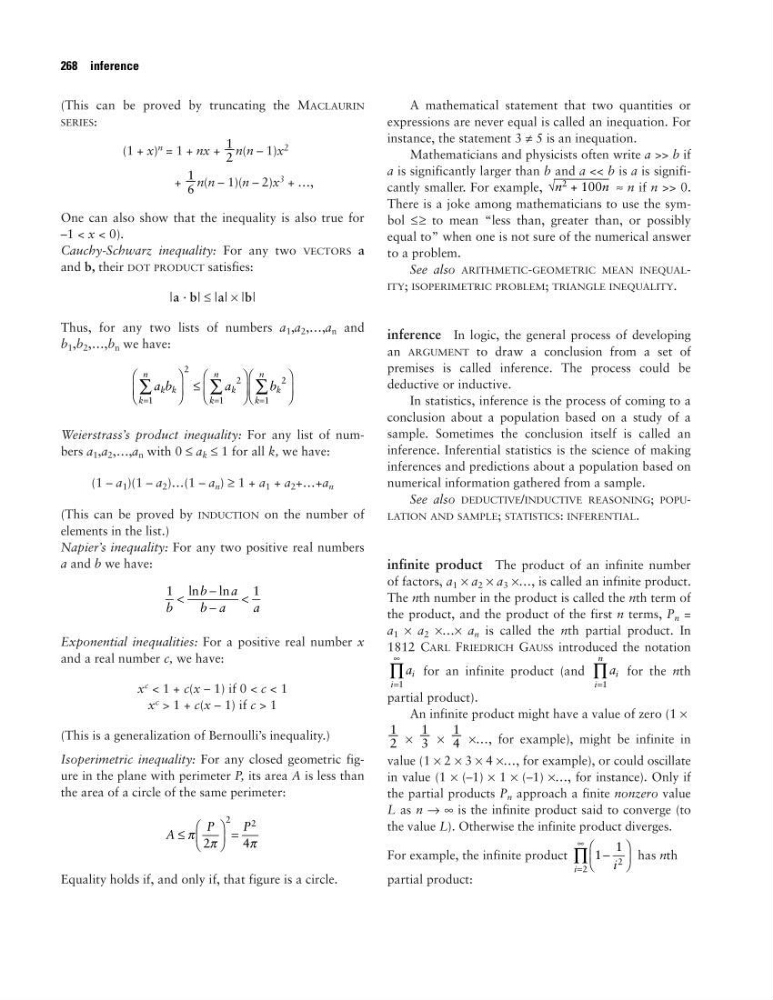
(This can be proved by truncating the MACLAURIN
SERIES:
(1 + x)
n = 1 + nx + n(n – 1)x
2
+ n(n – 1)(n – 2)x
3 + …,
One can also show that the inequality is also true for
–1 < x < 0).
Cauchy-Schwarz inequality: For any two VECTORS a
and b, their DOT PRODUCT satisfies:
|a · b| ≤ |a| × |b|
Thus, for any two lists of numbers a 1 ,a 2 ,…,a n and
b 1 ,b 2 ,…,b n we have:
Weierstrass’s product inequality: For any list of numbers a 1 ,a 2 ,…,a n with 0 ≤ a k ≤ 1 for all k, we have:
(1 – a 1 )(1 – a 2 )…(1 – a n ) ≥ 1 + a 1 + a 2 +…+a n
(This can be proved by INDUCTION on the number of
elements in the list.)
Napier’s inequality: For any two positive real numbers
a and b we have:
Exponential inequalities: For a positive real number x
and a real number c, we have:
x
c < 1 + c(x – 1) if 0 < c < 1
x
c > 1 + c(x – 1) if c > 1
(This is a generalization of Bernoulli’s inequality.)
Isoperimetric inequality: For any closed geometric figure in the plane with perimeter P, its area A is less than
the area of a circle of the same perimeter:
Equality holds if, and only if, that figure is a circle.
A mathematical statement that two quantities or
expressions are never equal is called an inequation. For
instance, the statement 3 ≠ 5 is an inequation.
Mathematicians and physicists often write a >> b if
a is significantly larger than b and a << b is a is significantly smaller. For example,
≈ n if n >> 0.
There is a joke among mathematicians to use the symbol ≤≥ to mean “less than, greater than, or possibly
equal to” when one is not sure of the numerical answer
to a problem.
See also ARITHMETIC-GEOMETRIC MEAN INEQUALITY; ISOPERIMETRIC PROBLEM; TRIANGLE INEQUALITY.
inference In logic, the general process of developing
an ARGUMENT to draw a conclusion from a set of
premises is called inference. The process could be
deductive or inductive.
In statistics, inference is the process of coming to a
conclusion about a population based on a study of a
sample. Sometimes the conclusion itself is called an
inference. Inferential statistics is the science of making
inferences and predictions about a population based on
numerical information gathered from a sample.
See also DEDUCTIVE/INDUCTIVE REASONING; POPULATION AND SAMPLE; STATISTICS: INFERENTIAL.
infinite product The product of an infinite number
of factors, a 1 × a 2 × a 3 ×…, is called an infinite product.
The nth number in the product is called the nth term of
the product, and the product of the first n terms, P n =
a 1 × a 2 ×…× a n is called the nth partial product. In
1812 CARL FRIEDRICH GAUSS introduced the notation
for an infinite product (and
for the nth
partial product).
An infinite product might have a value of zero (1 ×
×
×
×…, for example), might be infinite in
value (1 × 2 × 3 × 4 ×…, for example), or could oscillate
in value (1 × (–1) × 1 × (–1) ×…, for instance). Only if
the partial products P n approach a finite nonzero value
L as n → ∞ is the infinite product said to converge (to
the value L). Otherwise the infinite product diverges.
For example, the infinite product
has nth
partial product:
1
1
2
2
−
=
∞
∏ i
i
1
–
4
1
–
3
1
–
2
a i
i
n
=
∏
1
a i
i=
∞
∏
1
√n
2 + 100n
A
P
P
≤
=
π π
π
2
4
2
2
1
1
b
b
a
b a
a
<
−
−
<
ln
ln
a b
a
b
k k
k
n
k
k
n
k
k
n
=
=
=
∑
∑
∑
≤
1
2
2
1
2
1
1
–
6
1
–
2
268 inference
SERIES:
(1 + x)
n = 1 + nx + n(n – 1)x
2
+ n(n – 1)(n – 2)x
3 + …,
One can also show that the inequality is also true for
–1 < x < 0).
Cauchy-Schwarz inequality: For any two VECTORS a
and b, their DOT PRODUCT satisfies:
|a · b| ≤ |a| × |b|
Thus, for any two lists of numbers a 1 ,a 2 ,…,a n and
b 1 ,b 2 ,…,b n we have:
Weierstrass’s product inequality: For any list of numbers a 1 ,a 2 ,…,a n with 0 ≤ a k ≤ 1 for all k, we have:
(1 – a 1 )(1 – a 2 )…(1 – a n ) ≥ 1 + a 1 + a 2 +…+a n
(This can be proved by INDUCTION on the number of
elements in the list.)
Napier’s inequality: For any two positive real numbers
a and b we have:
Exponential inequalities: For a positive real number x
and a real number c, we have:
x
c < 1 + c(x – 1) if 0 < c < 1
x
c > 1 + c(x – 1) if c > 1
(This is a generalization of Bernoulli’s inequality.)
Isoperimetric inequality: For any closed geometric figure in the plane with perimeter P, its area A is less than
the area of a circle of the same perimeter:
Equality holds if, and only if, that figure is a circle.
A mathematical statement that two quantities or
expressions are never equal is called an inequation. For
instance, the statement 3 ≠ 5 is an inequation.
Mathematicians and physicists often write a >> b if
a is significantly larger than b and a << b is a is significantly smaller. For example,
≈ n if n >> 0.
There is a joke among mathematicians to use the symbol ≤≥ to mean “less than, greater than, or possibly
equal to” when one is not sure of the numerical answer
to a problem.
See also ARITHMETIC-GEOMETRIC MEAN INEQUALITY; ISOPERIMETRIC PROBLEM; TRIANGLE INEQUALITY.
inference In logic, the general process of developing
an ARGUMENT to draw a conclusion from a set of
premises is called inference. The process could be
deductive or inductive.
In statistics, inference is the process of coming to a
conclusion about a population based on a study of a
sample. Sometimes the conclusion itself is called an
inference. Inferential statistics is the science of making
inferences and predictions about a population based on
numerical information gathered from a sample.
See also DEDUCTIVE/INDUCTIVE REASONING; POPULATION AND SAMPLE; STATISTICS: INFERENTIAL.
infinite product The product of an infinite number
of factors, a 1 × a 2 × a 3 ×…, is called an infinite product.
The nth number in the product is called the nth term of
the product, and the product of the first n terms, P n =
a 1 × a 2 ×…× a n is called the nth partial product. In
1812 CARL FRIEDRICH GAUSS introduced the notation
for an infinite product (and
for the nth
partial product).
An infinite product might have a value of zero (1 ×
×
×
×…, for example), might be infinite in
value (1 × 2 × 3 × 4 ×…, for example), or could oscillate
in value (1 × (–1) × 1 × (–1) ×…, for instance). Only if
the partial products P n approach a finite nonzero value
L as n → ∞ is the infinite product said to converge (to
the value L). Otherwise the infinite product diverges.
For example, the infinite product
has nth
partial product:
1
1
2
2
−
=
∞
∏ i
i
1
–
4
1
–
3
1
–
2
a i
i
n
=
∏
1
a i
i=
∞
∏
1
√n
2 + 100n
A
P
P
≤
=
π π
π
2
4
2
2
1
1
b
b
a
b a
a
<
−
−
<
ln
ln
a b
a
b
k k
k
n
k
k
n
k
k
n
=
=
=
∑
∑
∑
≤
1
2
2
1
2
1
1
–
6
1
–
2
268 inference