

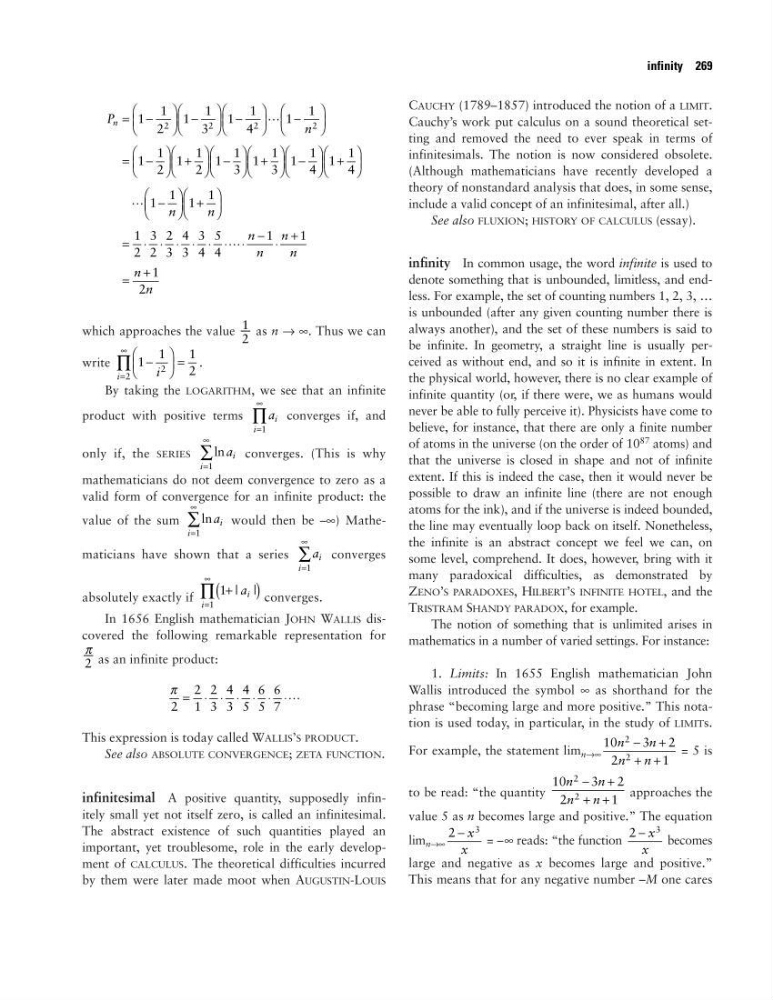
which approaches the value
as n → ∞. Thus we can
write
.
By taking the LOGARITHM, we see that an infinite
product with positive terms
converges if, and
only if, the SERIES
converges. (This is why
mathematicians do not deem convergence to zero as a
valid form of convergence for an infinite product: the
value of the sum
would then be –∞) Mathematicians have shown that a series
converges
absolutely exactly if
converges.
In 1656 English mathematician JOHN WALLIS discovered the following remarkable representation for
as an infinite product:
This expression is today called WALLIS’S PRODUCT.
See also ABSOLUTE CONVERGENCE; ZETA FUNCTION.
infinitesimal A positive quantity, supposedly infinitely small yet not itself zero, is called an infinitesimal.
The abstract existence of such quantities played an
important, yet troublesome, role in the early development of CALCULUS. The theoretical difficulties incurred
by them were later made moot when AUGUSTIN-LOUIS
CAUCHY (1789–1857) introduced the notion of a LIMIT.
Cauchy’s work put calculus on a sound theoretical setting and removed the need to ever speak in terms of
infinitesimals. The notion is now considered obsolete.
(Although mathematicians have recently developed a
theory of nonstandard analysis that does, in some sense,
include a valid concept of an infinitesimal, after all.)
See also FLUXION; HISTORY OF CALCULUS (essay).
infinity In common usage, the word infinite is used to
denote something that is unbounded, limitless, and endless. For example, the set of counting numbers 1, 2, 3, …
is unbounded (after any given counting number there is
always another), and the set of these numbers is said to
be infinite. In geometry, a straight line is usually perceived as without end, and so it is infinite in extent. In
the physical world, however, there is no clear example of
infinite quantity (or, if there were, we as humans would
never be able to fully perceive it). Physicists have come to
believe, for instance, that there are only a finite number
of atoms in the universe (on the order of 10
87 atoms) and
that the universe is closed in shape and not of infinite
extent. If this is indeed the case, then it would never be
possible to draw an infinite line (there are not enough
atoms for the ink), and if the universe is indeed bounded,
the line may eventually loop back on itself. Nonetheless,
the infinite is an abstract concept we feel we can, on
some level, comprehend. It does, however, bring with it
many paradoxical difficulties, as demonstrated by
ZENO’S PARADOXES, HILBERT’S INFINITE HOTEL, and the
TRISTRAM SHANDY PARADOX, for example.
The notion of something that is unlimited arises in
mathematics in a number of varied settings. For instance:
1. Limits: In 1655 English mathematician John
Wallis introduced the symbol ∞ as shorthand for the
phrase “becoming large and more positive.” This notation is used today, in particular, in the study of LIMITs.
For example, the statement lim n→∞
= 5 is
to be read: “the quantity
approaches the
value 5 as n becomes large and positive.” The equation
lim n→∞
= –∞ reads: “the function
becomes
large and negative as x becomes large and positive.”
This means that for any negative number –M one cares
2
3
− x
x
2
3
− x
x
10
3 2
2
1
2
2
n
n
n n
− +
+ +
10
3 2
2
1
2
2
n
n
n n
− +
+ +
π
2
2
1
2
3
4
3
4
5
6
5
6
7
= ⋅ ⋅ ⋅ ⋅ ⋅ ⋅L
π
–
2
1
1
+
(
)
=
∞
∏ | |
a i
i
a i
i=
∞
∑
1
ln a i
i=
∞
∑
1
ln a i
i=
∞
∑
1
a i
i=
∞
∏
1
1
1
1
2
2
2
−
=
=
∞
∏ i
i
1
–
2
P
n
n
n = −
−
−
−
= −
+
−
+
−
+
−
1
1
2
1
1
3
1
1
4
1
1
1
1
2
1
1
2
1
1
3
1
1
3
1
1
4
1
1
4
1
1
2
2
2
2
L
L
+
= ⋅ ⋅ ⋅ ⋅ ⋅ ⋅ ⋅
− ⋅
+
=
+
1
1
1
2
3
2
2
3
4
3
3
4
5
4
1
1
1
2
n
n
n
n
n
n
n
L
infinity 269
as n → ∞. Thus we can
write
.
By taking the LOGARITHM, we see that an infinite
product with positive terms
converges if, and
only if, the SERIES
converges. (This is why
mathematicians do not deem convergence to zero as a
valid form of convergence for an infinite product: the
value of the sum
would then be –∞) Mathematicians have shown that a series
converges
absolutely exactly if
converges.
In 1656 English mathematician JOHN WALLIS discovered the following remarkable representation for
as an infinite product:
This expression is today called WALLIS’S PRODUCT.
See also ABSOLUTE CONVERGENCE; ZETA FUNCTION.
infinitesimal A positive quantity, supposedly infinitely small yet not itself zero, is called an infinitesimal.
The abstract existence of such quantities played an
important, yet troublesome, role in the early development of CALCULUS. The theoretical difficulties incurred
by them were later made moot when AUGUSTIN-LOUIS
CAUCHY (1789–1857) introduced the notion of a LIMIT.
Cauchy’s work put calculus on a sound theoretical setting and removed the need to ever speak in terms of
infinitesimals. The notion is now considered obsolete.
(Although mathematicians have recently developed a
theory of nonstandard analysis that does, in some sense,
include a valid concept of an infinitesimal, after all.)
See also FLUXION; HISTORY OF CALCULUS (essay).
infinity In common usage, the word infinite is used to
denote something that is unbounded, limitless, and endless. For example, the set of counting numbers 1, 2, 3, …
is unbounded (after any given counting number there is
always another), and the set of these numbers is said to
be infinite. In geometry, a straight line is usually perceived as without end, and so it is infinite in extent. In
the physical world, however, there is no clear example of
infinite quantity (or, if there were, we as humans would
never be able to fully perceive it). Physicists have come to
believe, for instance, that there are only a finite number
of atoms in the universe (on the order of 10
87 atoms) and
that the universe is closed in shape and not of infinite
extent. If this is indeed the case, then it would never be
possible to draw an infinite line (there are not enough
atoms for the ink), and if the universe is indeed bounded,
the line may eventually loop back on itself. Nonetheless,
the infinite is an abstract concept we feel we can, on
some level, comprehend. It does, however, bring with it
many paradoxical difficulties, as demonstrated by
ZENO’S PARADOXES, HILBERT’S INFINITE HOTEL, and the
TRISTRAM SHANDY PARADOX, for example.
The notion of something that is unlimited arises in
mathematics in a number of varied settings. For instance:
1. Limits: In 1655 English mathematician John
Wallis introduced the symbol ∞ as shorthand for the
phrase “becoming large and more positive.” This notation is used today, in particular, in the study of LIMITs.
For example, the statement lim n→∞
= 5 is
to be read: “the quantity
approaches the
value 5 as n becomes large and positive.” The equation
lim n→∞
= –∞ reads: “the function
becomes
large and negative as x becomes large and positive.”
This means that for any negative number –M one cares
2
3
− x
x
2
3
− x
x
10
3 2
2
1
2
2
n
n
n n
− +
+ +
10
3 2
2
1
2
2
n
n
n n
− +
+ +
π
2
2
1
2
3
4
3
4
5
6
5
6
7
= ⋅ ⋅ ⋅ ⋅ ⋅ ⋅L
π
–
2
1
1
+
(
)
=
∞
∏ | |
a i
i
a i
i=
∞
∑
1
ln a i
i=
∞
∑
1
ln a i
i=
∞
∑
1
a i
i=
∞
∏
1
1
1
1
2
2
2
−
=
=
∞
∏ i
i
1
–
2
P
n
n
n = −
−
−
−
= −
+
−
+
−
+
−
1
1
2
1
1
3
1
1
4
1
1
1
1
2
1
1
2
1
1
3
1
1
3
1
1
4
1
1
4
1
1
2
2
2
2
L
L
+
= ⋅ ⋅ ⋅ ⋅ ⋅ ⋅ ⋅
− ⋅
+
=
+
1
1
1
2
3
2
2
3
4
3
3
4
5
4
1
1
1
2
n
n
n
n
n
n
n
L
infinity 269