

To examine this argument, note that it is indeed the
case that P(1) is valid, and it is true that P(k) implies
P(k+1)—for almost all values of k. The fault in the
argument above is that although P(2) establishes P(3),
and P(3) establishes P(4), and so forth, it is not the case
that P(1) establishes P(2): removing one horse from a
field containing just two horses does not, alas, establish
that both horses are the same color. In our chain of
dominoes, all but the first two dominoes are properly
spaced: the first domino does not topple the second
domino during its fall, and the chain remains standing.
This illuminates that one must always be careful that
any argument presented in a proof by induction is
indeed valid for all values of k.
See also PROOF; SUMS OF POWERS.
inductive reasoning See DEDUCTIVE/INDUCTIVE
REASONING.
inequality A mathematical statement that one quantity or expression is greater than or less than another is
called an inequality. The following symbols are used:
a > b, a is greater than b
a < b, a is less than b
a ≥ b, a is greater than or equal to b
a ≤ b, a is less than or equal to b
Inequalities satisfy a number of ORDER PROPERTIES.
An inequality is called closed or unconditional if it
holds for all values of the variables, if any, that appear
in the equation. For instance, the inequalities 3 ≤ 5,
x
2 + 1 > x
2
, and 5 + y
2 > 4y are closed inequalities for
they are always true. Inequalities that are not closed are
called open or conditional. The set of values of the variables that appear in the inequality that make the statement true is called the solution set of the inequality. For
example, the open inequality 2x + 1 > 7 has as a solution set the set of all real numbers x for which x > 3.
The solution set of the open inequality a
2 + b
2 < 0 is the
EMPTY SET.
Open inequalities can be solved in much the same
manner as equations. As the order properties show, one
can add or subtract the same quantity to both sides of
the inequality and preserve the inequality, or can multiply the inequality through by a positive quantity. Multiplying through by a negative quantity changes the sense
of the inequality. (For example, if a < b, then subtracting
the quantity a + b from both sides yields –b < –a. This
shows that the effect of multiplying through by –1 is to
reverse the sense of the inequality.) For example, one can
solve the inequality 2x + 1 > 7, as follows:
2x + 1 > 7
2x > 6
× 2x >
× 6
x > 3
indeed yielding the solution set {x:x > 3}.
It is worth noting that if a · b > 0, then we can be
sure that a and b are either both positive or both negative. If, on the other hand, a · b < 0, then we can be
sure that a and b have opposite signs. These observations are essential for solving inequalities involving a
single variable raised to the second power. For example, to solve the open inequality x
2 + x – 2 > 0, factor
the QUADRATIC to obtain (x + 1)(x – 2) > 0 and examine the two possible scenarios. Either x + 1 and x – 2
are both greater than zero (yielding that x must be
greater than 2), or x + 1 and x – 2 are both less than
zero (yielding that x must be less than –1). Thus the
solution set to the inequality is the set of all real numbers x with x > 2 or x < –1.
A single inequality in two variables defines a region
in the plane. For example, the inequality 2x + y ≥ 3 is
satisfied by the points (0,3), (5,0), and (2,2), for
instance. In this example, the complete solution set is
the closed HALF-PLANE sitting above the line y = –2x +
3 in the plane.
There are a number of standard inequalities in
mathematics:
Triangle inequality: For any triangle with side-lengths
a,b, and c we have: a + b > c.
Arithmetic-geometric mean inequality: For nonnegative
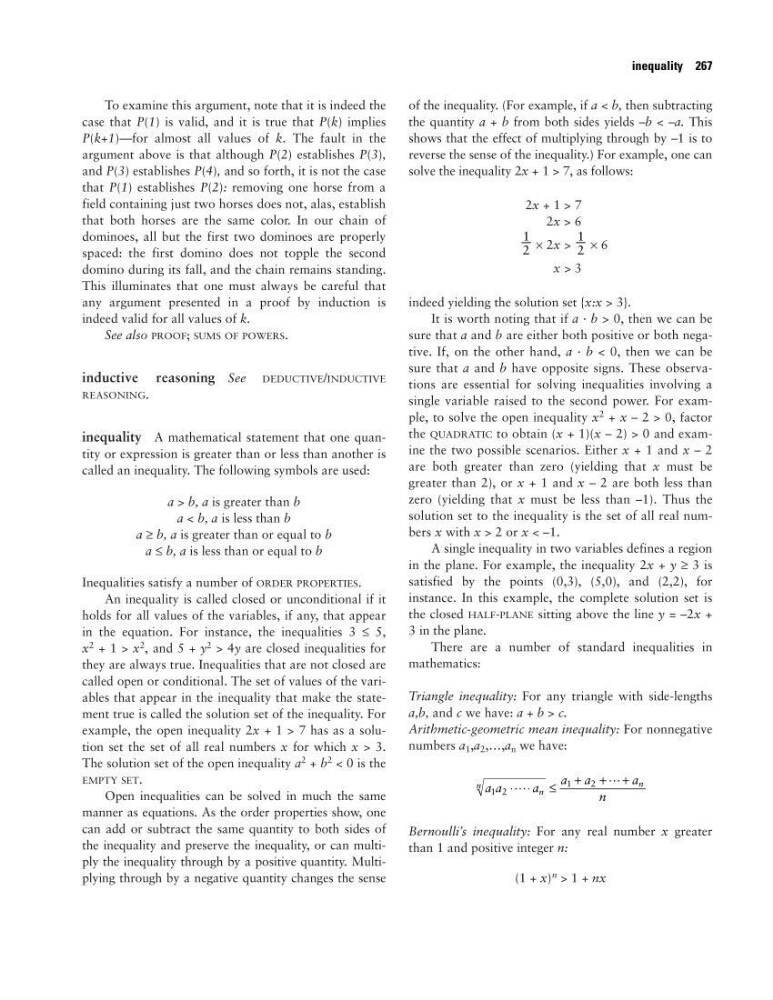
numbers a 1 ,a 2 ,…,a n we have:
Bernoulli’s inequality: For any real number x greater
than 1 and positive integer n:
(1 + x)
n > 1 + nx
a a
a
a a
a
n
n
n
n
1 2
1
2
⋅ ⋅ ≤
+ + +
L
L
1
–
2
1
–
2
inequality 267
case that P(1) is valid, and it is true that P(k) implies
P(k+1)—for almost all values of k. The fault in the
argument above is that although P(2) establishes P(3),
and P(3) establishes P(4), and so forth, it is not the case
that P(1) establishes P(2): removing one horse from a
field containing just two horses does not, alas, establish
that both horses are the same color. In our chain of
dominoes, all but the first two dominoes are properly
spaced: the first domino does not topple the second
domino during its fall, and the chain remains standing.
This illuminates that one must always be careful that
any argument presented in a proof by induction is
indeed valid for all values of k.
See also PROOF; SUMS OF POWERS.
inductive reasoning See DEDUCTIVE/INDUCTIVE
REASONING.
inequality A mathematical statement that one quantity or expression is greater than or less than another is
called an inequality. The following symbols are used:
a > b, a is greater than b
a < b, a is less than b
a ≥ b, a is greater than or equal to b
a ≤ b, a is less than or equal to b
Inequalities satisfy a number of ORDER PROPERTIES.
An inequality is called closed or unconditional if it
holds for all values of the variables, if any, that appear
in the equation. For instance, the inequalities 3 ≤ 5,
x
2 + 1 > x
2
, and 5 + y
2 > 4y are closed inequalities for
they are always true. Inequalities that are not closed are
called open or conditional. The set of values of the variables that appear in the inequality that make the statement true is called the solution set of the inequality. For
example, the open inequality 2x + 1 > 7 has as a solution set the set of all real numbers x for which x > 3.
The solution set of the open inequality a
2 + b
2 < 0 is the
EMPTY SET.
Open inequalities can be solved in much the same
manner as equations. As the order properties show, one
can add or subtract the same quantity to both sides of
the inequality and preserve the inequality, or can multiply the inequality through by a positive quantity. Multiplying through by a negative quantity changes the sense
of the inequality. (For example, if a < b, then subtracting
the quantity a + b from both sides yields –b < –a. This
shows that the effect of multiplying through by –1 is to
reverse the sense of the inequality.) For example, one can
solve the inequality 2x + 1 > 7, as follows:
2x + 1 > 7
2x > 6
× 2x >
× 6
x > 3
indeed yielding the solution set {x:x > 3}.
It is worth noting that if a · b > 0, then we can be
sure that a and b are either both positive or both negative. If, on the other hand, a · b < 0, then we can be
sure that a and b have opposite signs. These observations are essential for solving inequalities involving a
single variable raised to the second power. For example, to solve the open inequality x
2 + x – 2 > 0, factor
the QUADRATIC to obtain (x + 1)(x – 2) > 0 and examine the two possible scenarios. Either x + 1 and x – 2
are both greater than zero (yielding that x must be
greater than 2), or x + 1 and x – 2 are both less than
zero (yielding that x must be less than –1). Thus the
solution set to the inequality is the set of all real numbers x with x > 2 or x < –1.
A single inequality in two variables defines a region
in the plane. For example, the inequality 2x + y ≥ 3 is
satisfied by the points (0,3), (5,0), and (2,2), for
instance. In this example, the complete solution set is
the closed HALF-PLANE sitting above the line y = –2x +
3 in the plane.
There are a number of standard inequalities in
mathematics:
Triangle inequality: For any triangle with side-lengths
a,b, and c we have: a + b > c.
Arithmetic-geometric mean inequality: For nonnegative
numbers a 1 ,a 2 ,…,a n we have:
Bernoulli’s inequality: For any real number x greater
than 1 and positive integer n:
(1 + x)
n > 1 + nx
a a
a
a a
a
n
n
n
n
1 2
1
2
⋅ ⋅ ≤
+ + +
L
L
1
–
2
1
–
2
inequality 267