

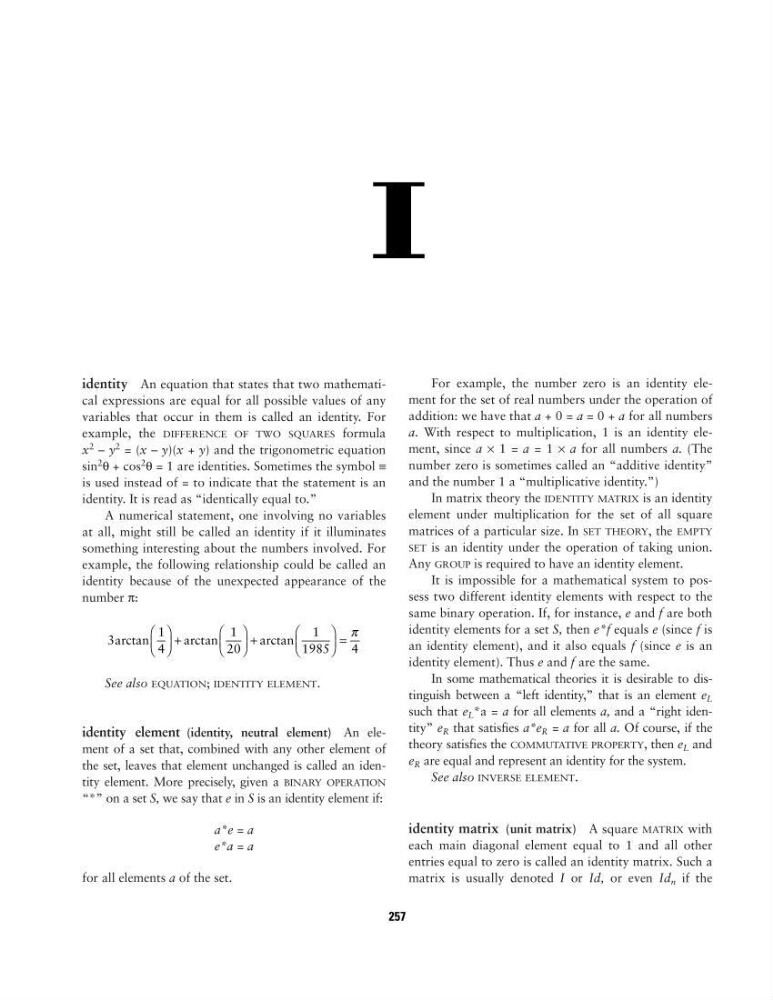
identity An equation that states that two mathematical expressions are equal for all possible values of any
variables that occur in them is called an identity. For
example, the DIFFERENCE OF TWO SQUARES formula
x
2 – y
2 = (x – y)(x + y) and the trigonometric equation
sin
2
θ + cos
2
θ = 1 are identities. Sometimes the symbol ≡
is used instead of = to indicate that the statement is an
identity. It is read as “identically equal to.”
A numerical statement, one involving no variables
at all, might still be called an identity if it illuminates
something interesting about the numbers involved. For
example, the following relationship could be called an
identity because of the unexpected appearance of the
number π:
See also EQUATION; IDENTITY ELEMENT.
identity element (identity, neutral element) An element of a set that, combined with any other element of
the set, leaves that element unchanged is called an identity element. More precisely, given a BINARY OPERATION
“*” on a set S, we say that e in S is an identity element if:
a*e = a
e*a = a
for all elements a of the set.
For example, the number zero is an identity element for the set of real numbers under the operation of
addition: we have that a + 0 = a = 0 + a for all numbers
a. With respect to multiplication, 1 is an identity element, since a × 1 = a = 1 × a for all numbers a. (The
number zero is sometimes called an “additive identity”
and the number 1 a “multiplicative identity.”)
In matrix theory the IDENTITY MATRIX is an identity
element under multiplication for the set of all square
matrices of a particular size. In SET THEORY, the EMPTY
SET is an identity under the operation of taking union.
Any GROUP is required to have an identity element.
It is impossible for a mathematical system to possess two different identity elements with respect to the
same binary operation. If, for instance, e and f are both
identity elements for a set S, then e*f equals e (since f is
an identity element), and it also equals f (since e is an
identity element). Thus e and f are the same.
In some mathematical theories it is desirable to distinguish between a “left identity,” that is an element e L
such that e L *a = a for all elements a, and a “right identity” e R that satisfies a*e R = a for all a. Of course, if the
theory satisfies the COMMUTATIVE PROPERTY, then e L and
e R are equal and represent an identity for the system.
See also INVERSE ELEMENT.
identity matrix (unit matrix) A square MATRIX with
each main diagonal element equal to 1 and all other
entries equal to zero is called an identity matrix. Such a
matrix is usually denoted I or Id, or even Id n if the
3
1
4
1
20
1
1985
4
arctan
arctan
arctan
+
+
=
π
257
I
variables that occur in them is called an identity. For
example, the DIFFERENCE OF TWO SQUARES formula
x
2 – y
2 = (x – y)(x + y) and the trigonometric equation
sin
2
θ + cos
2
θ = 1 are identities. Sometimes the symbol ≡
is used instead of = to indicate that the statement is an
identity. It is read as “identically equal to.”
A numerical statement, one involving no variables
at all, might still be called an identity if it illuminates
something interesting about the numbers involved. For
example, the following relationship could be called an
identity because of the unexpected appearance of the
number π:
See also EQUATION; IDENTITY ELEMENT.
identity element (identity, neutral element) An element of a set that, combined with any other element of
the set, leaves that element unchanged is called an identity element. More precisely, given a BINARY OPERATION
“*” on a set S, we say that e in S is an identity element if:
a*e = a
e*a = a
for all elements a of the set.
For example, the number zero is an identity element for the set of real numbers under the operation of
addition: we have that a + 0 = a = 0 + a for all numbers
a. With respect to multiplication, 1 is an identity element, since a × 1 = a = 1 × a for all numbers a. (The
number zero is sometimes called an “additive identity”
and the number 1 a “multiplicative identity.”)
In matrix theory the IDENTITY MATRIX is an identity
element under multiplication for the set of all square
matrices of a particular size. In SET THEORY, the EMPTY
SET is an identity under the operation of taking union.
Any GROUP is required to have an identity element.
It is impossible for a mathematical system to possess two different identity elements with respect to the
same binary operation. If, for instance, e and f are both
identity elements for a set S, then e*f equals e (since f is
an identity element), and it also equals f (since e is an
identity element). Thus e and f are the same.
In some mathematical theories it is desirable to distinguish between a “left identity,” that is an element e L
such that e L *a = a for all elements a, and a “right identity” e R that satisfies a*e R = a for all a. Of course, if the
theory satisfies the COMMUTATIVE PROPERTY, then e L and
e R are equal and represent an identity for the system.
See also INVERSE ELEMENT.
identity matrix (unit matrix) A square MATRIX with
each main diagonal element equal to 1 and all other
entries equal to zero is called an identity matrix. Such a
matrix is usually denoted I or Id, or even Id n if the
3
1
4
1
20
1
1985
4
arctan
arctan
arctan
+
+
=
π
257
I