

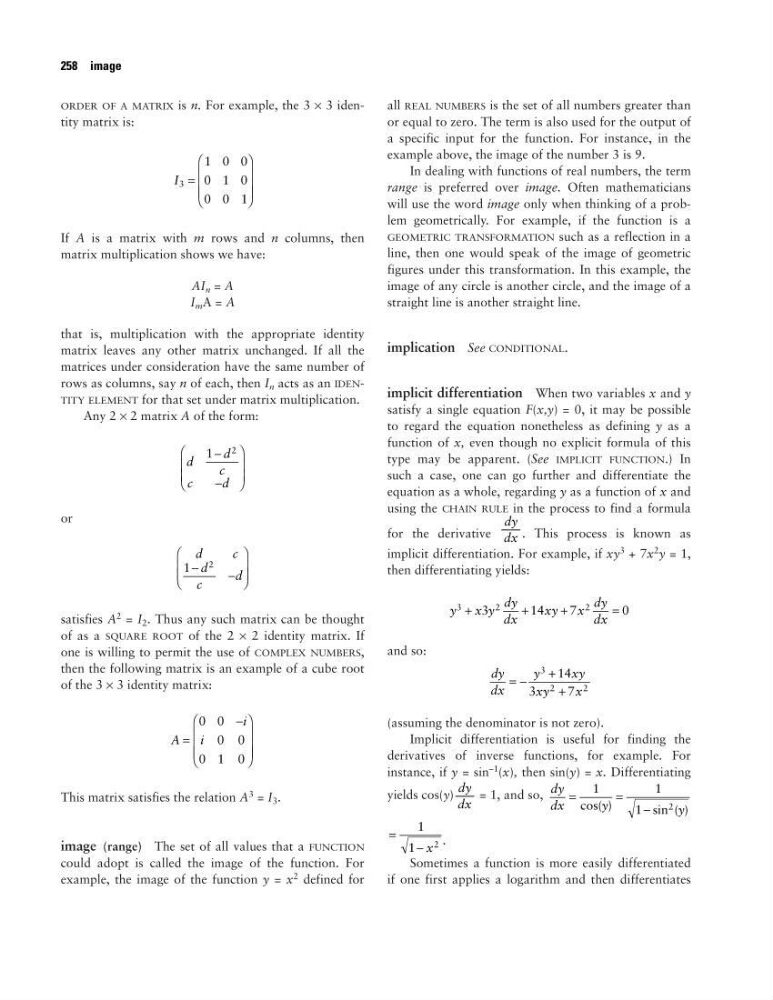
ORDER OF A MATRIX is n. For example, the 3 × 3 identity matrix is:
If A is a matrix with m rows and n columns, then
matrix multiplication shows we have:
AI n = A
I m A = A
that is, multiplication with the appropriate identity
matrix leaves any other matrix unchanged. If all the
matrices under consideration have the same number of
rows as columns, say n of each, then I n acts as an IDENTITY ELEMENT for that set under matrix multiplication.
Any 2 × 2 matrix A of the form:
or
satisfies A
2 = I 2 . Thus any such matrix can be thought
of as a SQUARE ROOT of the 2 × 2 identity matrix. If
one is willing to permit the use of COMPLEX NUMBERS,
then the following matrix is an example of a cube root
of the 3 × 3 identity matrix:
This matrix satisfies the relation A
3 = I 3 .
image (range) The set of all values that a FUNCTION
could adopt is called the image of the function. For
example, the image of the function y = x
2 defined for
all REAL NUMBERS is the set of all numbers greater than
or equal to zero. The term is also used for the output of
a specific input for the function. For instance, in the
example above, the image of the number 3 is 9.
In dealing with functions of real numbers, the term
range is preferred over image. Often mathematicians
will use the word image only when thinking of a problem geometrically. For example, if the function is a
GEOMETRIC TRANSFORMATION such as a reflection in a
line, then one would speak of the image of geometric
figures under this transformation. In this example, the
image of any circle is another circle, and the image of a
straight line is another straight line.
implication See CONDITIONAL.
implicit differentiation When two variables x and y
satisfy a single equation F(x,y) = 0, it may be possible
to regard the equation nonetheless as defining y as a
function of x, even though no explicit formula of this
type may be apparent. (See IMPLICIT FUNCTION.) In
such a case, one can go further and differentiate the
equation as a whole, regarding y as a function of x and
using the CHAIN RULE in the process to find a formula
for the derivative
. This process is known as
implicit differentiation. For example, if xy
3 + 7x
2
y = 1,
then differentiating yields:
and so:
(assuming the denominator is not zero).
Implicit differentiation is useful for finding the
derivatives of inverse functions, for example. For
instance, if y = sin
–1 (x), then sin(y) = x. Differentiating
yields cos(y)
= 1, and so,
.
Sometimes a function is more easily differentiated
if one first applies a logarithm and then differentiates
x
=
−
1
1
2
dy
dx
y
y
=
=
−
1
1
1
2
cos( )
sin ( )
dy
––
dx
dy
dx
y
xy
xy
x
= −
+
+
3
2
2
14
3
7
y x y
dy
dx
xy
x
dy
dx
3
2
2
3
1 4
7
0
+
+
+
=
dy
––
dx
A
i
i
=
−
0 0
0 0
0 1 0
d
c
d
c
d
1 2
−
−
d
d
c
c
d
1 2
−
−
I 3
1 0 0
0 1 0
0 0 1
=
258 image
If A is a matrix with m rows and n columns, then
matrix multiplication shows we have:
AI n = A
I m A = A
that is, multiplication with the appropriate identity
matrix leaves any other matrix unchanged. If all the
matrices under consideration have the same number of
rows as columns, say n of each, then I n acts as an IDENTITY ELEMENT for that set under matrix multiplication.
Any 2 × 2 matrix A of the form:
or
satisfies A
2 = I 2 . Thus any such matrix can be thought
of as a SQUARE ROOT of the 2 × 2 identity matrix. If
one is willing to permit the use of COMPLEX NUMBERS,
then the following matrix is an example of a cube root
of the 3 × 3 identity matrix:
This matrix satisfies the relation A
3 = I 3 .
image (range) The set of all values that a FUNCTION
could adopt is called the image of the function. For
example, the image of the function y = x
2 defined for
all REAL NUMBERS is the set of all numbers greater than
or equal to zero. The term is also used for the output of
a specific input for the function. For instance, in the
example above, the image of the number 3 is 9.
In dealing with functions of real numbers, the term
range is preferred over image. Often mathematicians
will use the word image only when thinking of a problem geometrically. For example, if the function is a
GEOMETRIC TRANSFORMATION such as a reflection in a
line, then one would speak of the image of geometric
figures under this transformation. In this example, the
image of any circle is another circle, and the image of a
straight line is another straight line.
implication See CONDITIONAL.
implicit differentiation When two variables x and y
satisfy a single equation F(x,y) = 0, it may be possible
to regard the equation nonetheless as defining y as a
function of x, even though no explicit formula of this
type may be apparent. (See IMPLICIT FUNCTION.) In
such a case, one can go further and differentiate the
equation as a whole, regarding y as a function of x and
using the CHAIN RULE in the process to find a formula
for the derivative
. This process is known as
implicit differentiation. For example, if xy
3 + 7x
2
y = 1,
then differentiating yields:
and so:
(assuming the denominator is not zero).
Implicit differentiation is useful for finding the
derivatives of inverse functions, for example. For
instance, if y = sin
–1 (x), then sin(y) = x. Differentiating
yields cos(y)
= 1, and so,
.
Sometimes a function is more easily differentiated
if one first applies a logarithm and then differentiates
x
=
−
1
1
2
dy
dx
y
y
=
=
−
1
1
1
2
cos( )
sin ( )
dy
––
dx
dy
dx
y
xy
xy
x
= −
+
+
3
2
2
14
3
7
y x y
dy
dx
xy
x
dy
dx
3
2
2
3
1 4
7
0
+
+
+
=
dy
––
dx
A
i
i
=
−
0 0
0 0
0 1 0
d
c
d
c
d
1 2
−
−
d
d
c
c
d
1 2
−
−
I 3
1 0 0
0 1 0
0 0 1
=
258 image