

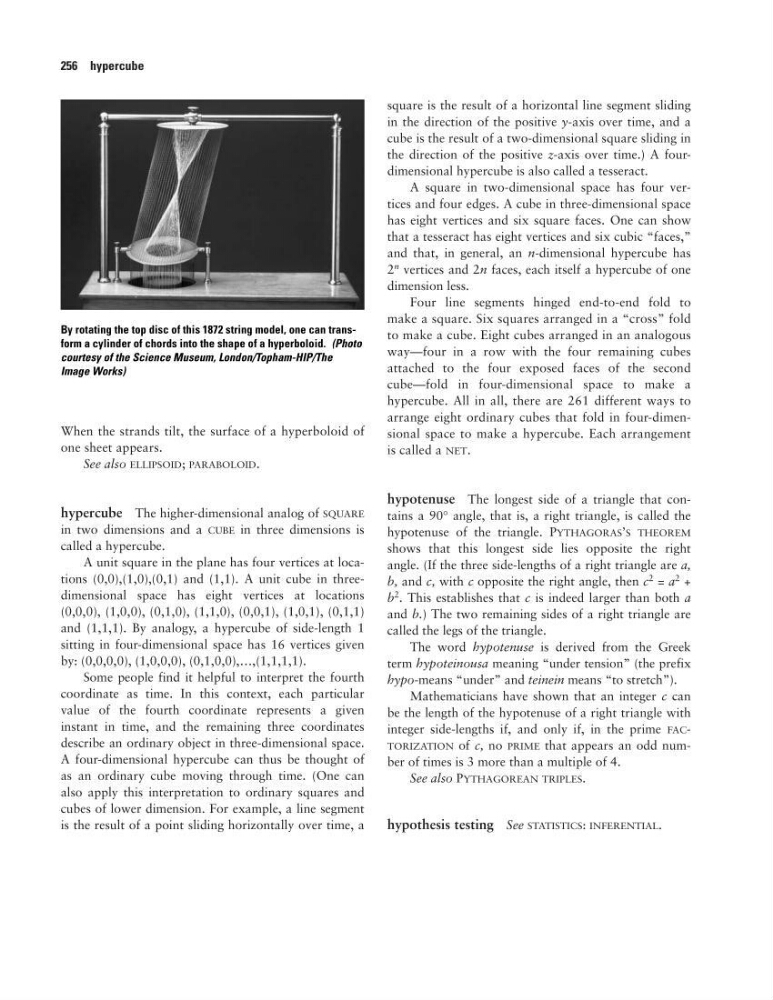
When the strands tilt, the surface of a hyperboloid of
one sheet appears.
See also ELLIPSOID; PARABOLOID.
hypercube The higher-dimensional analog of SQUARE
in two dimensions and a CUBE in three dimensions is
called a hypercube.
A unit square in the plane has four vertices at locations (0,0),(1,0),(0,1) and (1,1). A unit cube in threedimensional space has eight vertices at locations
(0,0,0), (1,0,0), (0,1,0), (1,1,0), (0,0,1), (1,0,1), (0,1,1)
and (1,1,1). By analogy, a hypercube of side-length 1
sitting in four-dimensional space has 16 vertices given
by: (0,0,0,0), (1,0,0,0), (0,1,0,0),…,(1,1,1,1).
Some people find it helpful to interpret the fourth
coordinate as time. In this context, each particular
value of the fourth coordinate represents a given
instant in time, and the remaining three coordinates
describe an ordinary object in three-dimensional space.
A four-dimensional hypercube can thus be thought of
as an ordinary cube moving through time. (One can
also apply this interpretation to ordinary squares and
cubes of lower dimension. For example, a line segment
is the result of a point sliding horizontally over time, a
square is the result of a horizontal line segment sliding
in the direction of the positive y-axis over time, and a
cube is the result of a two-dimensional square sliding in
the direction of the positive z-axis over time.) A fourdimensional hypercube is also called a tesseract.
A square in two-dimensional space has four vertices and four edges. A cube in three-dimensional space
has eight vertices and six square faces. One can show
that a tesseract has eight vertices and six cubic “faces,”
and that, in general, an n-dimensional hypercube has
2
n vertices and 2n faces, each itself a hypercube of one
dimension less.
Four line segments hinged end-to-end fold to
make a square. Six squares arranged in a “cross” fold
to make a cube. Eight cubes arranged in an analogous
way—four in a row with the four remaining cubes
attached to the four exposed faces of the second
cube—fold in four-dimensional space to make a
hypercube. All in all, there are 261 different ways to
arrange eight ordinary cubes that fold in four-dimensional space to make a hypercube. Each arrangement
is called a NET.
hypotenuse The longest side of a triangle that contains a 90° angle, that is, a right triangle, is called the
hypotenuse of the triangle. PYTHAGORAS’S THEOREM
shows that this longest side lies opposite the right
angle. (If the three side-lengths of a right triangle are a,
b, and c, with c opposite the right angle, then c
2 = a
2 +
b
2
. This establishes that c is indeed larger than both a
and b.) The two remaining sides of a right triangle are
called the legs of the triangle.
The word hypotenuse is derived from the Greek
term hypoteinousa meaning “under tension” (the prefix
hypo-means “under” and teinein means “to stretch”).
Mathematicians have shown that an integer c can
be the length of the hypotenuse of a right triangle with
integer side-lengths if, and only if, in the prime FACTORIZATION of c, no PRIME that appears an odd number of times is 3 more than a multiple of 4.
See also PYTHAGOREAN TRIPLES.
hypothesis testing See STATISTICS: INFERENTIAL.
256 hypercube
By rotating the top disc of this 1872 string model, one can transform a cylinder of chords into the shape of a hyperboloid. (Photo
courtesy of the Science Museum, London/Topham-HIP/The
Image Works)
one sheet appears.
See also ELLIPSOID; PARABOLOID.
hypercube The higher-dimensional analog of SQUARE
in two dimensions and a CUBE in three dimensions is
called a hypercube.
A unit square in the plane has four vertices at locations (0,0),(1,0),(0,1) and (1,1). A unit cube in threedimensional space has eight vertices at locations
(0,0,0), (1,0,0), (0,1,0), (1,1,0), (0,0,1), (1,0,1), (0,1,1)
and (1,1,1). By analogy, a hypercube of side-length 1
sitting in four-dimensional space has 16 vertices given
by: (0,0,0,0), (1,0,0,0), (0,1,0,0),…,(1,1,1,1).
Some people find it helpful to interpret the fourth
coordinate as time. In this context, each particular
value of the fourth coordinate represents a given
instant in time, and the remaining three coordinates
describe an ordinary object in three-dimensional space.
A four-dimensional hypercube can thus be thought of
as an ordinary cube moving through time. (One can
also apply this interpretation to ordinary squares and
cubes of lower dimension. For example, a line segment
is the result of a point sliding horizontally over time, a
square is the result of a horizontal line segment sliding
in the direction of the positive y-axis over time, and a
cube is the result of a two-dimensional square sliding in
the direction of the positive z-axis over time.) A fourdimensional hypercube is also called a tesseract.
A square in two-dimensional space has four vertices and four edges. A cube in three-dimensional space
has eight vertices and six square faces. One can show
that a tesseract has eight vertices and six cubic “faces,”
and that, in general, an n-dimensional hypercube has
2
n vertices and 2n faces, each itself a hypercube of one
dimension less.
Four line segments hinged end-to-end fold to
make a square. Six squares arranged in a “cross” fold
to make a cube. Eight cubes arranged in an analogous
way—four in a row with the four remaining cubes
attached to the four exposed faces of the second
cube—fold in four-dimensional space to make a
hypercube. All in all, there are 261 different ways to
arrange eight ordinary cubes that fold in four-dimensional space to make a hypercube. Each arrangement
is called a NET.
hypotenuse The longest side of a triangle that contains a 90° angle, that is, a right triangle, is called the
hypotenuse of the triangle. PYTHAGORAS’S THEOREM
shows that this longest side lies opposite the right
angle. (If the three side-lengths of a right triangle are a,
b, and c, with c opposite the right angle, then c
2 = a
2 +
b
2
. This establishes that c is indeed larger than both a
and b.) The two remaining sides of a right triangle are
called the legs of the triangle.
The word hypotenuse is derived from the Greek
term hypoteinousa meaning “under tension” (the prefix
hypo-means “under” and teinein means “to stretch”).
Mathematicians have shown that an integer c can
be the length of the hypotenuse of a right triangle with
integer side-lengths if, and only if, in the prime FACTORIZATION of c, no PRIME that appears an odd number of times is 3 more than a multiple of 4.
See also PYTHAGOREAN TRIPLES.
hypothesis testing See STATISTICS: INFERENTIAL.
256 hypercube
By rotating the top disc of this 1872 string model, one can transform a cylinder of chords into the shape of a hyperboloid. (Photo
courtesy of the Science Museum, London/Topham-HIP/The
Image Works)