

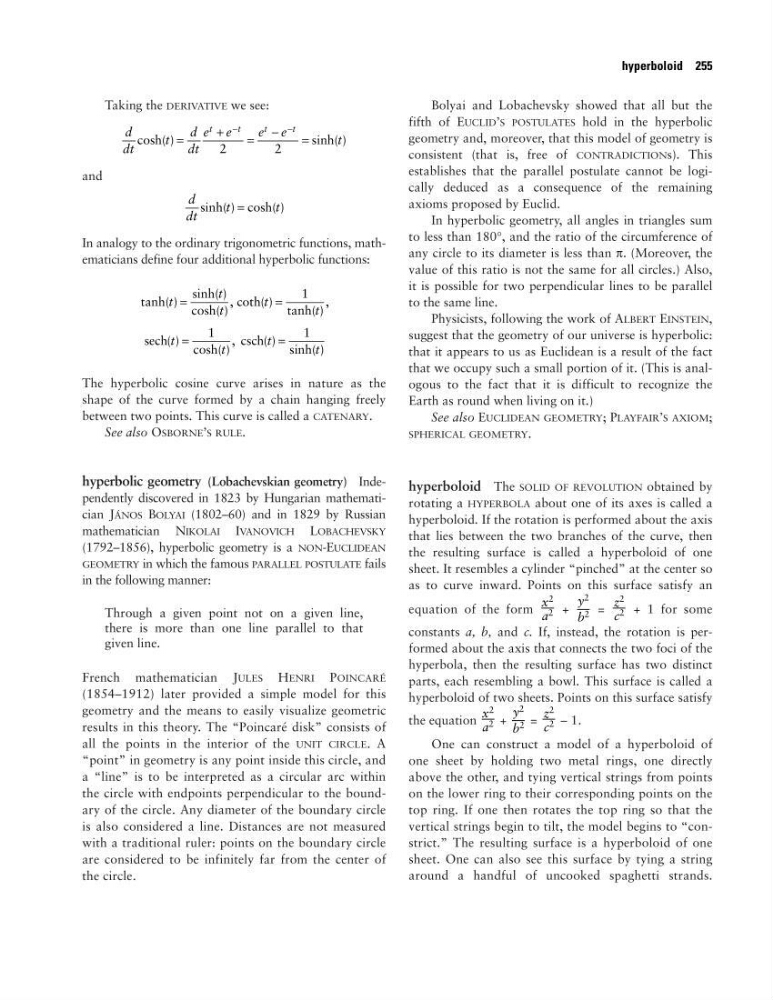
Taking the DERIVATIVE we see:
and
In analogy to the ordinary trigonometric functions, mathematicians define four additional hyperbolic functions:
The hyperbolic cosine curve arises in nature as the
shape of the curve formed by a chain hanging freely
between two points. This curve is called a CATENARY.
See also OSBORNE’S RULE.
hyperbolic geometry (Lobachevskian geometry) Independently discovered in 1823 by Hungarian mathematician JÁNOS BOLYAI (1802–60) and in 1829 by Russian
mathematician NIKOLAI IVANOVICH LOBACHEVSKY
(1792–1856), hyperbolic geometry is a NON-EUCLIDEAN
GEOMETRY in which the famous PARALLEL POSTULATE fails
in the following manner:
Through a given point not on a given line,
there is more than one line parallel to that
given line.
French mathematician JULES HENRI POINCARÉ
(1854–1912) later provided a simple model for this
geometry and the means to easily visualize geometric
results in this theory. The “Poincaré disk” consists of
all the points in the interior of the UNIT CIRCLE. A
“point” in geometry is any point inside this circle, and
a “line” is to be interpreted as a circular arc within
the circle with endpoints perpendicular to the boundary of the circle. Any diameter of the boundary circle
is also considered a line. Distances are not measured
with a traditional ruler: points on the boundary circle
are considered to be infinitely far from the center of
the circle.
Bolyai and Lobachevsky showed that all but the
fifth of EUCLID’S POSTULATES hold in the hyperbolic
geometry and, moreover, that this model of geometry is
consistent (that is, free of CONTRADICTIONs). This
establishes that the parallel postulate cannot be logically deduced as a consequence of the remaining
axioms proposed by Euclid.
In hyperbolic geometry, all angles in triangles sum
to less than 180°, and the ratio of the circumference of
any circle to its diameter is less than π. (Moreover, the
value of this ratio is not the same for all circles.) Also,
it is possible for two perpendicular lines to be parallel
to the same line.
Physicists, following the work of ALBERT EINSTEIN,
suggest that the geometry of our universe is hyperbolic:
that it appears to us as Euclidean is a result of the fact
that we occupy such a small portion of it. (This is analogous to the fact that it is difficult to recognize the
Earth as round when living on it.)
See also EUCLIDEAN GEOMETRY; PLAYFAIR’S AXIOM;
SPHERICAL GEOMETRY.
hyperboloid The SOLID OF REVOLUTION obtained by
rotating a HYPERBOLA about one of its axes is called a
hyperboloid. If the rotation is performed about the axis
that lies between the two branches of the curve, then
the resulting surface is called a hyperboloid of one
sheet. It resembles a cylinder “pinched” at the center so
as to curve inward. Points on this surface satisfy an
equation of the form
+
=
+ 1 for some
constants a, b, and c. If, instead, the rotation is performed about the axis that connects the two foci of the
hyperbola, then the resulting surface has two distinct
parts, each resembling a bowl. This surface is called a
hyperboloid of two sheets. Points on this surface satisfy
the equation
+
=
– 1.
One can construct a model of a hyperboloid of
one sheet by holding two metal rings, one directly
above the other, and tying vertical strings from points
on the lower ring to their corresponding points on the
top ring. If one then rotates the top ring so that the
vertical strings begin to tilt, the model begins to “constrict.” The resulting surface is a hyperboloid of one
sheet. One can also see this surface by tying a string
around a handful of uncooked spaghetti strands.
z
2
–
c
2
y
2
–
b
2
x
2
–
a
2
z
2
–
c
2
y
2
–
b
2
x
2
–
a
2
tanh( )
sinh( )
cosh( )
, coth( ) tanh( )
,
( ) cosh( )
,
() sinh( )
t
t
t
t
t
t
t
t
t
=
=
=
=
1
1
1
sech
csch
d
dt
t
t
sinh( ) cosh( )
=
d
dt
t
d
dt
e e
e e
t
t
t
t
t
cosh( )
sinh( )
=
+
=
−
=
−
−
2
2
hyperboloid 255
and
In analogy to the ordinary trigonometric functions, mathematicians define four additional hyperbolic functions:
The hyperbolic cosine curve arises in nature as the
shape of the curve formed by a chain hanging freely
between two points. This curve is called a CATENARY.
See also OSBORNE’S RULE.
hyperbolic geometry (Lobachevskian geometry) Independently discovered in 1823 by Hungarian mathematician JÁNOS BOLYAI (1802–60) and in 1829 by Russian
mathematician NIKOLAI IVANOVICH LOBACHEVSKY
(1792–1856), hyperbolic geometry is a NON-EUCLIDEAN
GEOMETRY in which the famous PARALLEL POSTULATE fails
in the following manner:
Through a given point not on a given line,
there is more than one line parallel to that
given line.
French mathematician JULES HENRI POINCARÉ
(1854–1912) later provided a simple model for this
geometry and the means to easily visualize geometric
results in this theory. The “Poincaré disk” consists of
all the points in the interior of the UNIT CIRCLE. A
“point” in geometry is any point inside this circle, and
a “line” is to be interpreted as a circular arc within
the circle with endpoints perpendicular to the boundary of the circle. Any diameter of the boundary circle
is also considered a line. Distances are not measured
with a traditional ruler: points on the boundary circle
are considered to be infinitely far from the center of
the circle.
Bolyai and Lobachevsky showed that all but the
fifth of EUCLID’S POSTULATES hold in the hyperbolic
geometry and, moreover, that this model of geometry is
consistent (that is, free of CONTRADICTIONs). This
establishes that the parallel postulate cannot be logically deduced as a consequence of the remaining
axioms proposed by Euclid.
In hyperbolic geometry, all angles in triangles sum
to less than 180°, and the ratio of the circumference of
any circle to its diameter is less than π. (Moreover, the
value of this ratio is not the same for all circles.) Also,
it is possible for two perpendicular lines to be parallel
to the same line.
Physicists, following the work of ALBERT EINSTEIN,
suggest that the geometry of our universe is hyperbolic:
that it appears to us as Euclidean is a result of the fact
that we occupy such a small portion of it. (This is analogous to the fact that it is difficult to recognize the
Earth as round when living on it.)
See also EUCLIDEAN GEOMETRY; PLAYFAIR’S AXIOM;
SPHERICAL GEOMETRY.
hyperboloid The SOLID OF REVOLUTION obtained by
rotating a HYPERBOLA about one of its axes is called a
hyperboloid. If the rotation is performed about the axis
that lies between the two branches of the curve, then
the resulting surface is called a hyperboloid of one
sheet. It resembles a cylinder “pinched” at the center so
as to curve inward. Points on this surface satisfy an
equation of the form
+
=
+ 1 for some
constants a, b, and c. If, instead, the rotation is performed about the axis that connects the two foci of the
hyperbola, then the resulting surface has two distinct
parts, each resembling a bowl. This surface is called a
hyperboloid of two sheets. Points on this surface satisfy
the equation
+
=
– 1.
One can construct a model of a hyperboloid of
one sheet by holding two metal rings, one directly
above the other, and tying vertical strings from points
on the lower ring to their corresponding points on the
top ring. If one then rotates the top ring so that the
vertical strings begin to tilt, the model begins to “constrict.” The resulting surface is a hyperboloid of one
sheet. One can also see this surface by tying a string
around a handful of uncooked spaghetti strands.
z
2
–
c
2
y
2
–
b
2
x
2
–
a
2
z
2
–
c
2
y
2
–
b
2
x
2
–
a
2
tanh( )
sinh( )
cosh( )
, coth( ) tanh( )
,
( ) cosh( )
,
() sinh( )
t
t
t
t
t
t
t
t
t
=
=
=
=
1
1
1
sech
csch
d
dt
t
t
sinh( ) cosh( )
=
d
dt
t
d
dt
e e
e e
t
t
t
t
t
cosh( )
sinh( )
=
+
=
−
=
−
−
2
2
hyperboloid 255