

(±
,0), and whose points P have distances with
common difference 2a from the foci. This equation
also reveals that the hyperbola has slant ASYMPTOTEs
y = ± x.
Hyperbolas have the following reflection property:
any ray of light that approaches the convex side of one
branch along a line pointing toward one focus is
reflected directly toward the other focus. (This property
can be proved in a similar way that the reflection property of a PARABOLA is proved.)
Hyperbolas appear in the folding of a thin piece of
paper. Draw a circle and a dot outside the circle on a
sheet of paper. Fold the dot onto the circle and crease
the paper. Open up the fold and do this again, this time
folding the dot to a different point on the circle. As you
do this many times, one branch of a hyperbola will
emerge along the side of all the creases. The marked
dot is one focus of the hyperbola, and the center of the
circle is the other. The radius of the circle is the constant difference of distances of a point on the hyperbola from the two foci.
In the process of deriving the equation of a hyperbola, we presented the equation:
valid for one branch of the figure at least. Set
. This is called the ECCENTRICITY
of the hyperbola and has a value greater than 1. The
above equation can be rewritten:
The numerator of the quantity on the left side is the
distance of a given point P from a focus, and the
denominator is the distance of the point P from the vertical line x = , called a directrix of the hyperbola.
This formulation provides an alternative characterization of the hyperbola:
A hyperbola is the set of all points P such that
the ratio of its distance from a fixed point (the
focus) to its distance from a fixed line (the
directrix) equals a constant e > 1.
See also APOLLONIUS’S CIRCLE; ELLIPSE.
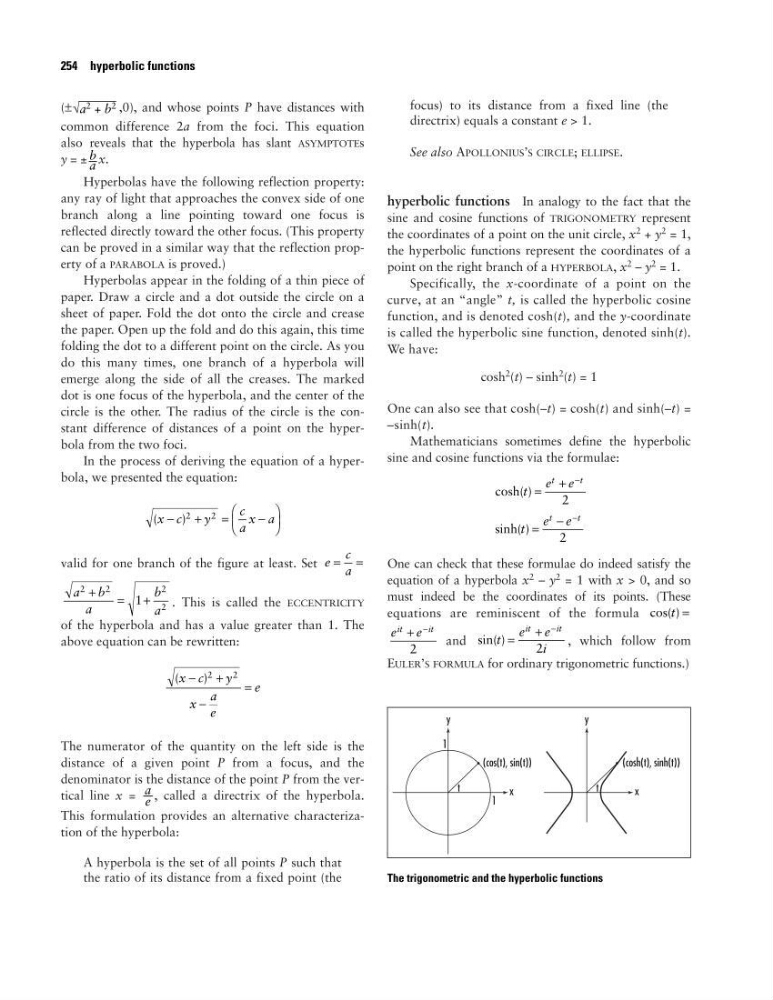
hyperbolic functions In analogy to the fact that the
sine and cosine functions of TRIGONOMETRY represent
the coordinates of a point on the unit circle, x
2 + y
2 = 1,
the hyperbolic functions represent the coordinates of a
point on the right branch of a HYPERBOLA, x
2 – y
2 = 1.
Specifically, the x-coordinate of a point on the
curve, at an “angle” t, is called the hyperbolic cosine
function, and is denoted cosh(t), and the y-coordinate
is called the hyperbolic sine function, denoted sinh(t).
We have:
cosh
2
(t) – sinh
2
(t) = 1
One can also see that cosh(–t) = cosh(t) and sinh(–t) =
–sinh(t).
Mathematicians sometimes define the hyperbolic
sine and cosine functions via the formulae:
One can check that these formulae do indeed satisfy the
equation of a hyperbola x
2 – y
2 = 1 with x > 0, and so
must indeed be the coordinates of its points. (These
equations are reminiscent of the formula
and
, which follow from
EULER’S FORMULA for ordinary trigonometric functions.)
sin( )
t
e
e
i
it
it
=
+
−
2
e
e
it
it
+
−
2
cos( )
t =
cosh( )
sinh( )
t
e e
t
e e
t
t
t
t
=
+
=
−
−
−
2
2
a
– e
(
)
x c
y
x
a
e
e
−
+
−
=
2
2
a b
a
b
a
+
=
+
2
2
2
2
1
e
c
a
= =
(
)
x c
y
c
a
x a
−
+
=
−
2
2
b
– a
√a
2 + b
2
254 hyperbolic functions
The trigonometric and the hyperbolic functions
,0), and whose points P have distances with
common difference 2a from the foci. This equation
also reveals that the hyperbola has slant ASYMPTOTEs
y = ± x.
Hyperbolas have the following reflection property:
any ray of light that approaches the convex side of one
branch along a line pointing toward one focus is
reflected directly toward the other focus. (This property
can be proved in a similar way that the reflection property of a PARABOLA is proved.)
Hyperbolas appear in the folding of a thin piece of
paper. Draw a circle and a dot outside the circle on a
sheet of paper. Fold the dot onto the circle and crease
the paper. Open up the fold and do this again, this time
folding the dot to a different point on the circle. As you
do this many times, one branch of a hyperbola will
emerge along the side of all the creases. The marked
dot is one focus of the hyperbola, and the center of the
circle is the other. The radius of the circle is the constant difference of distances of a point on the hyperbola from the two foci.
In the process of deriving the equation of a hyperbola, we presented the equation:
valid for one branch of the figure at least. Set
. This is called the ECCENTRICITY
of the hyperbola and has a value greater than 1. The
above equation can be rewritten:
The numerator of the quantity on the left side is the
distance of a given point P from a focus, and the
denominator is the distance of the point P from the vertical line x = , called a directrix of the hyperbola.
This formulation provides an alternative characterization of the hyperbola:
A hyperbola is the set of all points P such that
the ratio of its distance from a fixed point (the
focus) to its distance from a fixed line (the
directrix) equals a constant e > 1.
See also APOLLONIUS’S CIRCLE; ELLIPSE.
hyperbolic functions In analogy to the fact that the
sine and cosine functions of TRIGONOMETRY represent
the coordinates of a point on the unit circle, x
2 + y
2 = 1,
the hyperbolic functions represent the coordinates of a
point on the right branch of a HYPERBOLA, x
2 – y
2 = 1.
Specifically, the x-coordinate of a point on the
curve, at an “angle” t, is called the hyperbolic cosine
function, and is denoted cosh(t), and the y-coordinate
is called the hyperbolic sine function, denoted sinh(t).
We have:
cosh
2
(t) – sinh
2
(t) = 1
One can also see that cosh(–t) = cosh(t) and sinh(–t) =
–sinh(t).
Mathematicians sometimes define the hyperbolic
sine and cosine functions via the formulae:
One can check that these formulae do indeed satisfy the
equation of a hyperbola x
2 – y
2 = 1 with x > 0, and so
must indeed be the coordinates of its points. (These
equations are reminiscent of the formula
and
, which follow from
EULER’S FORMULA for ordinary trigonometric functions.)
sin( )
t
e
e
i
it
it
=
+
−
2
e
e
it
it
+
−
2
cos( )
t =
cosh( )
sinh( )
t
e e
t
e e
t
t
t
t
=
+
=
−
−
−
2
2
a
– e
(
)
x c
y
x
a
e
e
−
+
−
=
2
2
a b
a
b
a
+
=
+
2
2
2
2
1
e
c
a
= =
(
)
x c
y
c
a
x a
−
+
=
−
2
2
b
– a
√a
2 + b
2
254 hyperbolic functions
The trigonometric and the hyperbolic functions