

him in writing his 11-part commentary on the mathematical work of CLAUDIUS PTOLEMY (85–165 C.E.) and
on his production of a revised version of EUCLID’s The
Elements. Hypatia produced her own commentaries on
classical pieces, including Diophantus’s famous Arithmetica, Apollonius’s Conics, and astronomical works
by Ptolemy. All of her work, however, is today lost, and
we know of them only through references made by
later scholars.
Around 400 C.E. Hypatia headed the Platonist
school at Alexandria, where she consulted on scientific
matters and lectured on philosophy and mathematics.
During this time, Christianity surfaced as the dominant
religion of the region, and fanatics felt threatened by
her intellect and scholarship. Around 415 C.E. Hypatia
was brutally murdered by a group of religious followers who deemed her philosophical views pagan. Many
historians suggest that the death of Hypatia marks the
beginning of Alexandria’s decline as the great center of
scholarship and learning of antiquity.
It is worth mentioning that at least one other
woman is known to have played an active role in
mathematics during the Greek times. In his work Collection, PAPPUS OF ALEXANDRIA (300–350 C.E.) gives
acknowledgment to a female scholar by the name of
Pandrosion. Essentially nothing is known about her.
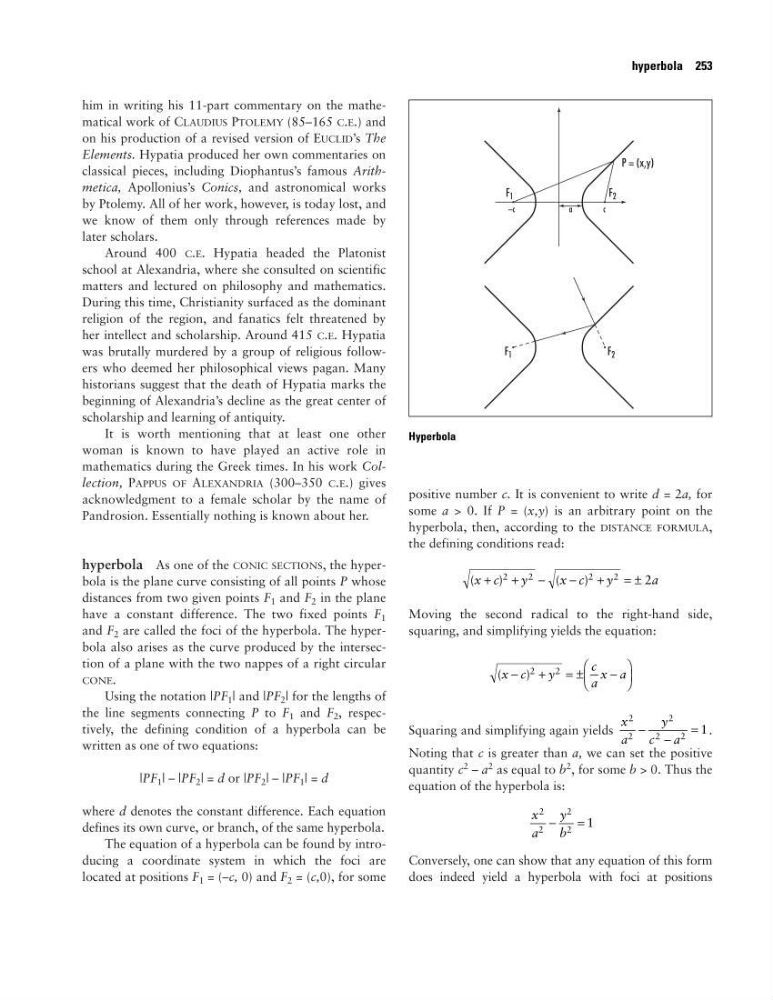
hyperbola As one of the CONIC SECTIONS, the hyperbola is the plane curve consisting of all points P whose
distances from two given points F 1 and F 2 in the plane
have a constant difference. The two fixed points F 1
and F 2 are called the foci of the hyperbola. The hyperbola also arises as the curve produced by the intersection of a plane with the two nappes of a right circular
CONE.
Using the notation |PF 1 | and |PF 2 | for the lengths of
the line segments connecting P to F 1 and F 2 , respectively, the defining condition of a hyperbola can be
written as one of two equations:
|PF 1 | – |PF 2 | = d or |PF 2 | – |PF 1 | = d
where d denotes the constant difference. Each equation
defines its own curve, or branch, of the same hyperbola.
The equation of a hyperbola can be found by introducing a coordinate system in which the foci are
located at positions F 1 = (–c, 0) and F 2 = (c,0), for some
positive number c. It is convenient to write d = 2a, for
some a > 0. If P = (x,y) is an arbitrary point on the
hyperbola, then, according to the DISTANCE FORMULA,
the defining conditions read:
Moving the second radical to the right-hand side,
squaring, and simplifying yields the equation:
Squaring and simplifying again yields
.
Noting that c is greater than a, we can set the positive
quantity c
2 – a
2 as equal to b
2
, for some b > 0. Thus the
equation of the hyperbola is:
Conversely, one can show that any equation of this form
does indeed yield a hyperbola with foci at positions
x
a
y
b
2
2
2
2
1
−
=
x
a
y
c
a
2
2
2
2
2
1
− −
=
(
)
x c
y
c
a
x a
−
+
= ±
−
2
2
(
)
(
)
x c
y
x c
y
a
+
+
−
−
+
= ±
2
2
2
2
2
hyperbola 253
Hyperbola
on his production of a revised version of EUCLID’s The
Elements. Hypatia produced her own commentaries on
classical pieces, including Diophantus’s famous Arithmetica, Apollonius’s Conics, and astronomical works
by Ptolemy. All of her work, however, is today lost, and
we know of them only through references made by
later scholars.
Around 400 C.E. Hypatia headed the Platonist
school at Alexandria, where she consulted on scientific
matters and lectured on philosophy and mathematics.
During this time, Christianity surfaced as the dominant
religion of the region, and fanatics felt threatened by
her intellect and scholarship. Around 415 C.E. Hypatia
was brutally murdered by a group of religious followers who deemed her philosophical views pagan. Many
historians suggest that the death of Hypatia marks the
beginning of Alexandria’s decline as the great center of
scholarship and learning of antiquity.
It is worth mentioning that at least one other
woman is known to have played an active role in
mathematics during the Greek times. In his work Collection, PAPPUS OF ALEXANDRIA (300–350 C.E.) gives
acknowledgment to a female scholar by the name of
Pandrosion. Essentially nothing is known about her.
hyperbola As one of the CONIC SECTIONS, the hyperbola is the plane curve consisting of all points P whose
distances from two given points F 1 and F 2 in the plane
have a constant difference. The two fixed points F 1
and F 2 are called the foci of the hyperbola. The hyperbola also arises as the curve produced by the intersection of a plane with the two nappes of a right circular
CONE.
Using the notation |PF 1 | and |PF 2 | for the lengths of
the line segments connecting P to F 1 and F 2 , respectively, the defining condition of a hyperbola can be
written as one of two equations:
|PF 1 | – |PF 2 | = d or |PF 2 | – |PF 1 | = d
where d denotes the constant difference. Each equation
defines its own curve, or branch, of the same hyperbola.
The equation of a hyperbola can be found by introducing a coordinate system in which the foci are
located at positions F 1 = (–c, 0) and F 2 = (c,0), for some
positive number c. It is convenient to write d = 2a, for
some a > 0. If P = (x,y) is an arbitrary point on the
hyperbola, then, according to the DISTANCE FORMULA,
the defining conditions read:
Moving the second radical to the right-hand side,
squaring, and simplifying yields the equation:
Squaring and simplifying again yields
.
Noting that c is greater than a, we can set the positive
quantity c
2 – a
2 as equal to b
2
, for some b > 0. Thus the
equation of the hyperbola is:
Conversely, one can show that any equation of this form
does indeed yield a hyperbola with foci at positions
x
a
y
b
2
2
2
2
1
−
=
x
a
y
c
a
2
2
2
2
2
1
− −
=
(
)
x c
y
c
a
x a
−
+
= ±
−
2
2
(
)
(
)
x c
y
x c
y
a
+
+
−
−
+
= ±
2
2
2
2
2
hyperbola 253
Hyperbola